Germany’s Funny Money
After World War I began and the imperial German government withdrew coins from circulation, local municipalities and businesses printed their own “emergency money” featuring striking imagery from German history, culture, and politics.
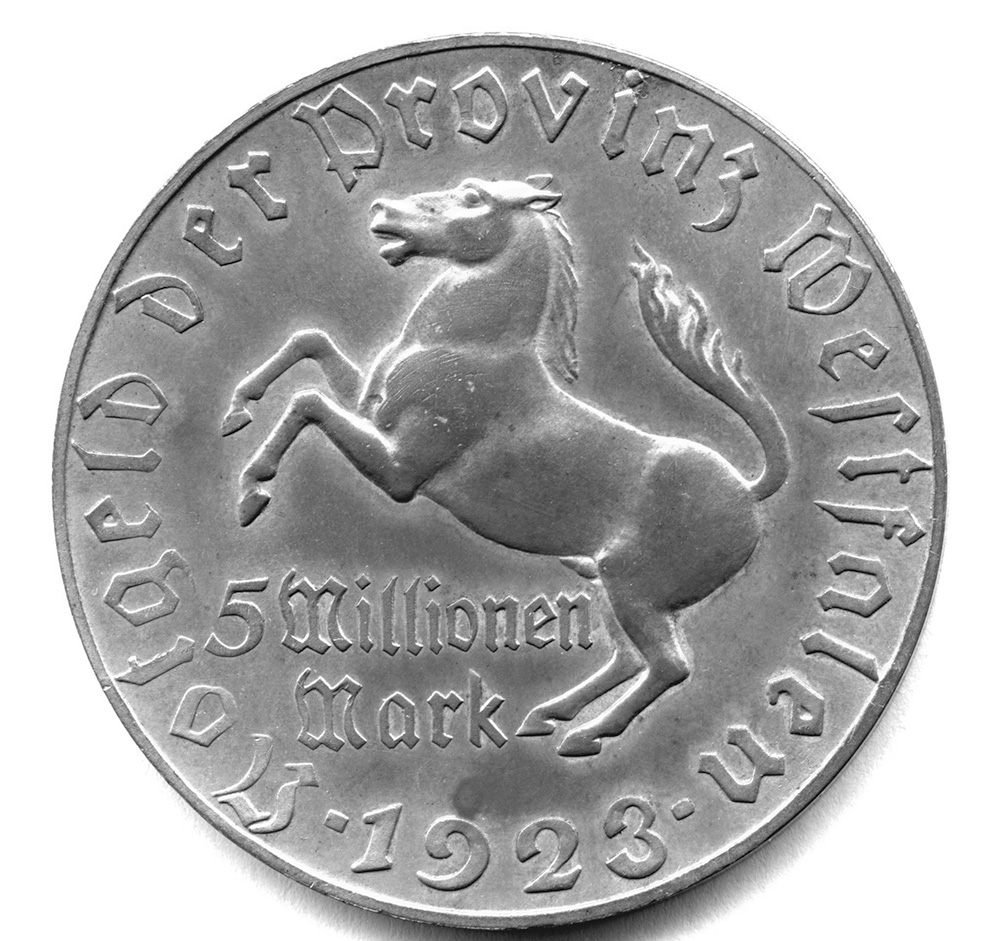
Photo by John Alan Elson
We usually remember the interwar German inflation in its critical phase — the hyperinflation that lasted from 1922 to 1923. In fact, the mark had started its decline in 1914, when the imperial government began printing money to pay for World War I. A parallel shortage of small change occurred at the same time, as the anxious populace hoarded coins and the government withdrew them from circulation for their metallic content. To make up for this shortage, businesses and municipalities printed small-denomination tokens known as “notgeld,” or emergency money. By the standards of normal currency, these were very odd: they could only be redeemed in their place of issue, and they usually had a limited term of validity. They looked strange, too, and they grew even stranger as issuers realized they could be sold to collectors and competed for the attention of this market with increasingly bizarre imagery. Some town halls raised substantial sums this way, but the proliferation of currencies only made the economic chaos worse. Meanwhile, on these tiny canvases, the cultural and political tensions of inflation played out before a popular audience.
Land
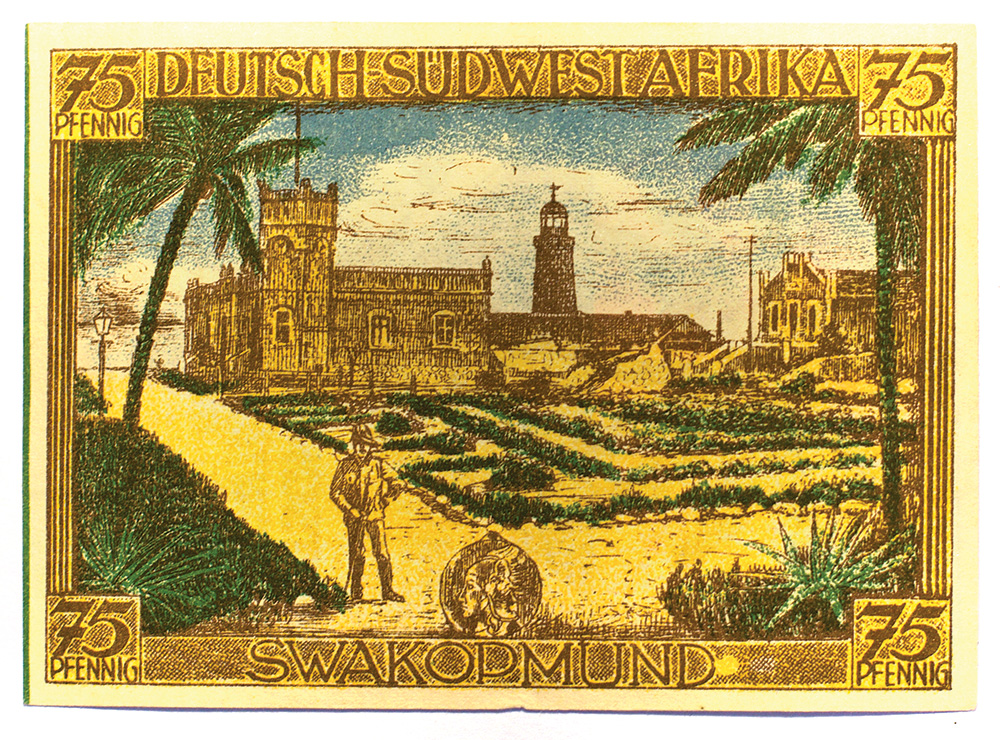
The majority of notgeld refers to the area in which it was produced. This was partly because it could only be spent where it had been issued, but references to land also had an ideological function: land was solid and dependable, and it had a conservative mystique as a source of value, so images of it were heaped up as a bulwark against the dangerously solvent power of money. The only problem was that these stabilizing images of landscapes appeared on precisely the object that was dismembering the nation. This example refers to one of the overseas colonies Germany had been forced to surrender in 1918, Swakopmund, in present-day Namibia. It was here that the genocide of Herero and Namaqua people had been carried out between 1904 and 1908, an event now widely seen as a precursor to the Holocaust.