The EU’s Border With Belarus Has Become a Deadly Rampart of Fortress Europe
This spring, Belarus announced that it would retaliate against European sanctions by loosening its border controls. Neighboring EU countries have responded with a brutal crackdown on asylum seekers — with deadly consequences.
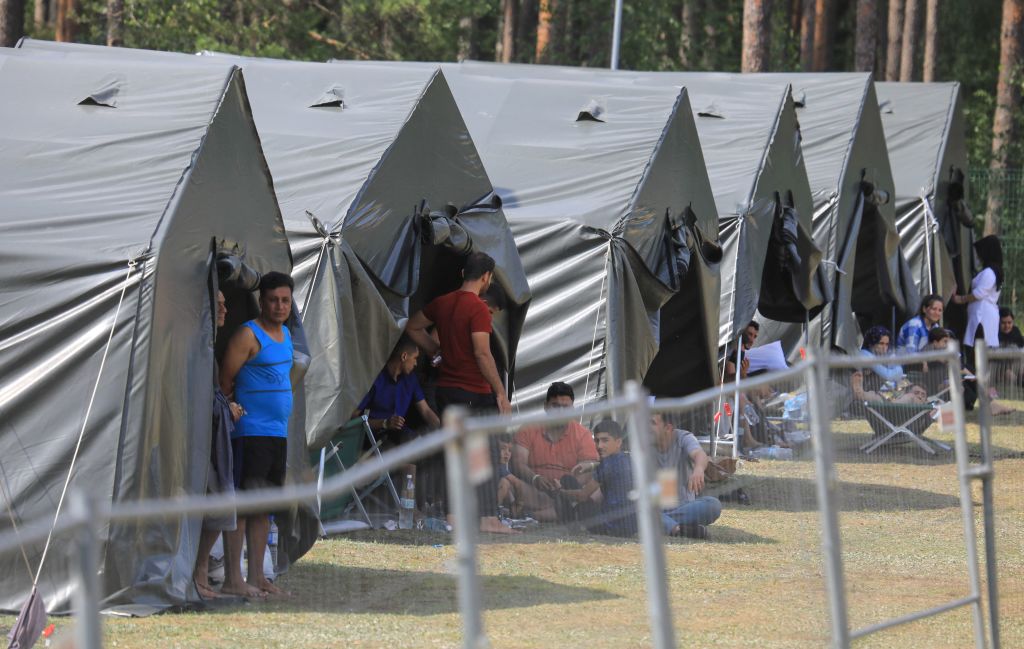
Migrants, who are mostly from Iraq, in a camp near the border town of Kapčiamiestis, Lithuania, July 18, 2021. (PETRAS MALUKAS/AFP via Getty Images)
Belarus’s grounding of a Ryanair plane this May, procuring the arrest of oppositionist Roman Protasevich, has in many European capitals become synonymous with air piracy. If last August’s fraudulent elections already provided Brussels grounds to impose sanctions, the forced landing offered the opportunity to accelerate its “fourth package” of restrictive measures. Beyond asset freezes and travel bans against dozens of figures accused of orchestrating the crackdown on anti-government demonstrators, Belarusian airliners have been banned from European Union airspace.
Yet the naive aura of EU claims that sanctions would pressure Alexander Lukashenko’s into “initiat[ing] a genuine and inclusive national dialogue with broader society” soon evaporated. Rather, the longtime president retaliated in spring by announcing that Belarus would loosen border controls against Western-bound migration and drug trafficking: “Now you will catch them yourselves,” he presaged. In the borderlands between Belarus and neighboring Lithuania, Latvia, and Poland — all EU member states — this warning was soon realized.
Border crossings were up already in early 2021. But if around ninety migrants made it from Belarus to Lithuania by May, over summer this figure skyrocketed. In June, the Lithuanian government portrayed the influx of supposedly “illegal” migrants as a conscious policy choreographed by Lukashenko. Interior minister Agnė Bilotaitė asserted that migrants flown to Minsk paid “enormous sums” to Belarusian officials, who then guided them to unguarded portions of the heavily wooded border. Unable to control the crossings, the Lithuanian government resorted to building a four-meter-high metal fence topped with razor wire along the four-hundred-mile-long frontier.