Adam Curtis Talks to Jacobin About Power, Politics, and His New Film
We talk to legendary filmmaker Adam Curtis about politics, power, music, and his new six-part documentary, Can’t Get You Out of My Head.
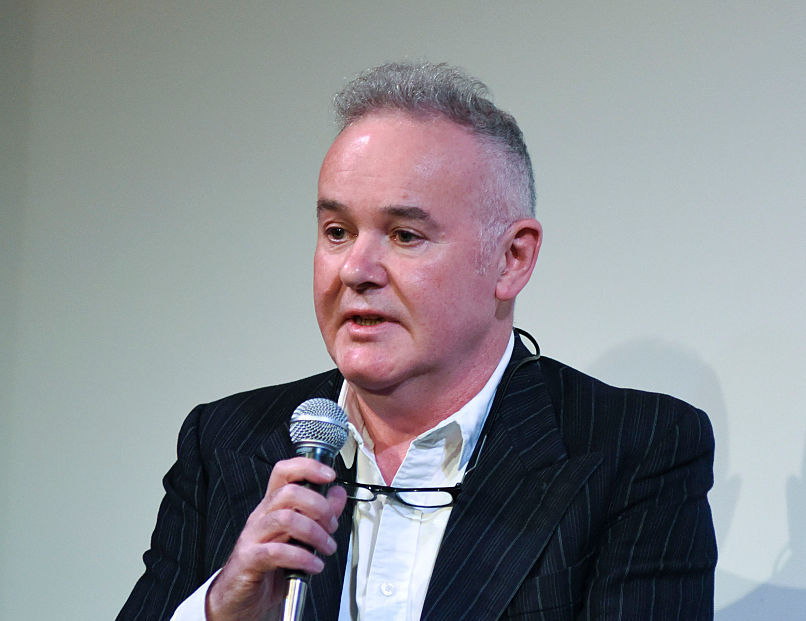
Documentary filmmaker Adam Curtis at the 2015 Telluride Film Festival on September 6, 2015 in Telluride, Colorado. (Vivien Killilea / Getty Images)
Adam Curtis’s career feels like a series of glitches right at the heart of the BBC. His films stand entirely apart from the channel’s output. Episode one of his series The Trap (2007), which covers the rise of game theory in the wake of Cold War paranoia, opens with a chilling title card (“human beings will always betray you”) and aired on BBC Two directly after extended coverage of Crufts — an international dog pageant.
Nowadays, however, Curtis’s films are all democratically available online and wildly popular with young people. They’re ostensibly documentaries, but his approach is closer to poetry or video art than traditional narrative television. Curtis also gingerly avoids prescriptive political labels, sometimes delivering revolutionary Marxist critiques of capitalist instability, sometimes manifesting as a libertarian techno-utopian. A consistent through line, though, in his emotive soundtracks and his baroque visual style is Curtis’s unswerving romanticism. He wants to engender a feeling in the viewer — not to simply explain the world.
Curtis’s new series, Can’t Get You Out of My Head, is a genuine epic, a six-part, eight-hour series that charts the ebb and flow of society as it moves from collectivism to individualism. His unrestricted access to the BBC archive equips each episode with a sort of all-seeing eye, one that Curtis uses to locate and explain power as it changes hands, uprooting the world.