“Bolivia’s Coup President Will End up Fleeing the Palace in a Helicopter”
Faced with the Left’s lead in the polls, coup-installed president Jeanine Áñez has suspended Bolivia’s election for the third time. The COB trade union federation has responded with a general strike and road blockades around Bolivia — showing that the country’s mighty social movements will not allow an illegitimate regime to continue clinging to power.
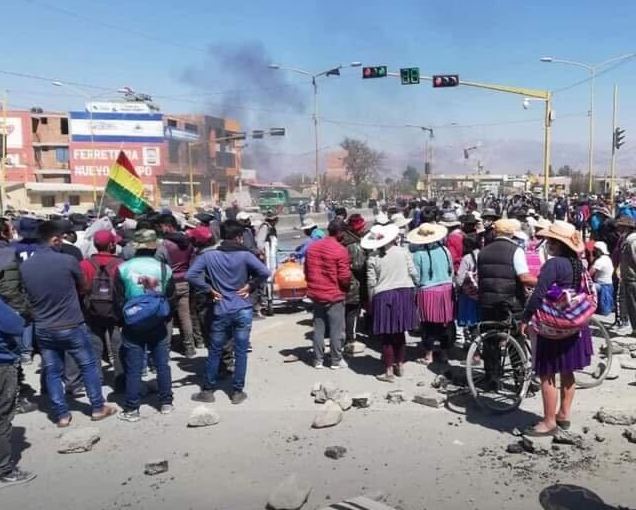
Protesters in Cochabamba. (Photo courtesy of COB)
Nine months after the military coup that ousted left-wing president Evo Morales, Bolivia’s coup government has suspended elections for the third time. In reaction to acting president Jeanine Áñez’s move to delay the ballot, the Bolivian Workers’ Central (COB) staged marches around the country, with some half a million people turning out for the demonstration in El Alto. Addressing the rally, COB general secretary Juan Carlos Huarachi threatened an indefinite general strike unless the elections went ahead as planned.
The El Alto demonstration was the biggest since the immediate aftermath of Morales’s overthrow in November, when indigenous people protesting the coup were “shot like animals,” killing at least thirty-seven. Yet the election court president Salvador Romero, appointed by the coup regime, ignored the protests, and on Monday, August 3, the indefinite general strike began in earnest, with protests, marches, and road blockades rapidly spreading across Bolivia. Within twenty-four hours, over seventy-five major roads and highways in the provinces of La Paz, Cochabamba, Santa Cruz, Oruro, and Potosí were completely or partially blockaded by local trade union branches and social movements.
The COB-backed blockades were widely supported by trade unions and social movements. Participants included the Union Federation of Bolivian Mine Workers (FSTMB), the coca growers (the Six Federations of the Trópico of Cochabamba), the Bartolina Sisa women’s federation, the Tupac Katari peasants’ federation, and the trade union Confederation of Intercultural Communities of Bolivia (CSCIB). These forces have a history of mass mobilizations against neoliberal governments, such as the historic 2003 Gas War and the 2000 water wars in Cochabamba. Following the first few days of blockades, on August 6 the Supreme Electoral Court (TSE) was forced to open talks with the social movements regarding the final date of the elections.