A Marxist Guide to Understanding the Gulf States’ Political Economy
Western analysts often regard the Gulf as a strange anomaly among capitalist states. In fact, it has the same underlying dynamics as capitalist countries elsewhere, and it is powerfully shaping the politics of the Middle East.
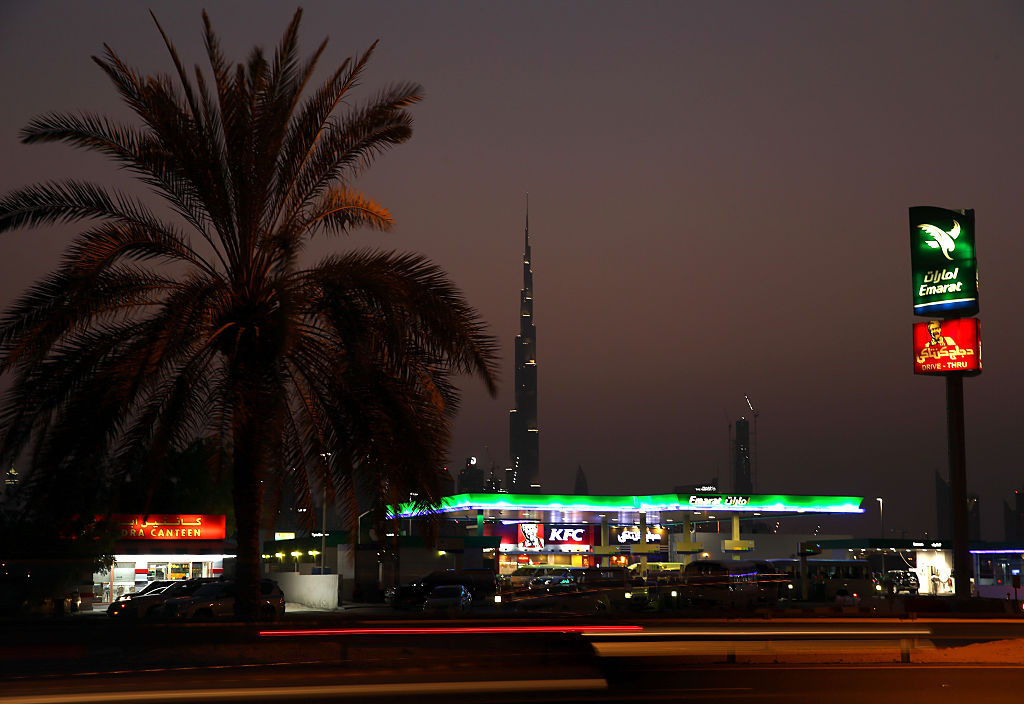
An Emarati petrol station is pictured with the Burj Khalifa on September 7, 2015, in Dubai, United Arab Emirates. Warren Little / Getty
In December 2019, the government of Saudi Arabia commenced partial privatization of its own oil firm, Saudi Aramco, in what became the world’s largest initial public offering (IPO) to date. This was the boldest move yet in Saudi crown prince Mohammed bin Salman’s plan to overhaul the country’s entire economy and raise funds to create a neoliberal nirvana.
Similar trends manifest in neighboring Gulf countries, with measures like reducing public spending and privatizing public assets featuring prominently in the region’s political discourse. This has especially become the case since the 2014 oil glut.
For an analysis of the state of the Gulf’s political economy, Hamza Culin spoke with Adam Hanieh. Adam teaches in the development studies department at SOAS, University of London. His most recent book, Money, Markets, and Monarchies, examines how the six states of the Gulf Cooperation Council are shaping the political economy of the wider Middle East. Here, he discusses the specific nature of Gulf capital, its role in regional and global markets, and its future in a post-COVID-19 world.