“Bolivia’s Postcoup Regime Did Nothing to Stop the Virus”
Six months after the coup in Bolivia, Luis Arce is presidential candidate for Evo Morales's MAS. Oliver Vargas interviewed him about the postcoup regime, its handling of coronavirus, and what the delayed election means for the Left's chances of returning to power.
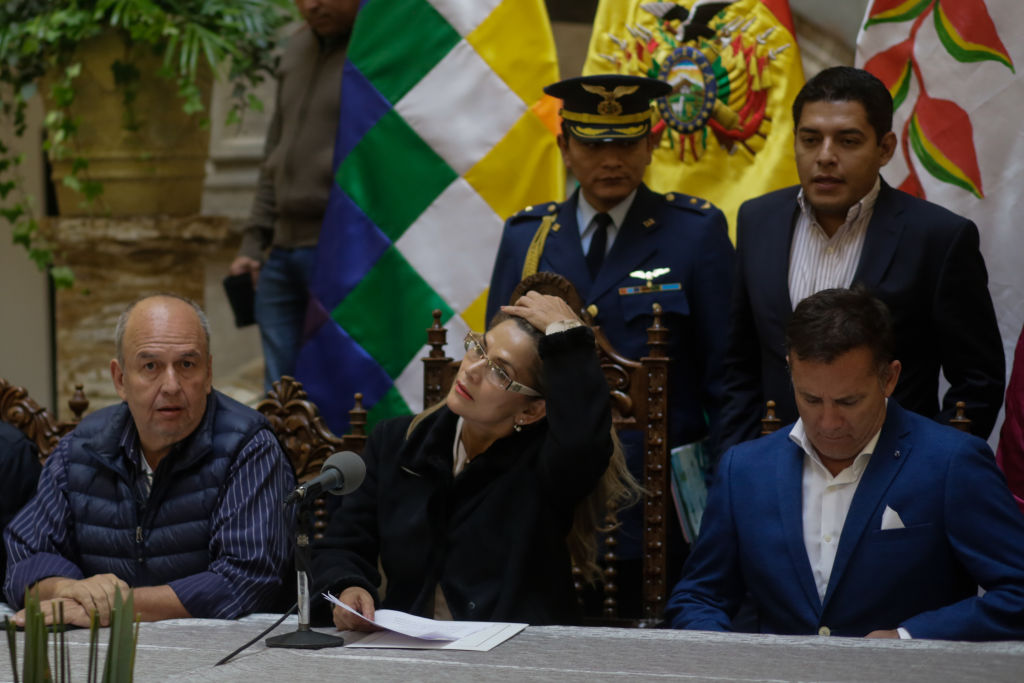
Postcoup president of Bolivia, Jeanine Añez, speaks during a press conference at the Palacio Quemado, on November 23, 2019 in La Paz, Bolivia. (Gaston Brito Miserocchi / Getty Images)
As the first wave of coronavirus infections hit Latin America, various governments across the continent began countermeasures. Yet alongside Jair Bolsonaro’s Brazil, Bolivia instead distinguished itself for the incompetence of its response — a combination of inaction and repression. This is, perhaps, no surprise, given the disastrous political situation in the country since the military coup last November.
In the months following Evo Morales’s removal, the coup regime has expelled hundreds of Cuban doctors and medical personnel, drastically reduced the level of cooperation with Russia and China, and halted large-scale health care projects begun under Morales’s administration, such as the Unified Health System (Sistema Única de Salud). Since the coup, a number of social programs, such as the Bono Juanctio Pinto, Bono Juana Azurduy, and Renta Dignidad cash transfer schemes, have been either cut drastically or effectively discontinued.
At the same time, the regime has used the crisis to mount an authoritarian crackdown. While those who breach curfew and quarantine measures risk up to ten years’ imprisonment, the government has done nothing to guarantee financial assistance or even job security for workers. This has led to riots throughout the working-class suburbs in El Alto and Oruro, and at least 1,200 arrests. This only adds to the hundreds of social activists and militants of Morales’s Movement Towards Socialism (MAS) to have been persecuted over the last few months.