Podemos: A “Party-Movement” in Government
Upon its creation in 2014, Podemos insisted it was nothing like the political parties that had long dominated Spain. Today, Pablo Iglesias’s party looks like an ever-more institutionalized force — yet one whose activists continue to see themselves as belonging to a “social movement” from below.
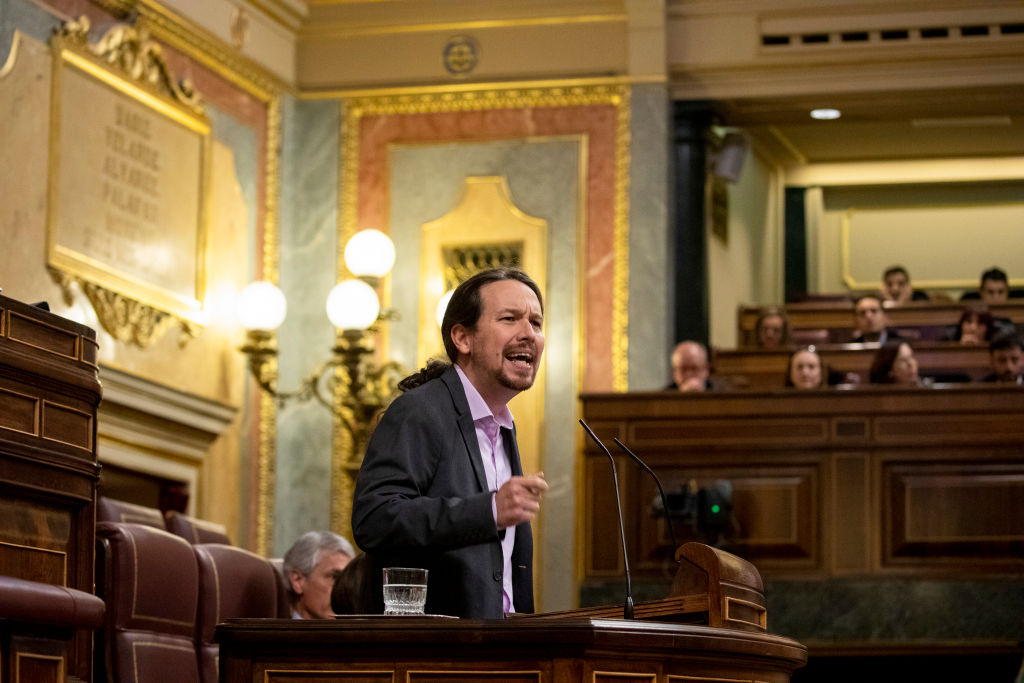
Podemos party leader Pablo Iglesias speaks during the investiture debate at the Spanish Parliament on January 4, 2020 in Madrid, Spain.Pablo Blazquez Dominguez / Getty
After four general elections in four years, January 7 saw the formation of an unprecedented coalition government in Spain. The incoming administration unites Pedro Sánchez’s Socialist Party (PSOE) and Pablo Iglesias’s Unidas Podemos, today taking up cabinet roles for the first time.
As Iglesias’s radical-left formation enters government, six years since its initial creation, some like sociologist Carlos Taibo say it has become a classic party. Pointing to its gradual institutionalization, such readings suggest Podemos is no longer the “movement” that emerged from the 15M anti-austerity protests of 2011.
But while Podemos has indeed been institutionalized — and has also lowered its ambitions since its first election run in 2014 — this has not yet brought any full break with its roots. Looking at the first years of its existence, we instead see that it remains a hybrid force — and one whose future remains in the balance between institutional pressures and the demands of the street.