The Nigerian Activist Whose Death Shamed Shell
Twenty-four years ago today, environmental activist Ken Saro-Wiwa was executed by the Nigerian state. His death brought international attention to the rapacious behavior of oil companies like Shell — and their complicity in the most violent forms of repression.
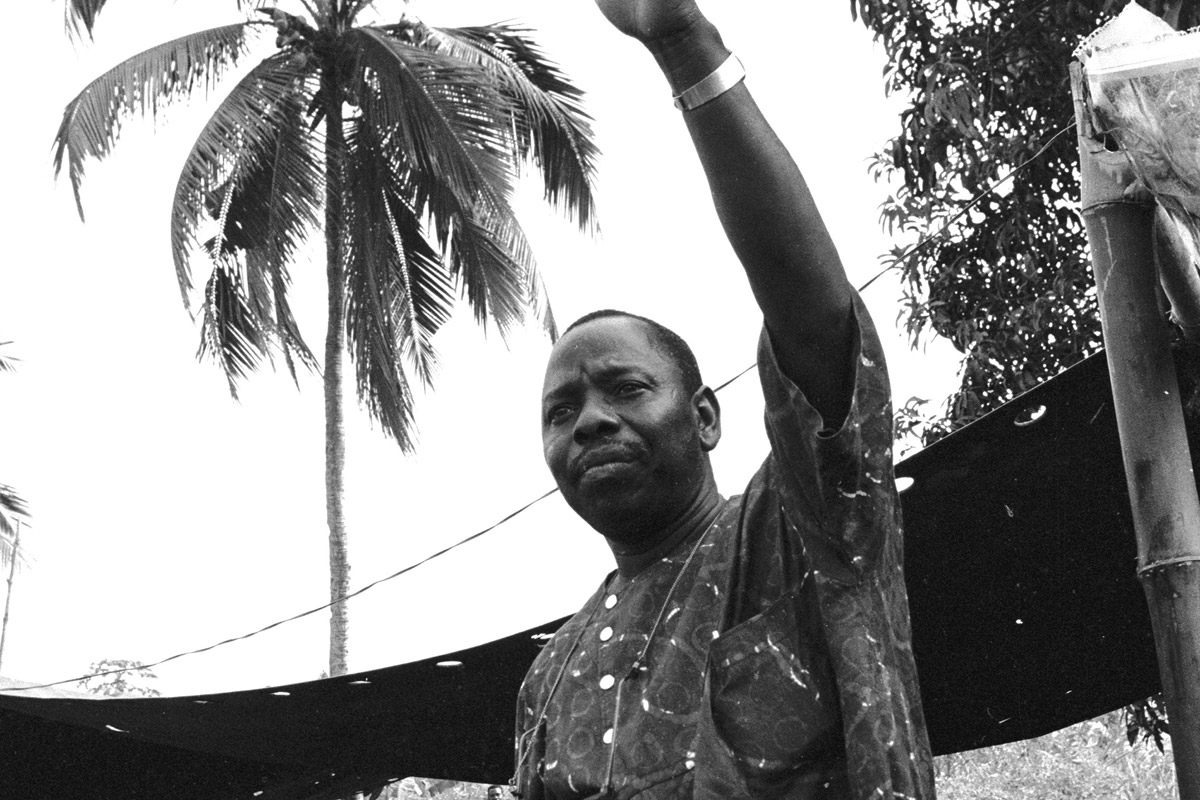
Ken Saro-Wiwa. (Greenpeace)
Born in 1941, Ken Saro-Wiwa came of age as Nigeria gained independence and became a lifelong advocate for the importance of minority rights within a unified national identity. A member of the Ogoni ethnic group, who at only half a million hold little sway in a country of two hundred million, Saro-Wiwa was central to mobilizing a popular movement that demanded accountability for companies like Shell that were extracting oil in the creeks of the Niger Delta.
In 1990, Saro-Wiwa created MOSOP (Movement for the Survival of the Ogoni People), which drew on Ogonis’ resentment at oil exploration for its destruction of the region’s economic foundations and its poisoning of crops and aquaculture. Despite bearing the brunt of black gold’s adverse impacts (from oil spills to gas flaring), the Ogoni were seeing scant financial benefits from the rush of oil revenues. Their homeland, Ogoniland, was being decimated. The movement grew quickly: in January 1993, a mass rally attracted three hundred thousand people, roughly two-thirds of the Ogoni.
Meanwhile, Saro-Wiwa — well-known for writing the 1980s Nigerian sitcom Basi and Company and the 1985 novel, Sozaboy: A Novel in Rotten English — was also publishing political works. Ogoni Bill of Rights was released in 1991, and Genocide in Nigeria: The Ogoni Tragedy came out the following year. Saro-Wiwa’s highly provocative argument: the destruction of a people’s natural environment should be considered a form of genocide.