History From Above in Africa
Africa’s massive new free trade deal promises to unify over a billion people and lift the continent out of poverty. But the case of Ethiopia shows that it will instead spark a continental race to the bottom and shut workers out from economic policy.
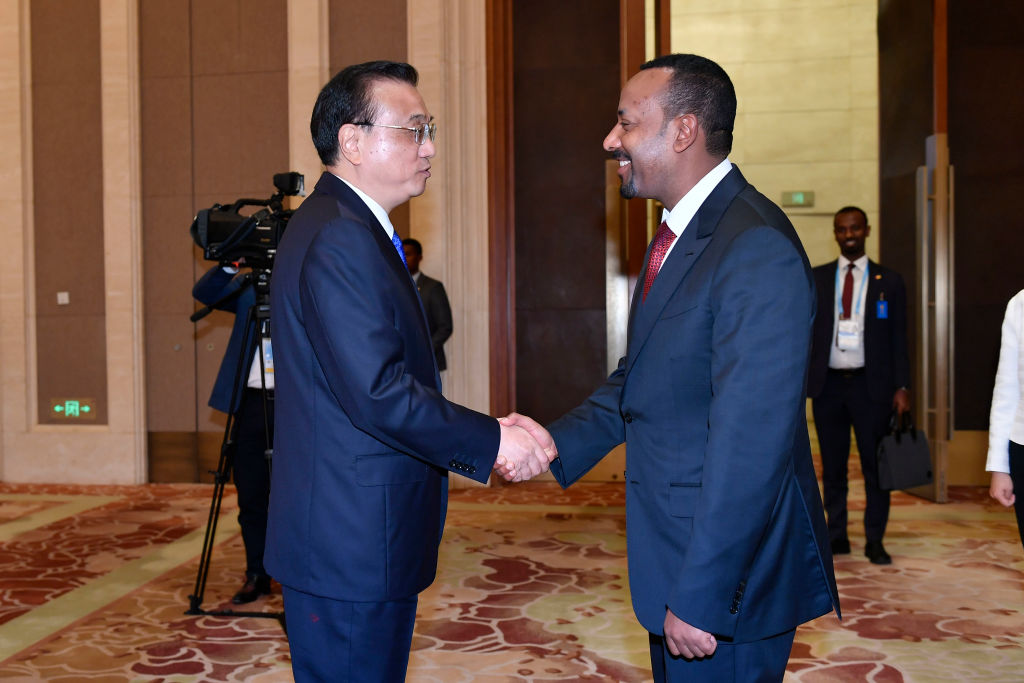
Ethiopia’s Prime Minister Abiy Ahmed (R), shakes hands with China’s Premier Li Keqiang after their meeting at the Diaoyutai State Guesthouse on April 24, 2019 in Beijing, China.(Parker Song – Pool / Getty Images)
These days, a lot of history is being made in Ethiopia. Under the leadership of its new Prime Minister Abiy Ahmed, Ethiopia has embarked on economic liberalization reforms which were unthinkable less than eighteen months ago. As part of the new scramble for Ethiopia, the government has initiated the partial privatization of key state-owned enterprises, including the country’s flagship Ethiopian Airlines. In addition, the new government is undertaking critical measures to open Ethiopia’s “closed” economy. Recently, the prime minister set up a ten-member national committee to resume the process of WTO accession, which had been paused for the past six years.
Last month the author Francis Fukuyama — best known for his “end of history” thesis in which he argued that the Cold War’s end, and the subsequent hegemony of liberal democracy, had ended the struggle between ideologies which drove human history — came to Ethiopia’s capital Addis Ababa to give a public lecture on the ultimate triumph of liberal democracy. After a few more talking points on the universal recipe for growth and development — essentially a technocratic state that supports the market-based economy — Fukuyama headed off for a private audience with the Ethiopian prime minister.
The transition to liberal democracy in Ethiopia over the past fifteen months has indeed been unprecedented, with tens of thousands of political prisoners released and progressive reforms to the country’s restrictive civil society and media laws. At the same time, the new government is carrying out a far-reaching reordering of the country’s political economy from above. The gap between the introduction of liberal democratic rights and the next elections in 2020 has meant a delayed democratization process: Abiy operates in a one-party state on the precipice of a multiparty one. The government is using this vacuum of democratic legitimacy to hastily introduce neoliberal structural reforms which may be impossible to rush through once Ethiopia has moved to a multiparty system and when civil society, including independent labor groups, have gained strength.