Grenada’s Revolution Should Never Be Forgotten
Forty years ago, a socialist revolution in the tiny Caribbean island of Grenada threatened to upturn the world economic order.
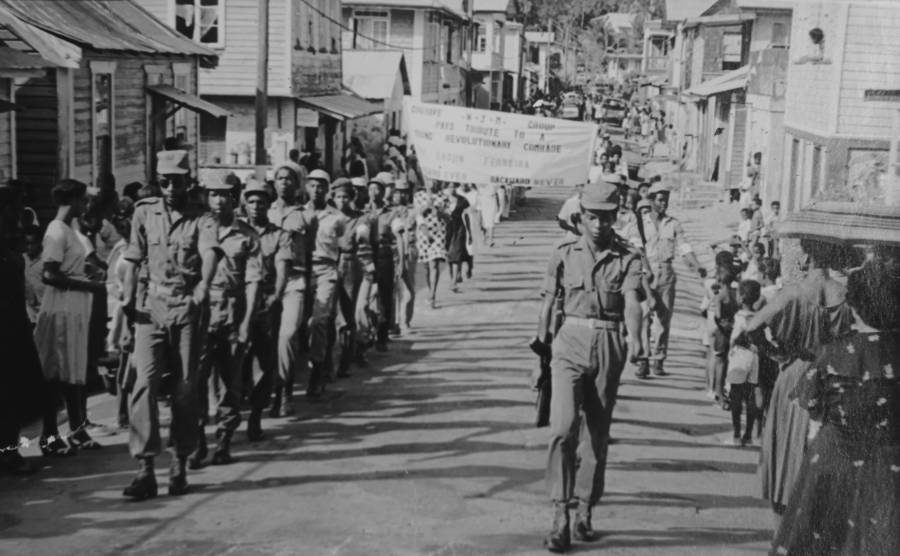
GrenadaNow
When Maurice Bishop, the revolutionary Grenadian leader, appeared at Hunter College in Brooklyn, New York in August 1983, the Reagan administration was worried. Four years earlier, in 1979, a socialist revolution had installed Bishop’s New Jewel Movement (NJM) in power in the Caribbean microstate of less than 100,000 people. A state department report from the time summarised the Americans’ concerns. The revolution in Grenada, it said, was in some ways even worse than the Cuban Revolution that had rocked the region a quarter of a century earlier: the vast majority of Grenadians were black, and therefore their struggle could resonate with thirty million black Americans; and the Grenadian revolutionary leaders spoke English, and so could communicate their message with ease to an American audience.
As it turned out, they were right to be concerned. Bishop’s speech in Hunter College was one of the great revolutionary orations of that century. In it, he defended the Grenadian Revolution with sweeping historical reference — in the context of the American Revolution of 1776, of Lincoln’s Emancipation, of the continued economic subservience of the developing world, of the overthrow of Salvador Allende’s government in Chile, and the brutal Contra interventions against the Sandinistas; in the context of the hypocrisy of Western nations in supporting Apartheid in South Africa, dispossession in Palestine, and dictatorship in South Korea.
But Bishop’s intervention was perhaps at its height when discussing its Caribbean roots. In the decades before 1979, Caribbean socialism had developed into a major force. Its forms were various — a fact best evidenced by the concurrent victories in the 1950s of Fidel Castro’s revolutionaries in Cuba and Cheddi Jagan’s People’s Progressive Party in elections in Guyana (the latter of which prompted British military intervention). In the years before NJM’s rise in Grenada, Trinidad had seen a Black Power uprising in 1970 and Jamaica had twice elected socialist Premier Michael Manley and his People’s National Party in 1972 and ’76 (events which, once again, prompted support for violent reaction from Western governments).