Painting Budapest Red
In March 1919, Hungary saw the creation of a short-lived revolutionary state. We look at the significance of the Hungarian Soviet Republic, and its attempted transformation of art and culture.
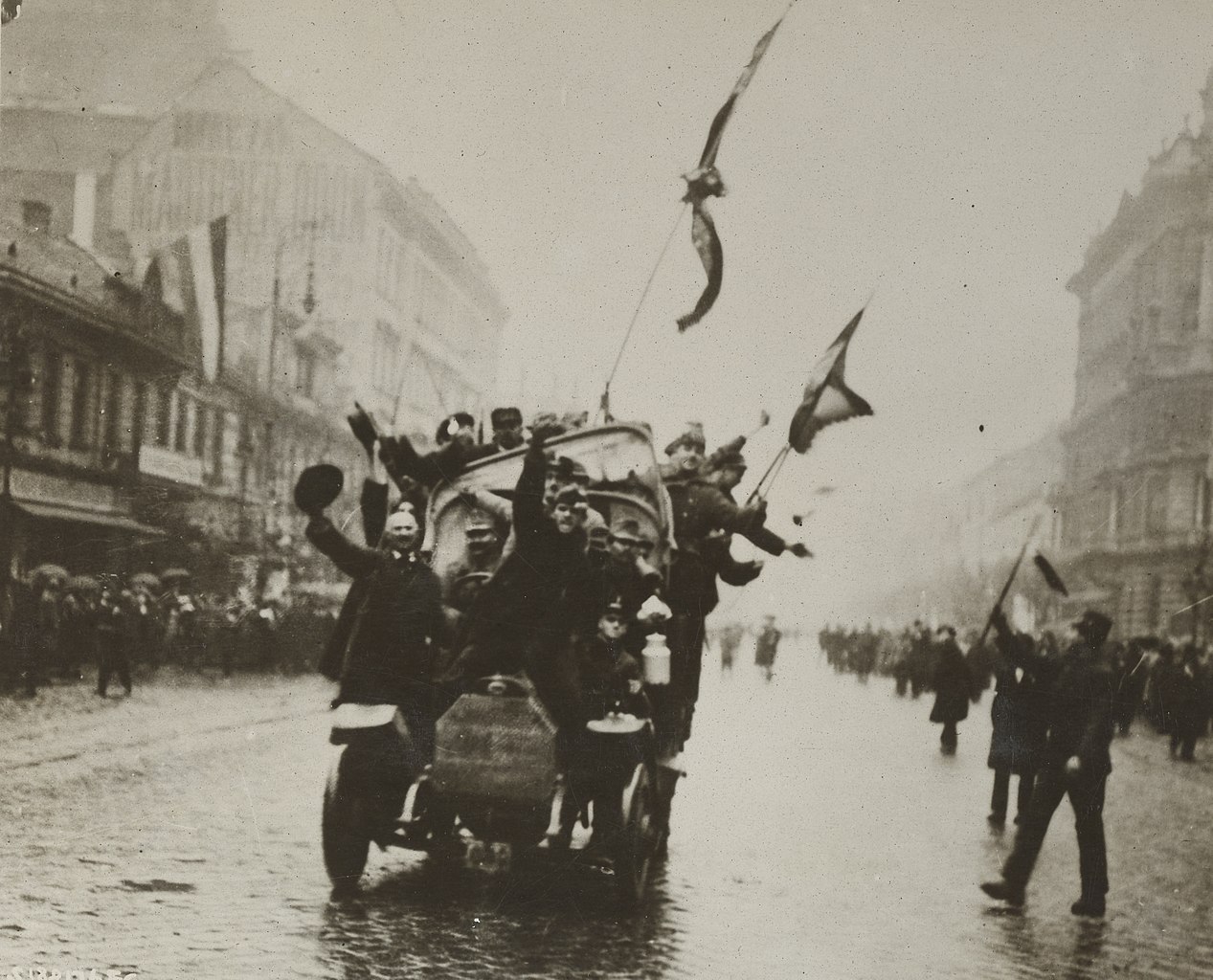
Automobile loaded with Communists dashing through the streets of Budapest, March 5, 1919.US National Archives and Records Administration / Wikimedia
In March 1919 Hungary saw the first attempt to create a Bolshevik-style state outside the old Russian Empire. Social democrats and communists combined to form a Council (or “Soviet”) Republic inspired by the Bolshevik example. Mounting sweeping nationalizations, raising wages and slashing rents, the state was however immediately engulfed in the post-World War I chaos. In August that same year, it was overthrown by Romanian troops in concert with Miklós Horthy’s far-right paramilitaries. Its defeat soon led to pogroms against Jews and leftists.
Despite its short existence, the Council Republic was notable for a revolution in the cultural field. Beyond efforts to socialize the economy, a People’s Commissariat for Education and Culture sought to open up the arts to the masses. As Bob Dent explains in his recent book, Painting the Town Red: Politics and the Arts During the 1919 Hungarian Soviet Republic, workers’ concerts, May Day parades, and new thinking on film and literature all sought to raise the cultural level of the population while breaking the hegemony of traditional elites and the Church.
Jacobin’s David Broder spoke to Bob about the significance of the experiment in Hungary, the revolution in the art world, and its legacy for post-World War II socialism.