Lost in the Fog
Environmental, political, and corruption crises have collided to threaten the core of Mongolia's democracy.
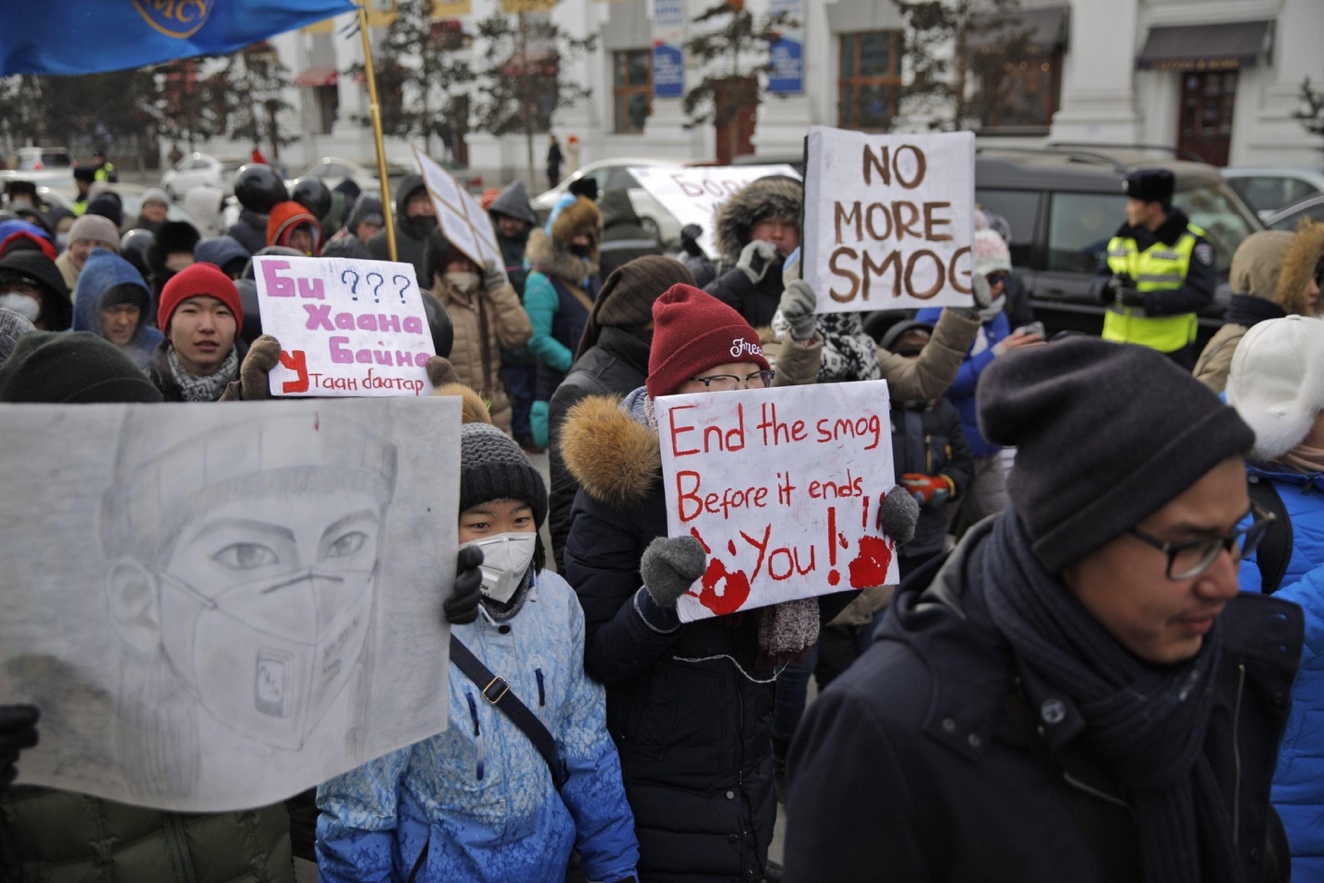
Protesters rallying against air pollution in Ulaanbaatar, Mongolia. Giustino Di Domenico / Environmental Justice Atlas
Protesters filled Sukhbaatar Square, an open space in front of the Parliament building in downtown Ulaanbaatar (UB), the capital of Mongolia. As the temperature dropped below negative 20 degrees Celsius, they demanded the resignation of Mongolia’s parliamentary speaker and former mayor of UB, Enkbold Miyegombo. These protests were precipitated by interdependent crises: a political crisis of trust in the government, recently inflamed by a corruption scandal, and a chronic air pollution crisis.
Ulaanbaatar means “Red Hero,” a term inherited from Mongolia’s past as a socialist republic (1924–1992). Formerly a “showcase of socialist progress,” Ulaanbaatar has become one of the most polluted cities in the world. Mongolians sarcastically refer to it as Utaabaatar or “Smoke Hero” and describe their lives as trapped behind a “smoke curtain.” UB residents face a daily struggle in which the fundamental conditions of life can no longer be taken for granted. The words of German philosopher Peter Sloterdijk are appropriate here: “The breathable air had lost its innocence.”
At the same time, Mongolians suffer from a miasma of corruption and state incompetence. MANAN, the Mongolian word for “fog” is also the acronym of the two major political parties, the Mongolian People’s Party (MAN) and the Democratic Party (AN). It is a telling coincidence. Democratic elections generate their promises, expectations, disappointment, and resignation, punctuated by the periodic corruption scandal.