Breaking Out of the Margins
- Joe Hayns
- Roberto Mozzachiodi
The yellow vests protests aren’t just a clash between Paris and France’s left-behind provinces. Emmanuel Macron’s fuel tax lit the fuse of a far wider sense of inequality.
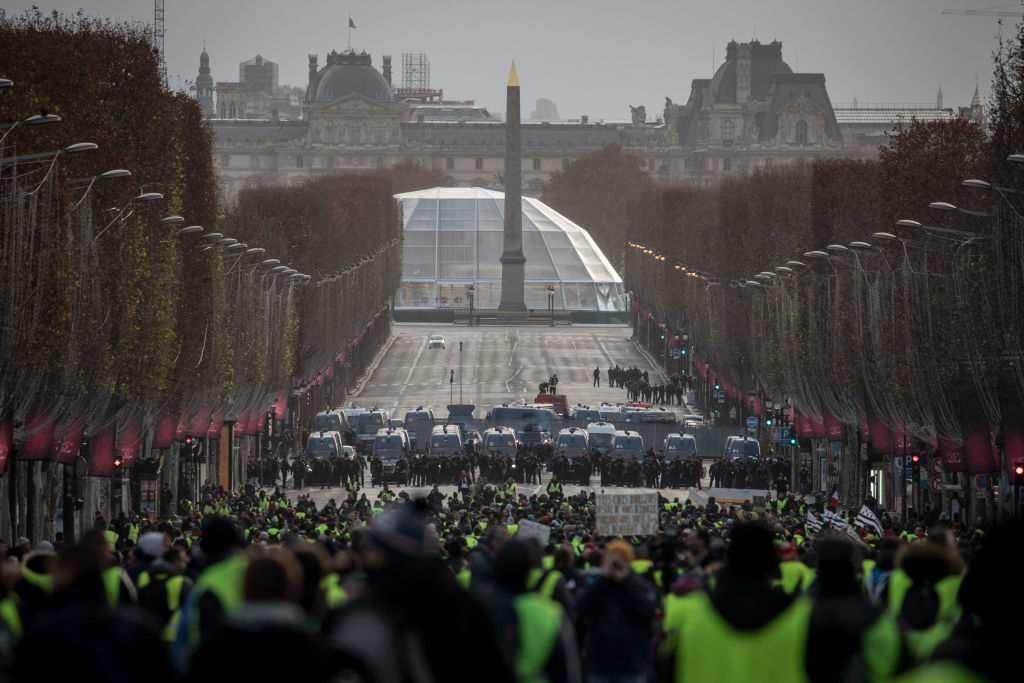
Protesters walk towards a police line on the Champs-Elysées during the yellow vests demonstration on December 8, 2018 in Paris France. Chris McGrath / Getty Images
Over recent days the gilets jaunes mobilization has been the subject of an exceptional degree of media coverage. With journalists on the lookout for the merest sign of trouble, various well-known media figures have followed one after another on the TV and the radio, bringing with them their partial analyses and interpretations of the movement.
Naturally, each has sought to validate their own theory of the French state and society, and certain terms have flourished. “Jacquerie” — designating peasant revolts in ancien régime France, and used by [hard-right commentator] Éric Zemmour since mid-November — has been adopted by part of the regional press. On Europe 1, Christophe Guilluy all but rejoiced at the revolt of “his” peripheral France — what Olivier Giesbert more bluntly called “that France” — while Nicolas Baverez spoke about the revenge of the citizens at the bottom.
Beyond its symbolic violence and its condescension, this narration — endlessly repeated urbi et orbi — doubtless says less about the gilets jaunes than the social and spatial imaginations of those who are voicing it. Since deeper inquiries into what exactly is going on in this movement — taken with a certain analytical remove — have not yet appeared, it seems useful to deconstruct a number of the pre-existing assumptions that have saturated public debate.