The End of ETA
For more than four decades, ETA waged an armed campaign for a Basque homeland. The group’s dissolution this spring marked the end of a history of terrorist violence and bloody state repression.
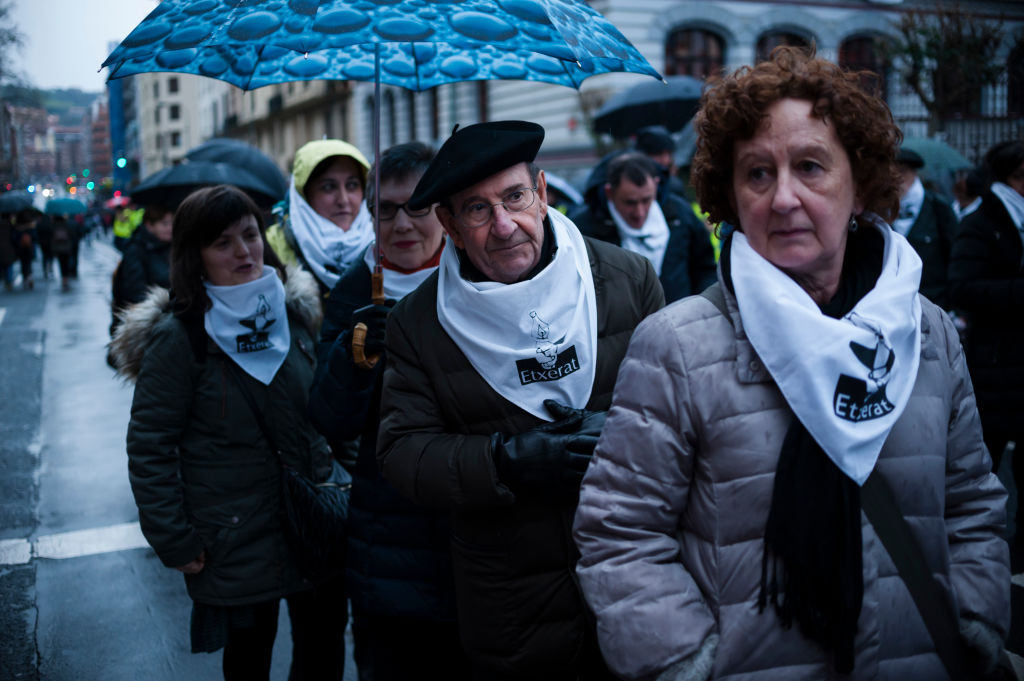
Relatives of Basque prisoners take part in a demonstration in Bilbao in January. Gari Garaialde / Getty Images
On May 4, a ceremony was held in the small French-Basque town of Cambo-les-Bains (Kanbo) to mark the final end of armed conflict in the region. It was held in response to the dissolution of ETA (Euskadi ta Askatasuna; “Homeland and Freedom”), the last left-wing armed-struggle organization in Western Europe. ETA had long proclaimed itself a “national liberation movement” whose ultimate aim was to create an “independent socialist Basque state” in the territory straddling northern Spain and southwestern France. This spring, its struggle finally came to an end.
ETA’s dissolution comes almost five decades after its militants carried out their first killing, on 2 August 1968, when they assassinated a notorious Francoite police chief. From that point until the ceasefire it declared in 2011, ETA’s armed activity claimed some 837 lives. During this campaign, which also included thousands of acts of kidnapping, arson and blackmail, ninety-four ETA members were killed by state security and seventy-three by para-police forces. There are 4,113 documented cases of police torture of ETA suspects: experts on the conflict unanimously agree that the real number is far higher.
ETA’s dissolution is doubtless of great importance to the Basque nationalist cause. But Basque nationalist demands also have a much older history, and perhaps a big future ahead of them. To understand ETA’s own journey, and its failure, also requires an understanding of this broader history.