A State of Division
- Adam Baltner
Elections in Bosnia and Herzegovina once again handed control to rival nationalists. But low turnout and weak social movements also show how institutionalized sectarianism hollows out democracy.
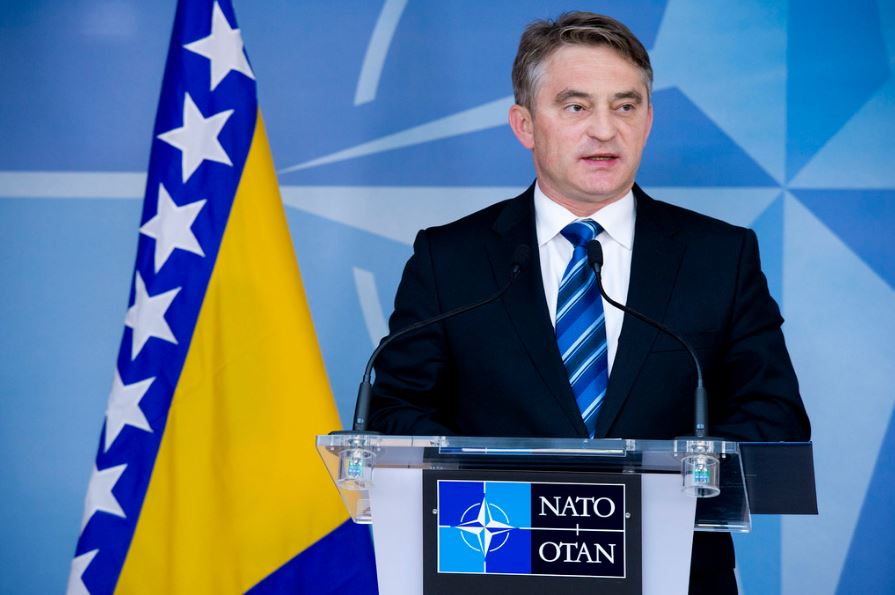
Zeljko Komsic, member of the presidency of Bosnia and Herzegovina, visiting NATO in 2014. NATO / Flickr
For its most famous poet Branko Ćopić, Bosnia and Herzegovina is a country full of magic, a country in which elves are haunted by dragons. Since the bloody civil war in the 1990s, it is also a country in which citizens are haunted by a so-called comprador bourgeoisie, i.e. one whose power rests on its international ties. Organized into a multitude of mostly nationalist parties, this comprador bourgeoisie has exploited the entire country economically, politically, culturally, morally, and institutionally.
The legislative framework facilitating this exploitation was provided by the peace agreement signed in Dayton, Ohio in 1995, which gave the country an ethno-national foundation. Since that point, the state has been made up of two separate political entities, namely the Republika Srpska (“Serb Republic”) and the Federation of Bosnia and Herzegovina (considered home to Muslims and Croats). This arrangement has wound itself around the country like a boa constrictor, choking off literally every instance of emancipatory resistance, however small. Portrayed as the only viable solution to conflict, this order is regarded by the international community as Bosnia and Herzegovina’s only legitimate form of sovereignty.
Interference from neighboring Croatia and Serbia has also proved disastrous. Not only do these states call Bosnia and Herzegovina’s territorial integrity into question — sometimes openly, sometimes through veiled allusions — but particularly during election seasons, both states instrumentalize the Croat and Serb populations living within the country for their own domestic political purposes. They finance and support Croat and Serb nationalist parties within their neighbor and place themselves above its constitution, as they please — for instance, when an election result turns out differently from what think tanks in Zagreb and Belgrade had hoped.