The Meaning of Lula’s Imprisonment
- Alex Hochuli
The soft coup now underway in Brazil shows just how quickly capitalists can turn against democracy.
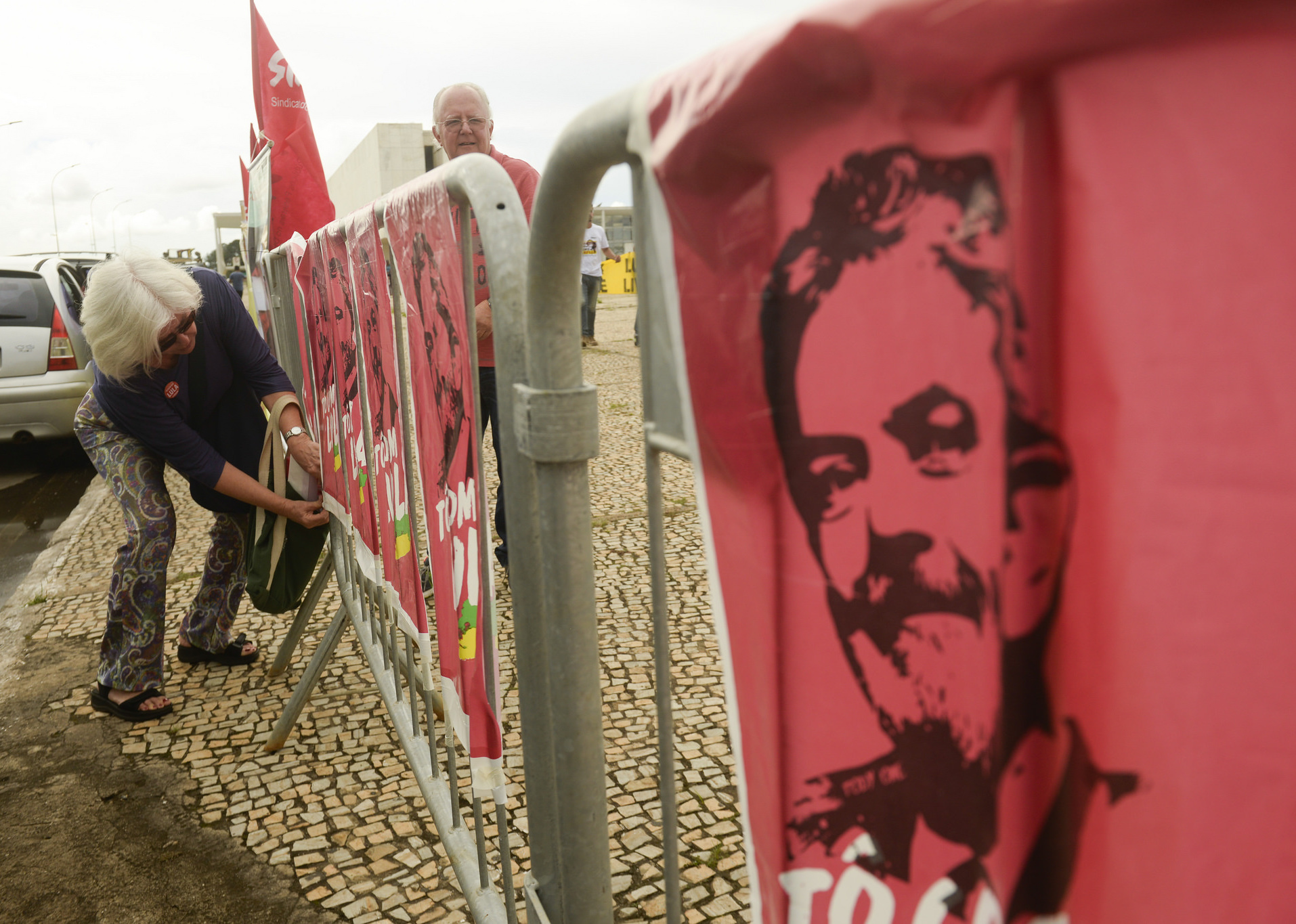
Supporters of former Brazilian president Luiz Inácio Lula da Silva put up banners outside the Supreme Federal Court in March. Senado Federal / Flickr
Exiting from the ranks and struggles of workers, Lula as president did not at any moment propose radical reforms to Brazil’s profoundly unequal social formation. By continuing to religiously pay off the external debt, reproducing the concentration of income, putting the brakes on agrarian reform, militarizing social life, and breaking up public services (to guarantee profits for big financial, industrial, and agribusiness corporations), his governments — like the first term of his successor, Dilma Rousseff — did what needed to be done, from the point of view of those above.
Concomitantly, while in power Lula significantly reduced unemployment, increased salaries and credit for the consumer market, deliberately increased targeted/compensatory social policies, opened up public sector entrance exams, and advanced affirmative-action policies. By means of this social partnership, through this sociopolitical engineering, Lula erected a party machine that showed itself capable of managing Brazilian capitalism better, and more securely, than the traditional bourgeois political representatives themselves; and for that reason, he became nearly invincible in the electoral game of our armored liberal democracy. There was not, up until that point, in that conjuncture, a better form of management of the capitalist order in a backwards, peripheral, and socially fractured country like Brazil.
It so happens that, as of the second half of Dilma Rousseff’s first term, the economic indices started abruptly to fall. Newly confident, the right-wing opposition was able to win back the love of a significant portion of the “extra-parliamentary mass of the bourgeoisie,” which, seduced by financial orgies, had resignedly accepted the PT at the forefront of its state. Now enamored with the neoliberal right, and even flirting with autocratic political tendencies, a large part of the Brazilian bourgeoisie managed rapidly to withdraw from the loveless affair it had been engaged in with petismo for the preceding ten years. PT leaders, meanwhile, would always keep alive the dream of breaking from this stable union. Having withdrawn, the bourgeoisie spilled all its bottled-up hate, a hate that can better be explained as a function of what the PT once was than by what it became while in power.