What Pat Robertson Teaches Us
Once marginal and reviled, evangelical Christians became a vital political bloc in the 1980s thanks to resolute organizing.
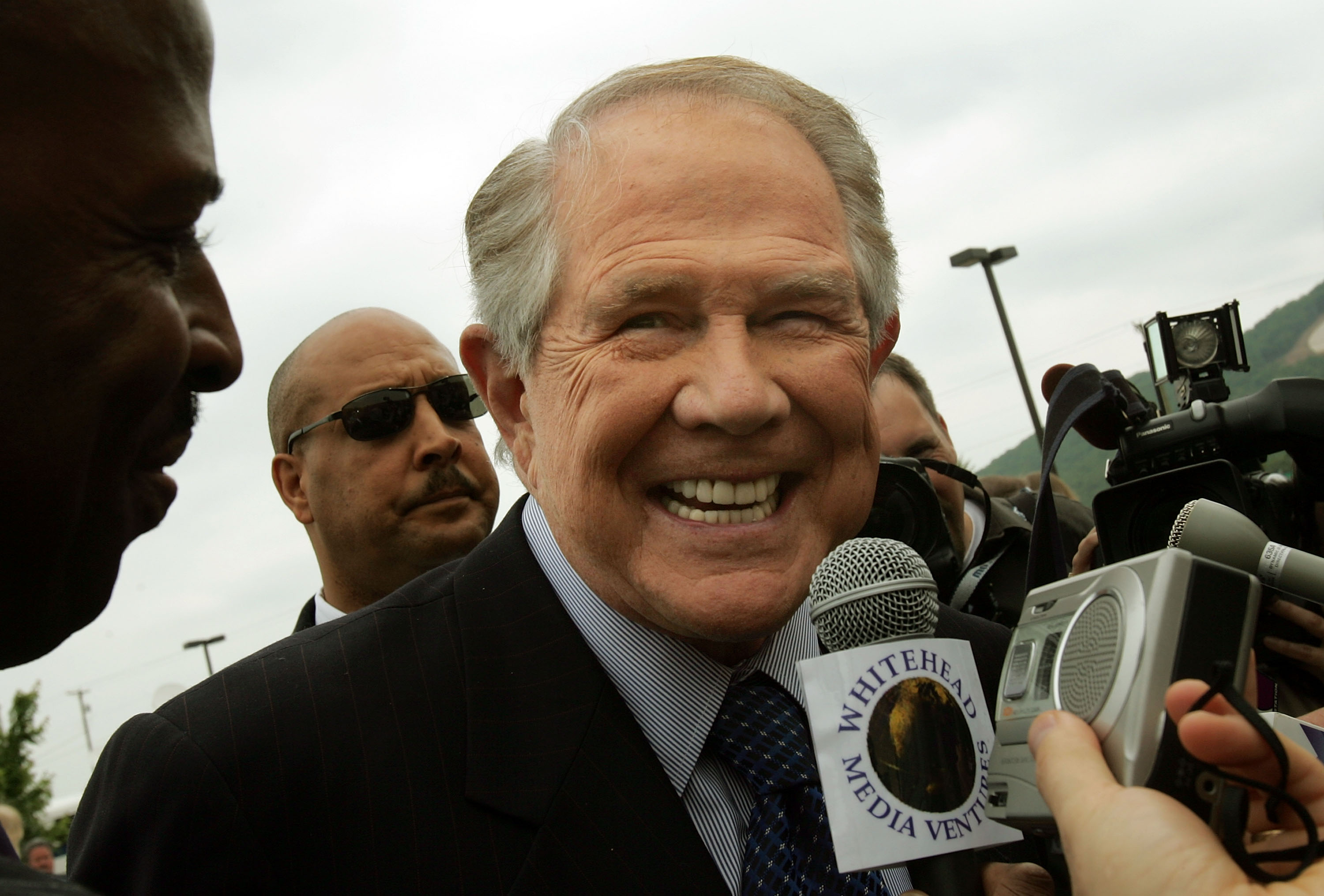
Religious broadcaster Pat Robertson arrives for the funeral of the Rev. Jerry Falwell at Thomas Road Baptist Church May 22, 2007 in Lynchburg, Virginia.Mario Tama / Getty
In the late seventies, evangelical Christians got no respect. The rest of America thought they were ignorant and eccentric at best, a perception consistently reflected in public polling from the period. Their ranks were swelling due to a mid-century revival in charismatic Christianity and the dawn of televangelism, but they had no place in American mainstream culture, no direct representation in the corridors of power, no seat at the table. That is, until Pat Robertson came along and made one for them.
Robertson came from political stock. His father Absalom Willis Robertson was a US congressman and senator for the state of Virginia for three decades. The younger Robertson showed an early interest in and aptitude for politics. He fought in the Korean War, attended law school, and was by all appearances following in his father’s footsteps when he had a religious awakening and instead became a born-again evangelical Christian. But his political acumen never diminished, and he never stopped believing that the political sphere was the locus of meaningful change — including the work of bringing God’s kingdom to Earth.
Christian television producer Terry Heaton, who worked closely with Pat Robertson on his show The 700 Club, describes him as “a political animal that happens to be a Christian evangelist, broadcaster and television personality.” In his new book The Gospel of Self: How Jesus Joined the GOP, Heaton examines Pat Robertson’s legacy. When it came to saving souls, Robertson was no more inspired than other televangelists like Billy Graham, Jim and Tammy Faye Bakker, and Oral Roberts. Robertson’s crucial intervention was the transformation of evangelicals from a populous but marginalized and atomized group into a discrete political constituency with significant purchase in the public sphere.