The Antisemitic Face of Israel’s Evangelical Allies
Evangelical Zionists want Jews to move to Palestine to set the stage for the divine requital of Armageddon. This hasn’t stopped Israel from sealing alliances with even nakedly antisemitic evangelicals, so long as they support the dispossession of Palestinians.
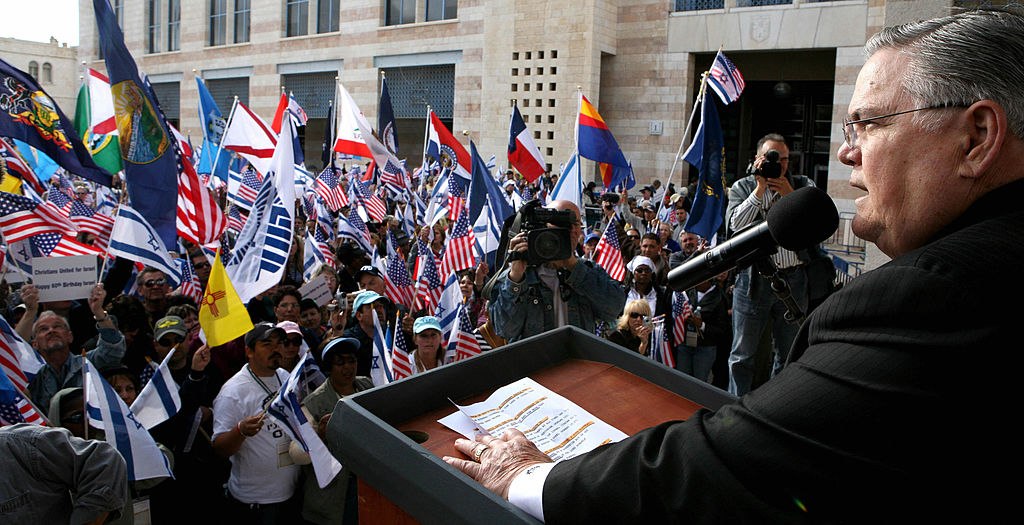
US evangelical pastor John Hagee addresses followers of the Christians United for Israel movement in downtown Jerusalem, 2008. (GALI TIBBON/AFP via Getty Images)
That the Israeli state has comfortable relationships with known antisemites is hardly news. If Donald Trump is an arch-Zionist, those who marched on Capitol Hill in his support wore clothing that professed the Holocaust insufficient. Brazilian president Jair Bolsonaro’s ties to the German far right and his historical revisionism terming the Nazis “leftists” have proven no impediment to his boosting bilateral ties with Israel. Hungarian premier Viktor Orbán has institutionalized Holocaust revisionism and is relentless in criticism of Jewish financier George Soros as a sort of global puppet master. But the Hungarian-Israeli relationship is tight.
Each such relationship represents a political calculation on the part of Israeli authorities. Underlying each partnership is the assumption, or wager, that such potential partners are either more Islamophobic than they are antisemitic (often true), or above all committed to their own nationalism (also mostly true), such that any whiff of antisemitism is overridden by a deeper commitment to the principle that a state can do whatever it wants inside the territory it controls. By either road — Islamophobic or isolationist — Israeli decision-makers are willing to excuse a little antisemitism for the certainty of silence or support in Israel’s incessant abuses against Palestinians.
However, the panoply of right-wing, conservative, and antisemitic Israeli allies also features one grouping less avowedly political than religious: evangelical Christians, who number some 90 million in the United States alone. Insofar as their inspiration is based in theology rather than hard realpolitik, it is also less rational, subject as it is to supposedly divine influences and, crucially, how their scriptures are interpreted down on earth.