The American Exception
US men's professional soccer is uniquely exclusionary. That might be why they didn't make it to the World Cup.
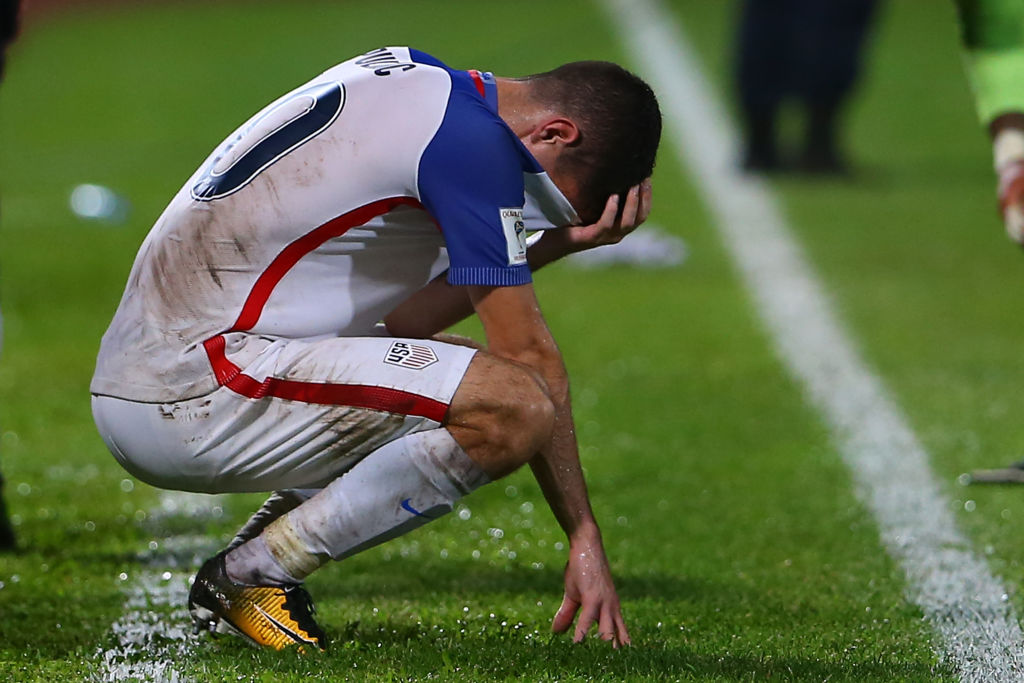
Christian Pulisic of the United States’ men’s national team reacts to their loss to Trinidad and Tobago on October 10, 2017. Ashley Allen / Getty Images)
On October 10, the US men’s national soccer team failed to qualify for the upcoming World Cup. All they needed to play in Russia 2018 was a draw with Trinidad and Tobago; instead, they turned in one of the most listless performances of an already-lackluster qualification campaign. As the whistle blew on a 2-1 defeat, the Americans slumped off a soggy Trinidadian field, having missed the World Cup for the first time since the Reagan administration.
There’s lots of blame to go around for last week’s screw-up, and much of it has been directed at US Soccer Federation (USSF) president Sunil Gulati, who was already a controversial figure. On the one hand, he has presided over some of American soccer’s greatest successes, including a 2015 World Cup victory for the US women’s national team, unprecedented growth for Major League Soccer (MLS), and the foundation of the National Women’s Soccer League. Then again, he also issued a firm “no” when the women’s team demanded to be paid as much as their male counterparts. When one of those women took a knee in solidarity with Colin Kaepernick last spring, Gulati’s organization immediately passed a new rule mandating that players “stand respectfully” for the anthem. Finally, there’s the hiring and firing of controversial men’s team manager Jürgen Klinsmann, followed by the choice of the conservative, uninspiring Bruce Arena to lead the ultimately disastrous World Cup qualifying campaign.
But looming behind Gulati’s controversies are more systemic issues: the monopolistic structure of US soccer, the disregard for training at the lower levels, and the deeply unequal access to the sport. These issues conspire to create a rot at the heart of US soccer, compounding disparities while driving down performance over time.