We’ll See Each Other in Bogotá
The western hemisphere's oldest guerrilla army is putting down their arms and becoming a political party. What does the future hold for them?
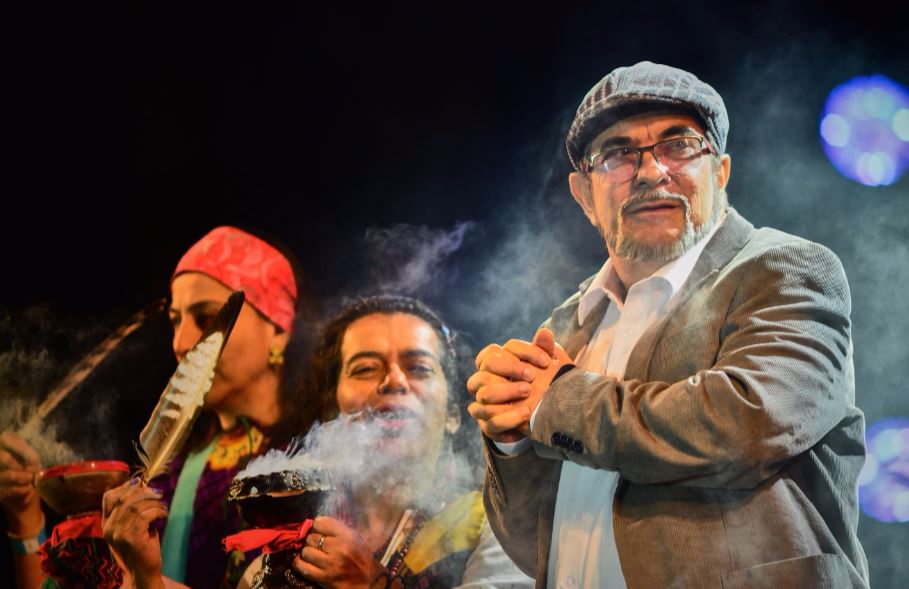
Rodrigo Londoño, alias “Timochenko,” leader of the FARC and president of the new party, with indigenous leaders at the party’s launch. Gerald Bermúdez / Jacobin
On September 1, Plaza Bolivar, the symbolic heart of Colombia’s capital city, Bogotá, was packed with members of the Armed Revolutionary Forces of Colombia (FARC), the Western Hemisphere’s oldest guerrilla force. Top-ranking commanders and foot soldiers alike filled the plaza. The FARC’s new logo was projected onto the facades of the Presidential Palace, Congress, the Justice Palace, and the Cathedral. Balloons, roses and ballad singers had been arranged.
This was not the military takeover of power that Mono Jojoy, one of the FARC’s historic commanders, had envisioned when he famously said to his troops, “We’ll see each other in Bogotá.” It was the launch of the newly founded Alternative Revolutionary Force of the Common (the acronym, FARC, preserved) and it had the look of a party to which all of Colombia’s historically dispossessed, oppressed, and marginalized had been invited.
Whether the FARC can make good on its promise to represent them, and whether the state institutions housed inside the buildings surrounding the plaza permit it, remains to be seen.