The Ghost of Japanese Internment
Trump's calls for a Muslim registry have reignited memories of the World War II–era incarceration of Japanese Americans.
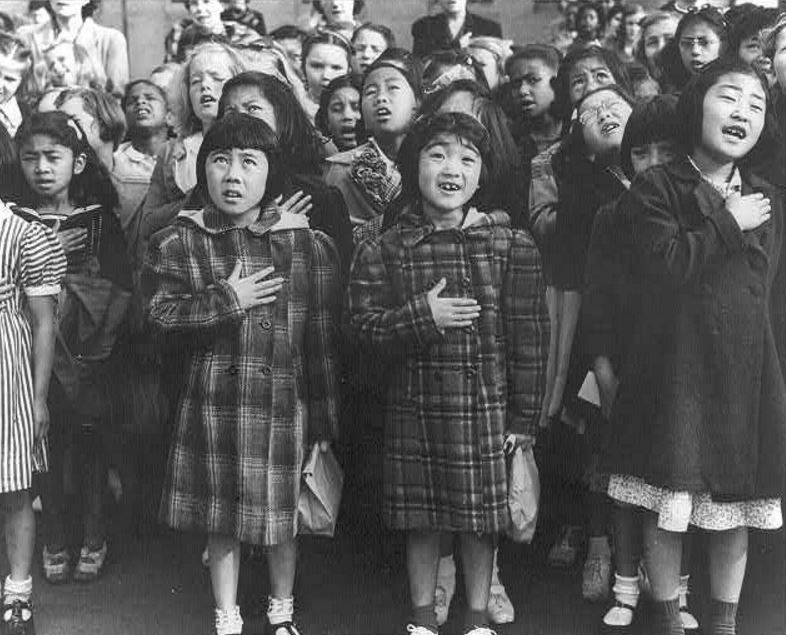
It is 1942 and two school girls wearing plaid overcoats and holding matching paper lunch bags are pledging allegiance to the United States flag at San Francisco’s Raphael Weill Public School. The girl on the right looks directly at the camera, smiling, proud. The girl on the left gazes up at the flag, worried and scared, her raised eyebrows grazing the edge of her shiny black bangs. President Franklin Roosevelt has just signed the executive order to forcibly imprison all those with Japanese ancestry in the western United States.
The girls’ different responses to the flag embody all the turbulent and unresolved history of the World War II–era incarceration of Japanese Americans. After decades of Asian-American activism for reparations and redress, the 1988 Civil Liberties Act formally apologized for this illegal crime of wartime hysteria and racism. This is the girl on the right: proudly claiming her equal part in the nation. And yet, with every new extension of US military power and every newly identified brown or black-skinned enemy, internment is resurrected and retroactively justified. This is the girl on the left, worried and skeptical of a country where her life is always precarious, her rights never fully protected.