The Bases of US Empire Are Crumbling
In recent decades, the basis of US hegemony has shifted from domestic industrial strength to its ability to enforce the rules that organize global production, finance, and money. Today this imperial role is now increasingly under strain.
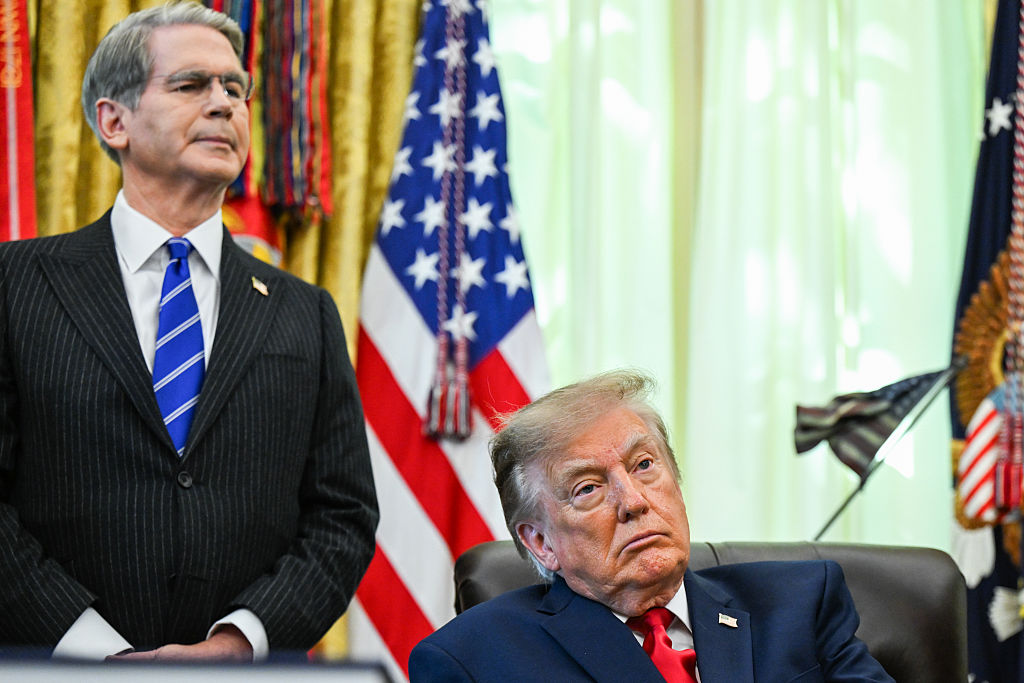
Donald Trump wants to restore domestic industry while also defending multinationals’ privileges. Understanding why these two goals can’t be reconciled is key to grasping the weaknesses of US capitalism today. (Annabelle Gordon / The Washington Post / Bloomberg via Getty Images)
Imperialism is again at the forefront of world politics. Large-scale war has become a permanent feature of the present era, from Ukraine to Gaza. Donald Trump’s second term has added a tariff war, threats to annex Greenland, the abduction of Venezuela’s president, and, together with Israel, an unprovoked war on Iran. This is not the whim of one man, for the confrontation with China began under Trump’s first term and deepened under Joe Biden.
At the same time, politics across the mature capitalist countries is in deep turmoil. In the United States, the Left has become a force in mass politics, with a democratic socialist as mayor of New York and widespread opposition to Immigration and Customs Enforcement (ICE), Israel’s genocide in Palestine, and the war on Iran. In France, governments have fallen one after the other, and social unrest is spreading. But the far right is also rising powerfully, from France’s Rassemblement National and Germany’s Alternative für Deutschland to Reform UK and Austria’s Freiheitliche Partei Österreichs, alongside the Trump White House.
Left and Right draw on the same realities of stagnant wages, industrial decline, and degraded public services. If the Left is to offer a credible political program to the working class and the poor, it must grasp what links resurgent imperialism to the decay of capitalist accumulation in the historic core of the world economy. With millions of people now looking for answers, this means offering a politics of class rupture.
The US Paradox
The starting point is the paradox at the heart of US capitalism, which is also the central paradox of contemporary imperialism. In 1945, the United States produced about half of world manufacturing output; today it produces roughly one-sixth. Productivity growth has been feeble since the great financial crisis of 2007–9, investment has remained weak, and real wages have stagnated for over a generation. Yet the dollar’s share of official reserves has slipped only slightly below 60 percent. US productive preeminence has declined, but the monetary hierarchy has hardened.
The United States alone settles its international obligations in its own liabilities. Everyone else must acquire dollars, manage dollar exposures, and adjust to the policy of the Federal Reserve. Foreign investors hold around $9 trillion of US Treasury bonds, about a third of the marketable stock, and central banks across the world are stuffed with US public paper.
The material basis of US hegemony has thus shifted from domestic industrial strength to the capacity to set and enforce the rules that organize global production, finance, and money. This is also where its imperial power truly lies.
US corporations have flourished within this structure. Among the largest globally active enterprises, US corporations take around 44 percent of profits and hold 34 percent of intellectual property, compared to 11 and 14 percent for their Chinese counterparts. US multinationals led the globalization of production from the 1980s onward, exporting productive capital and building the global chains that shifted industrial capacity abroad, while relying on the dollar to run them.
This was a triumph for private US capital, but it hollowed out industry within the United States and created the social wreckage that became Trump’s political raw material. Global monetary, financial, and corporate dominance has gone together with domestic deterioration.
This is why neither of the two main US parties has been able to reverse industrial decline. Trump’s 2018 tariffs brought little reshoring, since many corporations simply moved their supply chains to Vietnam and Mexico. Biden kept the tariffs and added the subsidies of the Inflation Reduction Act and the CHIPS Act but left US capital’s global strategy untouched.
Trump now wants to restore domestic industry while at the same time defending the privileges of multinationals. One of his first acts on returning to office was to withdraw from the Base Erosion and Profit Shifting framework of the Organisation for Economic Co-operation and Development (OECD), which more than 130 countries had signed, including the Biden-era United States. It would have allowed states to tax a share of the profits generated by multinationals within their borders and to impose a minimum tax of 15 percent, curbing the transfer of profits to tax havens through intellectual property held offshore.
But Trump’s aims cannot be reconciled. To see why, we must look at how production and finance are organized around the world today.
Lenin, the Dollar, and the F-35
Vladimir Lenin insisted in 1916 that imperialism must be grasped through the dominant mechanisms of accumulation of its time. Drawing primarily on Rudolf Hilferding, he identified these as the fusion of banking and industrial capital into finance capital, the export of capital, and the territorial division of the world among rival powers. His method remains indispensable, but the concrete forms of imperialism have changed profoundly.
Applied to contemporary capitalism, Lenin’s method reveals two structural foundations of imperialism: first, the pairing of globalized productive capital with internationalized financial capital; second, the dollar as world money, which turns that pairing into a hierarchy enforced ultimately by US military power. World money is a crucial element of imperialism today but a consideration that classical Marxist theory never developed.
Contemporary production is organized through global chains coordinated by multinationals — mostly US, European, and Japanese — that control design, intellectual property, logistics, and access to markets. Finance has become global alongside production, but the two have not fused as in Hilferding’s time. They form a pairing in which neither side simply commands the other. Productive capital generates value and surplus value; financial capital supplies the credit, liquidity, and means of payment without which global production could not run. US capital has led on both sides of the pairing: its multinationals built the chains, and its banks and asset managers globalized finance.
The pairing of capitals operates in a world market that has no world state, no world central bank, and no world court of justice. What holds it together is world money, which must serve across separate jurisdictions as unit of account, means of payment, and reserve of value, especially in a crisis. Only the dollar performs these functions.
A manufacturing supplier in Vietnam or Mexico ships components today and waits sixty or ninety days to be paid, but wages and inputs must be paid now. The gap has to be financed, and because the lead firm in the chain invoices in dollars, it is financed in dollars at rates priced off dollar benchmarks. This is not an economic choice but the price of admission to the chain. Between 1999 and 2019, about three-quarters of exports in the Asia-Pacific and virtually all exports in the Americas were invoiced in dollars. Through these chains, the monetary policy of the Federal Reserve reaches directly into workshops on the other side of the world.
The state that issues the necessary dollars is not just another power pursuing its interests abroad. It is the authority that ultimately guarantees settlement, liquidity, and enforceability for globally mobile capital, deciding whose liabilities count as money and whose balance sheets must adjust. Production remains the foundation, but the hegemon’s command over world money is the hinge of imperial power, the point at which the pairing of capitals is disciplined across the world.
The hierarchy becomes fully visible in a crisis. In 2008 and again in 2020, the Fed opened dollar swap lines to a select circle of fourteen central banks. Those inside stabilized their financial systems in days. Those outside, including India, Indonesia, and South Africa, faced currency depreciation, loss of reserves, and austerity. Sanctions and exclusion from payment systems complete the apparatus of coercion, as the freezing of approximately $300 billion of Russian central bank assets in 2022 showed. The fourteen account for roughly 55 percent of US imports and 60 percent of US exports. They also host more than 90 percent of US military personnel stationed abroad. The map of monetary privilege and the map of US military power largely coincide.
The dollar and the F-35 are two moments of a single structure of domination, and US air and naval power guards the choke points through which world trade moves. This is imperialism running through the balance sheets of firms, banks, and states, backed by military power. It does not need to plant a flag over a territory or to establish an expensive colonial administration.
Financialization Mark II
Crucially, the financial side of the pairing has itself been transformed since the great financial crisis of 2007–9. Before the crash there was Financialization Mark I, centered on globally active commercial banks, which turned workers’ homes into a prime terrain of extraction through mortgages and consumer debt. At its peak, bank profits in the United States approached 40 percent of all corporate profits. The crash ended that regime.
It was replaced by Financialization Mark II, resting on shadow banks — above all, asset managers such as BlackRock, Vanguard, and State Street. Research that I and colleagues have recently done on 426 major asset managers shows that the equity they manage rose from $13 trillion in 2013 to $46 trillion by mid-2025. That is roughly 40 percent of the equity of all billion-dollar listed companies in the world. In every region outside North America, US asset managers are the largest group of foreign investors. They represent imperial power exercised through balance sheets rather than territory.
Unlike commercial banks that draw their profits mostly from the spread between the lending and the borrowing rates of interest, asset managers depend on the gap between the rate of profit and the rate of interest — what Hilferding called founder’s profit. Such profits are realized primarily through rising asset prices. Stock market inflation has thus become a leading channel of financial accumulation.
The entire edifice of Mark II rests on the state. US gross public debt rose from just over 60 percent of GDP in 2007 to more than 120 percent by 2025. At the same time, the Federal Reserve absorbed public debt securities on a historic scale, created vast amounts of new dollars on its balance sheet, and became dealer of last resort for the shadow banks and others in the money markets. Whatever the neoliberal rhetoric of free markets might say, contemporary capitalism survives through state hyperinterventionism, but on behalf of finance, not to rebuild production.
Investment and productivity outside a narrow set of sectors have consequently stayed weak. The vast AI boom does not alter this picture; it confirms it. Spending on data centers and chips is concentrated in a handful of giant corporations, financed from their enormous cash holdings and increasingly by vast debt, while asset managers pour capital into the same few stocks. The promised productivity gains remain largely a matter of expectation, already priced into shares long before they appear in production. This is still primarily accumulation through asset price inflation, not yet a true transformation of production.
The historic core of the world economy thus continues to drift in an interregnum. The old order has lost its dynamism, but no new one has emerged.
Subordinate Financialization
Still, the reach of the Fed extends far beyond the borders of the United States, since the dollars it creates are world money. The dollar dependence created by global production chains accumulates into national pressures: dollar debts that must be serviced, profits that must be repatriated, technology payments that must flow abroad. The burden falls heaviest on the Global South, and the result is subordinate financialization. This is not an immature version of the financialization of the United States or Britain but a distinct form produced by subordination in both production and finance.
A peripheral central bank cannot expand its balance sheet at will or ignore the exchange rate when it forms monetary policy, since it operates in the highly precarious environment of loanable capital flowing in and out of the country. Much of that capital is managed by the same US asset managers that dominate Mark II.
In October 2025, the average policy interest rate in Brazil, India, Indonesia, Mexico, and South Africa stood 4 percentage points above the Fed’s. This is a liquidity tribute, levied by the monetary hierarchy itself. High rates choke domestic investment, attract speculative inflows, push up the exchange rate, and undermine domestic manufacturing. Peripheral states are forced to stockpile dollars as self-insurance and park them in US Treasuries, while their own governments and firms borrow at far higher rates. Resources that could build factories, railways, and hospitals are, in effect, lent to Washington.
Tribute on this scale needs local beneficiaries. Large firms in peripheral countries borrow cheaply in dollars and invest in domestic financial assets at high yields; banks profit from the public debt issued to absorb the inflows; and sections of the middle class enjoy cheap imports. In a peripheral country, the exchange rate is a class weapon as much as an economic variable. And the United States does not need a viceroy to collect the tribute, for it flows through the ordinary workings of the world market.
Empire Without Hegemony
China presents the opposite picture to the United States. It accounts for close to 30 percent of world manufacturing value added and around 15 percent of world merchandise exports. State-owned enterprises dominate its strategic sectors, and it has built institutions that partly bypass the US-led order, such as the Belt and Road Initiative and the Asian Infrastructure Investment Bank.
Yet China is not attempting to construct a separate imperial bloc or to acquire territory. It seeks a determining voice in the rules that govern trade, technology, and investment, and, in the longer term, new arrangements for world money.
That is where it is at its weakest. The renminbi accounts for less than 3 percent of global reserves and international payments, and less than 5 percent of world trade is invoiced in it, against roughly half in dollars. Chinese public debt does not serve as global collateral, the People’s Bank of China offers no liquidity backstop to the world market, and China’s own payment system processes little more than 12 percent of the dollar volume handled by the Society for Worldwide Interbank Financial Telecommunication.
The barrier is structural, not a matter of will. World money requires deep markets in safe public liabilities, legal protection for foreign creditors, and an open capital account. The capital controls and public command over finance that protected China’s industrialization are precisely what prevent the renminbi from becoming world money. China is a productive superpower obliged to settle its obligations in a currency it does not issue and to hold its reserves in its rival’s debt.
Nor is Chinese domestic accumulation free of contradictions. Since 2007–9, growth and profitability have fallen to a “new normal.” China still invests roughly double the US share of GDP, but the returns on that investment have declined sharply. The rational course would be to lower investment and systematically raise the incomes and consumption of Chinese workers, but the economic, social, and political risks of doing so are enormous.
The result is an impasse. The hegemon cannot recover its productive foundations, and the challenger cannot issue world money. Neither can impose a resolution, and neither will accept permanent subordination. There is no orderly path of succession within a monetary hierarchy that is singular, coercive, and increasingly contested, and therein lies the danger for the world.
The United States has stopped acting as the hegemon, that is, as the power that presents its own interests as the general interest. It acts instead as the biggest and most aggressive contestant in an increasingly open field, treating even its allies as subordinates. When Washington demanded sanctions on Russian energy after 2022, Germany accepted them at severe cost to its own industrial base. Yet US military predominance is no longer uncontested, and the war on Iran has shown that even weaker opponents cannot simply be made to submit. The situation echoes the rivalries before 1914. World war is not inevitable, but proxy wars, reserve seizures, payment exclusion, and technology embargoes have become an embedded feature of world politics.
Should the Left, then, cheer for de-dollarization and the BRICS? Weakening the monopoly of the dollar would loosen a crucial mechanism of domination. But the putative challengers are neither a socialist bloc nor a new anti-colonial movement. They are states competing in the world market and seeking ways around the dollar, not a fairer world money. Multipolarity is not a class category. The Left should oppose sanctions, the liquidity tribute, and the forced accumulation of reserves without enlisting in anyone’s camp.
The Politics of Class Rupture
One of the most encouraging political developments in this gloomy conjuncture is the US left seriously debating how to win and use governing power. Max Elbaum has rightly argued here that it cannot limit its positive platform to domestic issues while saying only what it opposes in foreign policy.
The analysis above shows why. The domestic and the imperial are two sides of the same structure, and a left government would confront that structure from day one. Success is not possible without overturning the prevailing capitalist mechanisms of social, economic, and political power. This is precisely the politics of class rupture that the Left should be offering to the millions seeking change.
I saw what this means at close quarters in Greece in 2015. Syriza’s election win had little significance in itself — it was at best only the beginning. A left-wing government that truly sought to save Greece from the disaster of the bailouts had to break the established mechanisms of power. That could only be done by using the machinery of the state in conjunction with the mass movement. To deliver results, a left-wing government would be obliged to transform the state.
The challenge crystallized on one issue — as it typically does in times of a radical upheaval. That was, to stay in the European Monetary Union (EMU), or to exit? Breaking with the euro would have required capital controls, public command over the banks and money, and a far-reaching reorganization of the economy that could have shifted power toward workers and the poor. Inevitably, there would have been a profound rupture with the entrenched class and imperial interests stifling Greece, both of which threw their weight behind the policy of remaining with the EMU. The mere thought was enough to send shivers down the spine of the timid Syriza leadership. Abject surrender followed.
There is a lesson here for the US left — and beyond it — despite the vast difference between the preeminent imperial power and a small European power. If it seeks to offer a politics of rupture that tilts the balance decisively in favor of workers and the poor, it must use and transform the machinery of the state while drawing on the strength of the mass movement. It should also be clear that there will be fierce and violent opposition on all levels. Success will not come without decisively overturning the domestic and the imperial configuration of class power in the United States. Of that there can be no doubt. It is almost redundant to say that the task is of world-historic importance.
Popular Sovereignty Against Empire
There is, however, plenty of historical experience on which the US left can draw as it seeks a class politics that could bring success. The first step involves developing a program of reversing domestic US productive decline, with the working class in the lead, as has already been argued for other developed capitalist countries.
That means public investment on a scale not seen in generations, public banks directing credit to production, and a central bank brought within a democratic economic plan instead of serving as dealer of last resort for BlackRock. It also means restoring capital controls as a normal instrument of policy and extending public ownership in energy, infrastructure, and housing, where social need and private profit sharply diverge. And it further means democratic, worker-based control of corporations, since a bureaucratic state corporation run on the priorities of capital changes nothing essential.
Such a program would reverse the global accumulation strategy of US capital, subordinating multinational and financial capital to democratically determined priorities. In short, it would aim to deglobalize and definancialize the US economy. This is neither isolationism nor autarky. The aim is an open economy that continues to trade, invest, and cooperate across borders but on terms set democratically rather than by multinationals and footloose financial capital. Openness should serve the reconstruction of production at home and genuine cooperation abroad, not the global strategy of US capital.
A program of this kind ultimately rests on the issue of sovereignty. The problem is that this term has been appropriated by the Right, which uses it to assert the unrestrained power of the US state abroad while defending the interests of capital at home. But for the Left, sovereignty has a different and older content, that of popular sovereignty. If democracy is to have real meaning, workers and the poor ought to have both voice and power at the workplace, the neighborhood, the town, the city, and the country. Popular sovereignty does not mean only electing a government that spends more on social care, housing, and infrastructure while taxing the rich, necessary as that is. It requires building the organized power of working people — channeling the renewed strike militancy of the United Auto Workers and the drives to organize the nonunion factories of the South — alongside the communities and movements that have resisted ICE, the genocide in Palestine, and the war on Iran.
Since, moreover, there is no democratic space beyond the borders of the nation-state, a program of class rupture would also rest on national sovereignty. This is an even thornier issue for the Left to grasp. In a subordinate country, such as Greece in 2015, national sovereignty means breaking out of imperialist domination. But the United States sits at the top of the imperialist hierarchy, and the sovereignty of the US state is a lever through which other nations are subordinated.
For the United States, therefore, national sovereignty raises directly the question of what the nation is and which class constitutes it. For the Right, the nation is the imperial state and the capital it serves. For the Left, national sovereignty is anti-imperialist at its core and means fighting against the oppression of others. Karl Marx and Friedrich Engels put it plainly, after stating that workers have no country: the proletariat must “rise to be the leading class of the nation, must constitute itself the nation,” and is in that sense “itself national, though not in the bourgeois sense of the word.”
This is the opposite of nationalism, which asks workers to line up behind their own ruling class. The task is then clear. The US working class can constitute itself as the nation only by taking command of the instruments of imperial power — the Fed, the sanctions machinery of the Treasury, the military budget — and ending their use to subordinate other nations. US workers gain nothing durable from the dollar order. The more Washington pursues imperial primacy, the more it hollows out the domestic economy.
Antiwar politics and anti-capitalist politics are one struggle. Opposition to war that leaves domestic property relations untouched is incomplete, and transformation at home that ignores the imperial order will be crushed by it. The system that extracts value from the periphery is the same system that hollows out the core. That is what gives working-class internationalism a material content, instead of leaving it a liberal slogan compatible with the free movement of capital. It is the ground on which a genuinely internationalist socialist politics can be built.