Enough With the “Public Option” Already
The public option sounds like a step toward universal health care, but it’s really a delay tactic. The latest versions would force public plans to mimic private insurers, while the fight over the arcane details buys the industry another decade or two.
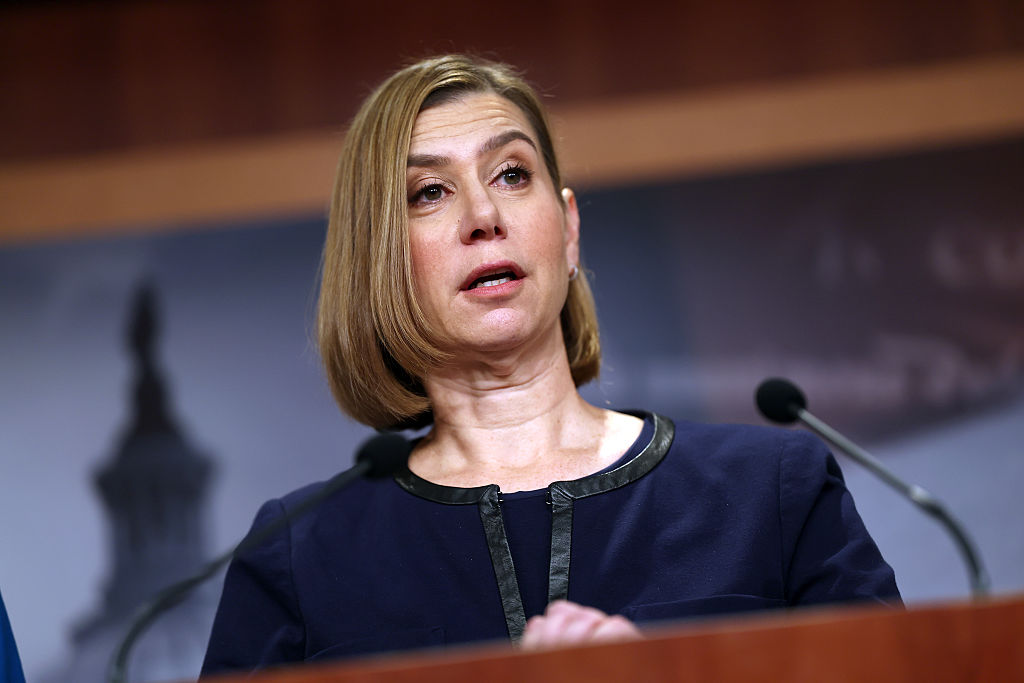
The concept of the public option is designed as a distraction. Wasting years on policy rabbit holes is the point. It’s a perfect nonsolution to our three-headed crisis of health care cost, access, and quality. (Kevin Dietsch / Getty Images)
The difference between a vampire and a bad health care policy idea is that vampires jump out of their coffins and drink blood at sunset. Undead health care proposals emerge from think tank closets and suck the life out of useful ideas when the sun rises on a national health care debate. As public fury at exploding costs and deadly corporate claims denials boils over into historic Democratic election gains, can someone please find a wooden stake for the public option?
Improved and expanded Medicare for All would give everyone full coverage at much lower cost than the combined private premiums, taxes, and out-of-pocket payments that are eating up family income today. But it violates a cardinal rule of federal politics: never do anything that causes corporations or the ultrawealthy any pain.
Instead, corporate Democrats wanting to be seen “doing something” about the imploding US health care system have long peddled a vague public option notion because it sounds like the marriage of a big noncorporate vision (it’s public!) with competition and freedom of choice (it’s an option!). Liberal nongovernmental organizations (NGOs) and pundits revived its rotting corpse in response to pro–Medicare for All candidates’ primary victories and Tuesday night’s stunning results.
It’s a perfect nonsolution to our three-headed crisis of health care cost, access, and quality. Nobody knows what a “public option” is because there’s no common definition and nothing like it has ever been seen in the wild, so it can be anything weaselly politicians want it to be. It needs to be put out of our misery.
The “Right” Path
There’s danger in chasing the content of various “public options.” The concept is designed as a distraction. Wasting years on policy rabbit holes is the point. But killing it requires some analysis, so it’s worth pointing out that every one of its shape-shifting forms withers under cursory scrutiny.
Rising Democratic Senate star Elissa Slotkin (D-MI) says she “wouldn’t say no forever” to a White House run if “there’s not anyone else who’s on the right path.” Slotkin’s favored path leads to one of the sillier public option proposals. In January, Slotkin, Senator Sheldon Whitehouse (D-RI), and Rep. Jan Schakowsky (D-IL) introduced the Affordable Consumer Health Options and Insurance Competition Enhancement (CHOICE) Act, or the Affordable CHOICE Act (“ACA” — get it?). The CHOICE Act would get the federal government into the business of selling crummy insurance to almost nobody by allowing the feds to market their own versions of “bronze,” “silver,” and “gold” plans on the Obamacare exchanges.
Even at record enrollment, the Affordable Care Act exchanges covered less than 7 percent of Americans. Nearly everyone with insurance has Medicare, Medicaid, or private insurance through a job. Three-quarters of US working-age adults are eligible for job-based coverage, nearly all of which is considered legally “affordable” by ACA rules. That means almost all workers are barred from receiving ACA premium subsidies. Presumably they could buy a Slotkinized plan by paying the full premium cost if they really wanted one. Nice option.
Subsidized or not, Slotkinized plans would cover only between 58 and 82 percent of the actual cost of health care after premiums, depending on the “metal” label attached to the plan.
CHOICE Act public option plans would have to play the same failed “cost control” game as private insurers, building their own private provider networks and trading privileged access to their patients for discounts off market price from providers who join those networks. So, Senator Slotkin’s options will come loaded with the copays, coinsurance, and deductibles that private insurance corporations use to coerce patients into accepting in-network doctors and hospitals. It’s a mockery of “affordability” for patients and would offer neither better nor worse provider payments than UnitedHealth, Aetna, or Cigna.
The contrast between Senator Slotkin and the winner of Michigan’s other Senate seat couldn’t be clearer. At his victory celebration, Abdul El-Sayed turned his three-line slogan into a roaring call and response, with Medicare for All as the closer: “Money out of . . . POLITICS! Money in your . . . POCKET! Medicare for . . . ALL!” Corporate Democrats are still trying to paint Medicare for All as too radical and urge progressive winners toward “moderation,” torturing voting data into arguments about electability. The facts: In 2024, Elissa Slotkin defeated Mike Rogers by a 0.3 percent margin. With unlimited American Israel Public Affairs Committee and corporate cash arrayed against him and in the face of nakedly racist opposition, El-Sayed beat Rogers by a full 7 percent.
Wait, Not That Public Option
Criticize one slippery idea and the optionites will just say, “Hey, I didn’t mean that public option.” In two recent posts, economist Paul Krugman hyped a Medicare “buy-in” version to “allow individuals, and possibly more important, employers, to sign up for Medicare benefits, paying actuarially fair premiums to Medicare reflecting the health status of their workers” (emphasis added). Krugman insists that “many people and many employers would surely take it.”
Surely many who need it the most wouldn’t. The US health care system is so broken in part because we’ve asked six million separate employers who don’t know and shouldn’t be expected to know much about health care to buy it for most of us. But even they know that premiums reflecting the health status of workers would immediately price employers who most need an affordable option — those with high-cost employees — out of any “buy-in.”
The Krugmanite option violates a core Medicare precept. Of course, individual Medicare premiums shouldn’t exist at all. Paying taxes should buy your health care. Even so, except for a few high-income people, everyone pays the same Medicare premiums right now. “Actuarially fair premiums” tailored to health risks contradict the basic notions of solidarity at the heart of public benefits and the very idea of insurance, which is supposed to pool risk across groups of people, not segregate it.
Offering existing original Medicare as a standalone option for employers and nondisabled individuals younger than sixty-five to “buy” is an idea only a Nobel-winning trade economist dabbling in health care could love. Original Medicare’s cost-sharing has already driven most eligible people into Medicare Advantage plans run by the very companies that Krugman dismissed as “parasites.”
So, to fully cover their workers, employers would have to — you guessed it — buy supplemental insurance from the private insurance industry. Never underestimate the power of Nancy Pelosi’s Iron Law of Democratic Health Policy: Congress shall make no law respecting expansion of health care access that does not subsidize the private health insurance industry, and all gestures to the contrary shall be performance art.
False Equivalence
Some people may actually take these ideas seriously, but the essence of public optionism is a bully’s taunt.
Virtually every economic analysis of the issue has concluded that a single-payer system would generate large savings to fund both expanding coverage to everyone and dramatically improving existing coverage. Two key sources of those savings are huge, useless administrative costs: the insurance industry’s skim, and the massive bureaucracies that providers have to build just to get paid by thousands of private insurance plans whose terms and members constantly change.
Original Medicare is far more efficient than private insurance, spending 97 to 98 percent of revenue on actual health care, while private plans capture more than 10 percent of our premiums as overhead and profit.
If public insurance is so darned efficient, the argument goes, a public option should outcompete private insurance. That would have the dual benefit of giving people cheaper, better coverage, and proving to a socialism-averse public that something like Medicare for All could work. So prove it, lefties!
The problem, of course, is that operating in existing markets under rules that will force public options to behave like private insurers strips these plans of the permanence and power that make Medicare and truly “public” insurance relatively efficient.
Medicare controls prices because it permanently covers everyone in the largest group of people who use a lot of health care. When you turn sixty-five and enroll, you’re in for life. If hospitals want to treat the group of people most likely to need their services, they have to take Medicare prices.
The CHOICE Act makes a head fake in that direction. The bill instructs the Health and Human Services secretary to create a provider network and set hospital and physician prices “through a negotiated agreement with health care providers,” without naming which providers or how they’ll negotiate. In the absence of successful negotiations, CHOICE Act plans can just pay any claim at existing Medicare prices. That may sound like a little public muscle flexing to hold prices down, but the CHOICE Act also allows hospitals and doctors to opt out of the public options’ networks, turning Medicare prices into a backstop that applies only to out-of-network claims.
Having a guaranteed right to impose low prices on out-of-network care would give public option plans a little pricing leverage. But in the end, the Slotkinized plans would likely wind up creating networks and setting prices in a manner similar to private plans, whose tussles with hospitals are based entirely on market power. Having surrendered the power that allows Medicare to set its own prices and competing as start-ups with private insurance to entice “covered lives” to enroll, the public options would soon find themselves face-to-face with massively powerful regional health systems affiliated with Ivy League schools or the Catholic Church. Have fun.
To persuade the necessary “covered lives” to enroll, CHOICE Act plans will have to ape private plans by constantly marketing themselves and enrolling and disenrolling clients. Alongside the headache of managing networks, that work requires skimming billions in premium dollars off the top, just like private insurers.
Slotkin, Krugman, and their optional pals have also managed the remarkable feat of finding an idea that would add a little more bureaucracy to the already bloated administrative expenses that choke US hospitals. The CHOICE Act doesn’t create an option. It envisions hundreds of local public option plans with premiums set geographically — ACA plans are offered on a county-by-county basis. Viewed from a hospital’s business office, that means at least three separate local plans, one per “metal,” with each becoming just another payer with its own unique prices, networks, utilization review, and patient cost-sharing to follow, track, bill, and sue when payments don’t show up.
Finally, should policymakers and regulators fool themselves into thinking that these options will be efficient because, you know, they’re “public” and offer below-market premiums, the plans face a potential flood of high-risk sign-ups (the “adverse selection” problem). As Jim Kahn and Hank Abrons point out in Health Justice Monitor, even the more-expansive-than-Krugman version offered by The American Prospect is particularly vulnerable on this question. Being stuck with disproportionately high-cost patients wouldn’t be good for plans trying to prove the efficiency of public insurance, but it would be great for politicians seeking to prove that the government really can’t do health care.
We could go on forever about the details, but the content doesn’t really matter. These ideas are little more than lumps of lead over which political alchemists like Slotkin and Krugman chant their two magic words to dazzle us into believing they’re creating gold. Public options aren’t incremental reforms toward universal coverage. They’re increments of nothing that enable the status quo.
This fantasy nonidea endures because fighting for it achieves a critical bipartisan goal: buying time for corporate control of the rest of the health care system. A legislative timeline would likely look like this: two years until the Democrats have a shot at the White House, followed by a year or two of GOP panic about “communism.” Throw in two to three years to write the regulationss, then five or ten years to roll out the plans and watch them fail. Presto! A decade or two of corporate looting passes, with trillions of dollars squandered and another million or two preventable deaths.
There are plenty of meaningful steps on the way to a publicly financed universal health care system that ensures everyone gets the care they need without facing personal bankruptcy or fighting off bloodthirsty private bureaucrats. Politicians who want to improve access or cost control could jump on a few of these sample bandwagons. Don’t expect a rush, though. Most of these ideas take a bite out of the industry’s hide, and letting poor people who make an extra penny keep their health care will give alleged conservatives apoplexy. But here they are:
Set fair hospital prices by regulation for all payers, to stop the gouging of employers and patients and end the episodic waves of terror that engulf communities when big insurance companies and hospitals threaten patients with loss of access during local rate negotiations.
Lower the age at which everyone becomes eligible for Medicare to fifty or fifty-five.
Eliminate the extreme cost-sharing in the original Medicare program.
Abolish the Medicare Advantage privatization scheme that lets private insurance companies overcharge the federal government tens of billions of dollars a year, and use the savings to fund said elimination of original Medicare cost-sharing.
Buck Washington, DC’s current antitrust fad by lifting restrictions on employers who want to join together to bargain for health care and administer benefits. Look, employer control of health care makes no sense. But if corporate politicians fantasize that it’s a route to better benefits and lower costs, let bosses gather the power to control prices and administrative costs, as long as they do it themselves without the insurance industry, and as long as they’re willing to pay the price of offering uniform plans across their cartel — no more tiny tweaks to networks or boutique cost-sharing provisions for each employer.
Dramatically expand the time people can stay on Medicaid. Medicaid’s constant means-testing makes it an unreliable source of coverage. California applied for a waiver to keep kids enrolled through the first five years of their lives instead of making their parents reapply every year. Do more of that and for longer.
The worst thing about public optionism is enduring smug lectures that Medicare for All is a political fantasy that could never happen from people promoting a vague, unworkable idea now enjoying its twenty-third year of politically viable nonexistence. Yet The American Prospect casually assumes that a series of essential Medicare for All elements against which the industry will fight like rabid dogs can easily be grafted onto a public option.
Health care is a public good. Pretending that having government act like a health insurance corporation will do anything useful is absurd. Let’s kill this putrefying political monster right now.