A New Single-Payer Effort Is Underway in Georgia
With Bernie Sanders no longer leading the charge, Medicare for All has slipped from the spotlight. But a new state-level single-payer bill in Georgia — where Republicans refused to expand Medicaid and 1.2 million people are uninsured — shows signs of life.
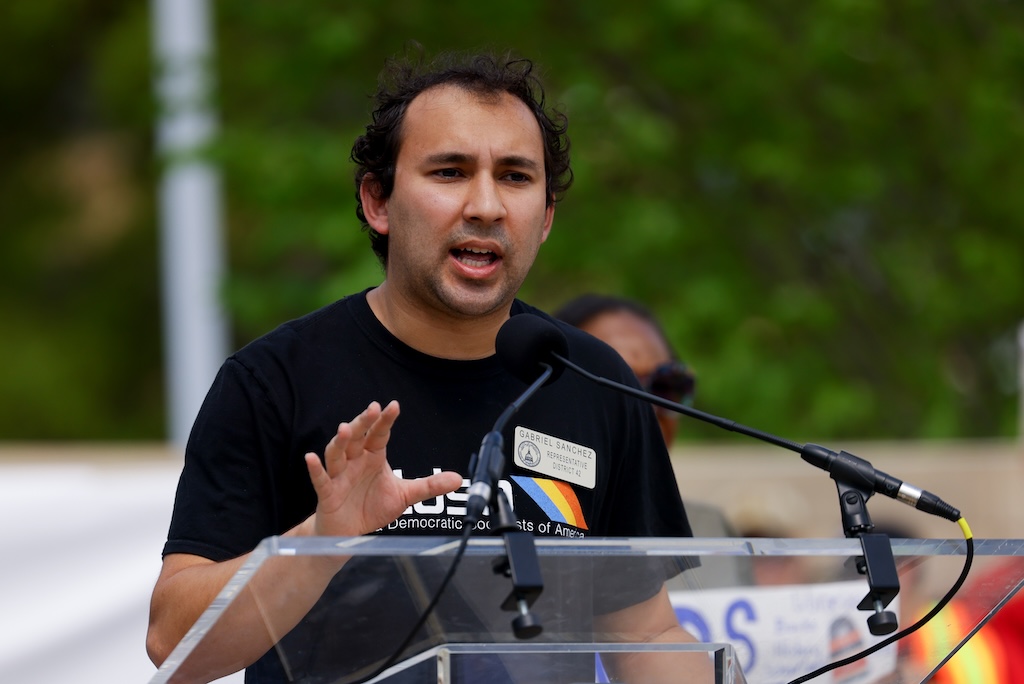
A new Georgia bill would create a single-payer health system covering every resident. Sponsor Gabriel Sanchez is reviving a fight that 1990s reformers waged in the same statehouse — and arguing that the South can lead the movement. (Carol Lee Rose / Getty Images for Community Change Action)
On a Sunday afternoon in April, Atlanta residents gathered at St Paul’s Episcopal Church to discuss their alarm about the American health care system and what they could do about it. Attendants ranged widely in age, but they were united in their concern over the ballooning costs of medical treatment and the increasing inadequacy of insurance coverage.
Dr Belinda McIntosh, a psychiatrist at Grady Hospital and a member of Georgians for a Universal Health Program, opened the forum by taking the collective temperature of the room to see how sick people were of the country’s inefficient and profit-driven health care system.
“Anyone in here maybe saw a doctor or wanted to see a doctor and had a difficult time figuring that out because of in-network restrictions?” asked McIntosh. A few people raised their hands.
“Anyone been staggered by a medical bill that really shocked you?” This time, more than half of the attendees raised their hands.
If crushing debt and preventable disease were the result of a profit-oriented health system, the health panelists then argued, the cure is improved and expanded Medicare for All. The demand took center stage during the era spanning Bernie Sanders’s two presidential campaigns. Since then, without a champion in the spotlight and with other pressing concerns posed by the second Trump administration, the movement for Medicare for All has been in retreat. The popularity of the demand itself, however, has gone nowhere amid surging health care costs and rising uninsurance rates.
In conversation with Jacobin, Georgia state representative Gabriel Sanchez raised a novel idea. What if the South led the demand for single payer by implementing it first on the state level?
“We have these for-profit institutions sucking the life out of people, frankly just to make an extra buck,” Sanchez said, “and we have yet to really address that issue head-on, and people are suffering because of it.”
Two years ago, Sanchez became the state’s first elected democratic socialist, representing District 42. In keeping with his platform of “health care and housing for all,” which helped propel Sanchez into office over his rival, a centrist Democrat, Sanchez recently submitted legislation to establish a state single-payer system. House Bill 1480 would create a publicly funded health insurance system that would provide universal, cradle-to-grave coverage for all Georgians.
Sanchez modeled his single-payer bill on Vermont Senator Bernie Sanders’s signature federal legislation as well as two prior proposals introduced in the Georgia legislature. The measure contains provisions for some of the unique challenges facing today’s seniors, women, and threatened minority groups; it would reinstate reproductive freedoms under Roe v. Wade, repeal state legislation designed to curtail transgender treatment, and cover vision and dental care, which are currently not included under traditional Medicare.
Few issues have the potential to unite Americans across the political spectrum like health care. Support for Medicare for All is boosting progressive candidates in 2026 Democratic primaries. Even Georgia’s former US representative Marjorie Taylor Greene, perhaps the most stalwart devotee of Donald Trump and the MAGA movement, decried skyrocketing insurance costs amid Republicans’ refusal to rein in unaccountable health care corporations fueling the national affordability crisis.
Georgia now joins other states like New York, California, Washington, and Colorado, each with its own single-payer bill and grassroots movements mobilized to secure its passage. But even among this small cohort, Georgia is unique. “It’s already bad enough on the national level even under Obamacare,” said Sanchez. But “in Georgia specifically, it’s even worse because we didn’t even expand Medicaid.”
No region of the country stands to benefit from Medicare for All more than the South. The legacy of Jim Crow racism, enduring class divisions, and low union density result in a region whose health outcomes continue to lag behind those of the majority of the country.
Seven of the ten states that refused to expand Medicaid under the Affordable Care Act are located in the South, leaving millions of people without health coverage. Georgia has the second-highest percentage of uninsured adults in the country, according to the Kaiser Family Foundation, with an estimated 1.2 million people without coverage.
In 2023, Republican officials in Georgia rolled out a means-tested Medicaid expansion program with work requirements. Unsurprisingly, Georgia Pathways has so far only enrolled an abysmal 3,500 Georgians out of an expected 25,028. A damning report from the US Government Accountability Office blasted Georgia Pathways for failing to deliver on its promises to insure low-income Georgians despite spending more on administrative tasks.
Sanchez’s legislative proposal, meanwhile, establishes health care as a human right, not a privilege. All Georgia residents would receive health coverage regardless of age, income, employment, or citizenship status.
The Southern Strategy
The freshman legislator walks a path forged by past health reformers who waged an unlikely yet valiant campaign to demand universal health care in Georgia during the 1990s. Back then, Rita Valenti, a registered nurse turned Georgia state representative, joined physicians, nurses, members of the disability community, and other health advocates to form Georgians for a Commonsense Health Plan to lead the effort.
Valenti served in the Georgia House of Representatives when doctors and researchers David Himmelstein and Steffie Woolhandler published their influential New England Journal of Medicine article outlining a national health program in the United States.
The 1989 article inspired a groundswell of grassroots organizing activity around the country. Labor unions working alongside organizations such as Physicians for a National Health Program (PNHP), the Universal Health Care Action Network, and others formed the foundation of a renewed movement to pass comprehensive national health reform. Similarly inspired by the call for change, Valenti and other advocates agitated for change at the state level.
In 1992, Valenti introduced HB 1531, the Common Sense Health Plan, a proposal to create a universal, single-payer program in Georgia. Like the Sanchez plan, Valenti called for a board of governors to administer the program and contain costs by reducing administrative waste and prioritizing preventive services.
At that time, health justice organizers hoped to pressure the nascent Clinton administration into advancing a national health program. Enthusiasm for a systematic overhaul on the national level prompted members of the editorial board at the Atlanta Journal-Constitution (AJC), the state paper of record, to throw their support behind Valenti’s state proposal.
“The proposal is not given much chance in this session of the Legislature, despite the fact that ‘health care reform’ has become one of the buzz words of this political season,” wrote the AJC editorial board. “Politicians are sure the voters want it, but they are nervous about giving it to them.”
As predicted, Georgia politicians refused to take up health reform, and the resolution failed in committee. If the Georgia campaign had only been predicated on passing the legislation, it would have been a waste of time and energy.
“We knew that [the Georgia resolution] wasn’t gonna pass,” recalled Valenti. “But what the resolution did was frame the kind of public insurance that we should have and how it should be used, and how it could be directed, and what global budgeting was . . . there would be no co-pays, no deductibles, all of that.”
Valenti used the resolution as an opportunity to educate Georgians about single-payer health care and the need to build upon the grassroots, multiracial movement that secured Medicare and Medicaid during the 1960s.
The demand for comprehensive health reform in Georgia not only elicited positive media coverage but also raised public awareness by underscoring the radical potential for expanding health coverage to all residents. Polls showed 65 percent of Georgians supported expanding health insurance. To put this into context, a recent poll from Data for Progress found comparable support for Medicare for All nationwide.
Netting a similarly enthusiastic response in 1992 in the heart of the conservative South underscores the broad appeal of universal social programs like Medicare for All. Valenti believes even more Georgians would be supportive of comprehensive health reform today.
“More people, especially young folks, are seeing that capitalism does not work for them,” she said.
The history of the single-payer movement shows that merely having a robust policy proposal is not enough to overcome the well-financed forces that stand to lose millions in revenue if comprehensive reform passes and are already mobilized to defend the status quo. Just like today, simply having a majority of public support for your cause is not enough to win, as Valenti and other health advocates learned in the 1990s, when Bill Clinton’s health proposal collapsed amid political compromise, special-interest lobbying, and right-wing attacks.
“I think as we became more politically sophisticated,” Valenti said, “I think we realized that single payer really requires the end of the private insurance industry and that’s not going to happen through a legislative process.”
Sanchez plans to reintroduce his Medicare for All bill during the next legislative session, having received positive feedback from constituents and fellow Democrats. State Representative Sam Park, the minority whip of the Georgia House Democratic Caucus, was among the bill’s five cosponsors. That number could grow, Sanchez said, if Democrats can chip away at the Republican stranglehold over the state legislature in 2026.
Still, Sanchez acknowledged the need to organize with groups like Georgians for a Universal Health Program, a local chapter of PNHP, to rebuff assaults by special interest groups.
“We have to combat [money in politics] with the power of the people and putting the pressure on them to do what is right and in this case passing Medicare for All,” Sanchez said.