A Global Socialism Built on Shared Prosperity
Writing in Jacobin, Thomas Piketty and his fellow Global Justice Report coordinators argue that every country can reach today’s richest living standards by 2100, with rewards for workers in the Global North too.
Thomas Piketty and colleagues reply to a Jacobin critique of the Global Justice Report, arguing that nearly 90% of humanity can double its income while working half as many hours. (Daniel Perron / Hans Lucas via AFP / Getty Images)
All countries in the world can converge to the income levels of today’s richest regions by 2100 while staying within the 2 degrees Celsius climate target. That is the central finding of the Global Justice Report, published by the World Inequality Lab in June 2026 and drawing on the work of more than two hundred researchers. It holds under three conditions: a rapid energy transition; a shift in what economies produce (shorter working hours and less material consumption in rich countries); and substantial redistribution within and between countries. None of these conditions is enough on its own.
Virgilio Urbina Lazardi’s recent review of the report, published in Jacobin, argues that this scenario offers too little to workers in the Global North. But it leaves a fundamental question unanswered: Who or what pays for even faster growth in the North? The implicit answer is the Global South, the climate, or both.
An internationalist working-class movement can hardly accept this trade-off. The Global Justice Report proposes another path. It brings development and the ecological crisis into a single framework, combining four dimensions that today’s debates usually treat separately: a radical transformation of energy systems, substantial shifts in work time and consumption patterns, global redistribution, and a deep reform of the international financial and economic order. Unlike most climate scenarios, including those of the Intergovernmental Panel on Climate Change (IPCC), it places inequality, class structure, and sufficiency at the center of the analysis.
The challenges of this century are global. Today the average income in sub-Saharan Africa is one-sixteenth of that in North America, and the world’s richest eighty thousand individuals own three times as much wealth as the poorest half of humanity. At the same time, current policies put the world on course for potentially more than 4 degrees Celsius of warming by 2100. Any serious discussion of future growth trajectories and the climate crisis must therefore acknowledge the legitimate demand of countries in the Global South to raise their living standards to the level of today’s rich countries.
In developing a new progressive vision, the report draws inspiration from two sources. The first is the great social movements of the twentieth century, which, through collective mobilization and legislation, cut working hours by more than a third, strengthened workers’ rights, and made progressive taxation a core pillar of modern welfare states. The second is today’s internationalist initiatives from the Global South: the African Group’s push for a United Nations tax convention, the Barbados-led Bridgetown Initiative to reform the international financial order, and the G20 initiatives of Brazil and South Africa on international taxation and global inequality. Building on these proposals, the report aims to offer a positive vision of the future from the left, in sharp contrast to the techno-autocratic narratives that dominate today’s public debate.
Putting Class Structure at the Center of Climate Scenarios
In the report’s central scenario of “Sustainable Convergence,” average monthly income per person converges to €5,000 in every country by 2100. This implies annual growth rates of 3–4 percent in today’s poorest regions and close to zero in the richest, as convergence at higher levels would likely exceed the 2 degrees Celsius carbon budget.
Such a trajectory is possible only if the transformation rests simultaneously on three pillars. The first is the rapid — and unprecedented — decarbonization of energy systems. The second is a major shift toward sufficiency: a sharp cut in working hours to shrink the material footprint, along with profound changes in consumption patterns and diets, land use, and forest cover. The third is a drastic reduction in inequality of income, wealth, and power, both between and within countries.
This transition requires massive investment in sustainable development, including education, health, and low-carbon energy systems. As part of a new international order, the report proposes a Global Justice Fund, financed by progressive taxes on income and wealth, that would raise around 10 percent of world GDP per year over the coming decades. The fund is a key building block of a broader reform of the international financial and trade system, which would abolish the current plutocratic voting rules in international organizations such as the International Monetary Fund and the World Bank, where voting power depends largely on economic size and gives rich countries outsize influence.
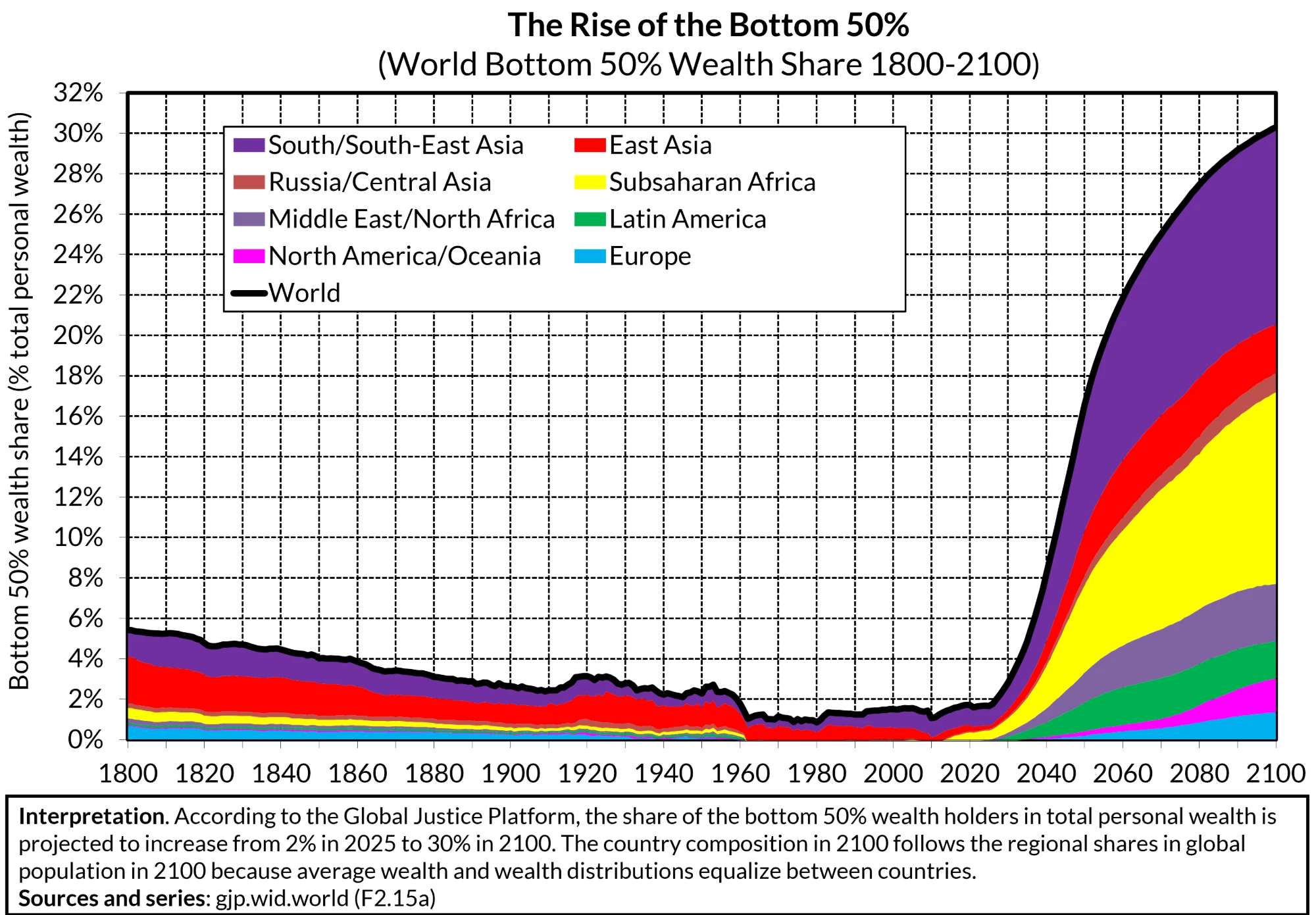
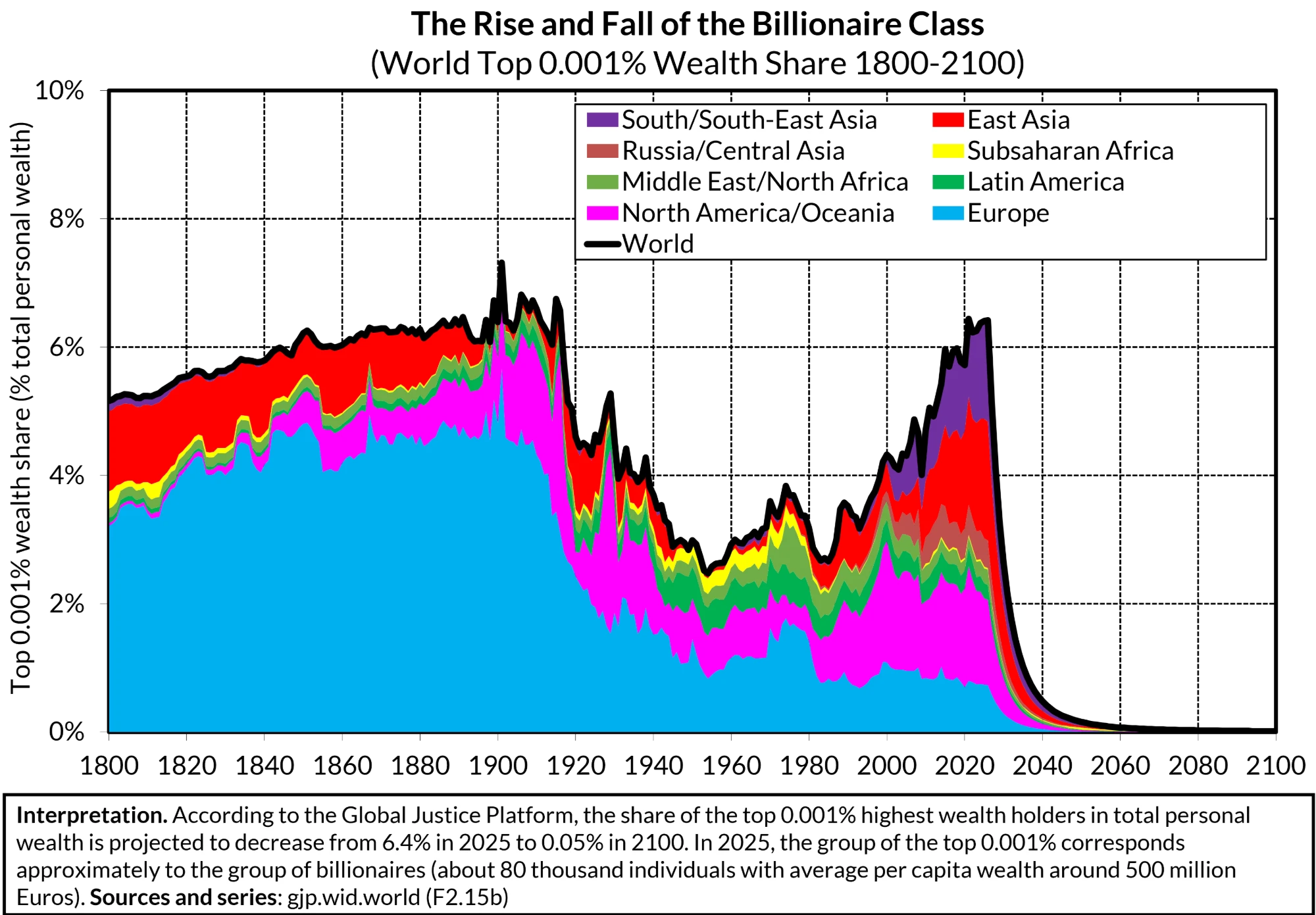
The result is a profound change in the global social structure. The share of world wealth owned by the bottom half rises from 2 percent to 30 percent, while the billionaire class’s share falls from about 6 percent to 0.05 percent. Nearly 90 percent of the world’s population doubles its income while working roughly half as many hours as today. Warming reaches 1.8 degrees Celsius by 2100, compared with more than 4 degrees Celsius if current policy trends continue.
The projected rise of the bottom 50 percent wealth share from about 2 percent today to over 30 percent represents a particularly striking shift. Together with the collapse of top wealth shares, this would amount to a major transformation of the social structure and power relations. This is especially true for today’s most unequal countries, such as the United States, where the working class would benefit enormously.
Do We Project Too Little Monetary Income Growth in the Global North?
Urbina Lazardi’s core objection is that doubling the average income of the bottom 80–90 percent in rich countries between 2026 and 2100 is far too little for the North’s working class to accept. This critique overlooks three fundamental points. First, projecting faster growth in the North comes at a price: abandoning the 2 degrees Celsius target, abandoning the South’s catch-up, or relying on wishful techno-optimism about emission decoupling. Second, income is not the only measure of well-being: workers in the North would also gain more leisure time, more equal societies, better public services, and a habitable planet. Third, given the North’s historical responsibility for climate change and colonial damages, our convergence plan may ask too little of rich countries, not too much.
More Income for the Global North?
Whether the working class in the Global North could enjoy higher income growth rates depends on the answers to two questions: how large the world economy can become, and how its income is shared.
The first question is whether a larger global economy is compatible with planetary boundaries. In our core scenario, all countries converge to an average per capita income of €60,000 a year (€5,000 a month), and the world economy grows fourfold by 2100. With seven of nine planetary boundaries already breached today, this growth must go hand in hand with a profound transformation that makes production far less emission-intensive, wasteful, and extractive. Our modeling focuses on greenhouse gases, with the aim of limiting warming to below 2 degrees Celsius. This lies at the upper end of the Paris Agreement’s goal of keeping warming “well below 2 degrees Celsius” while pursuing efforts to limit it to 1.5 degrees Celsius, a goal set because even 2 degrees Celsius of warming is expected to cause severe climate impacts and great human suffering.
The Jacobin review suggests that we are too pessimistic about technology and underestimate future gains in reducing emissions per unit of output, so-called decoupling. Yet our Sustainable Convergence scenario relies on the most ambitious decarbonization scenario of the International Energy Agency’s World Energy Outlook 2025, and our decoupling rates are similar to those of the most optimistic Shared Socioeconomic Pathways (SSPs). For the world economy, we model annual decoupling rates of more than 6 percent over the next twenty-five years and even faster decoupling after 2050. In recent years, the world economy decoupled at less than 2 percent a year, so the pace would have to triple almost immediately. We consider this barely feasible under the proposed new international order in which global progressive taxation raises around 3–4 percent of world GDP each year for the necessary climate investment. Even so, €60,000 may prove too high once other planetary boundaries, such as critical-mineral extraction and fresh water use, are considered. We therefore see no credible path to even faster global growth without unrealistic techno-optimism.
Once the size of the economy compatible with 2 degrees Celsius is set, the second question is how its income is shared. If the Global North grows faster, the Global South has less environmental space. The resulting persistent inequality between regions beyond 2100 is built into most climate scenarios in use today: even in the most egalitarian SSP (SSP1) used by the IPCC, the richest regions remain three times richer than the poorest in 2100. But we are convinced that any vision of a desirable global future spanning several generations must take seriously the ambition of the Global South to catch up. Our scenario therefore starts from the principle of convergence. Given convergence between countries, the working class in the North could gain more only through even more radical redistribution within countries. However, our scenario is already very egalitarian: the income ratio between the richest and poorest falls to five-to-one, far below the eleven-to-one of the Nordic European social democracies in the 1970s, which were among the most equal societies in Western history.
Calls for more income growth for workers in the North must therefore spell out what they imply for low-income countries, for the climate, and for assumptions about technology. Moreover, as we argue next, our vision is desirable for the workers of the North too, once we look at well-being rather than income alone.
Well-Being Is More Than Income
If faster growth in the North is incompatible with global convergence within 2 degrees Celsius, the question becomes whether the gains our scenario does offer are really as meager as the review suggests. We do not think they are. In purely monetary terms, the gains for most workers in rich countries are modest. A doubling of income over seventy-five years corresponds to annual growth of just under 1 percent. That is roughly the pace at which median incomes grew during the neoliberal period. However, that growth came at great environmental cost, and a narrow focus on income leaves out much of what makes life better or worse.
The first additional gain, compared with growth-focused scenarios, is free time. In our scenario, the doubling of income comes with a sharp decline in working hours, so income per hour worked roughly triples. That is the opposite of the neoliberal period, when global working hours largely stopped falling after their steady decline during the rise of the welfare state before 1970. It would be a return to the long historical trend: societies have commonly used a large share of their productivity gains to work less rather than to consume more, and shorter workweeks, free weekends, and more holidays were some of the labor movement’s greatest victories. More free time means more time for family, friends, culture, and political life, and it makes a fairer division of domestic work between women and men easier to achieve.
The second gain is a healthier planet. Keeping warming below 2 degrees Celsius, rather than somewhere around 4 degrees Celsius under high-growth and slow-decarbonization scenarios, means cleaner air, more stable harvests, restored forests, and far fewer heat waves, floods, and forced displacements that would otherwise become a regular part of life in the North as well as the South. Workers and poorer households, who have the fewest means to protect themselves from such shocks, stand to gain the most.
The third gain comes from lower inequality itself. A large body of research suggests that more equal societies tend to do better on health, life expectancy, social and economic mobility, trust, and social cohesion, and that status anxiety and the sense of falling behind weigh less heavily on people’s lives. What matters for prosperity is not only how much people earn but also how unequal their incomes are.
Historical Responsibility and the Scale and Speed of Reform
The core scenario of the Global Justice Platform rests on a universalist principle: convergence of all countries to equal living standards by 2100. Yet we firmly believe that such a platform must also take seriously the historical responsibility for colonial and climate damages, which adds another powerful reason to support the Global South.
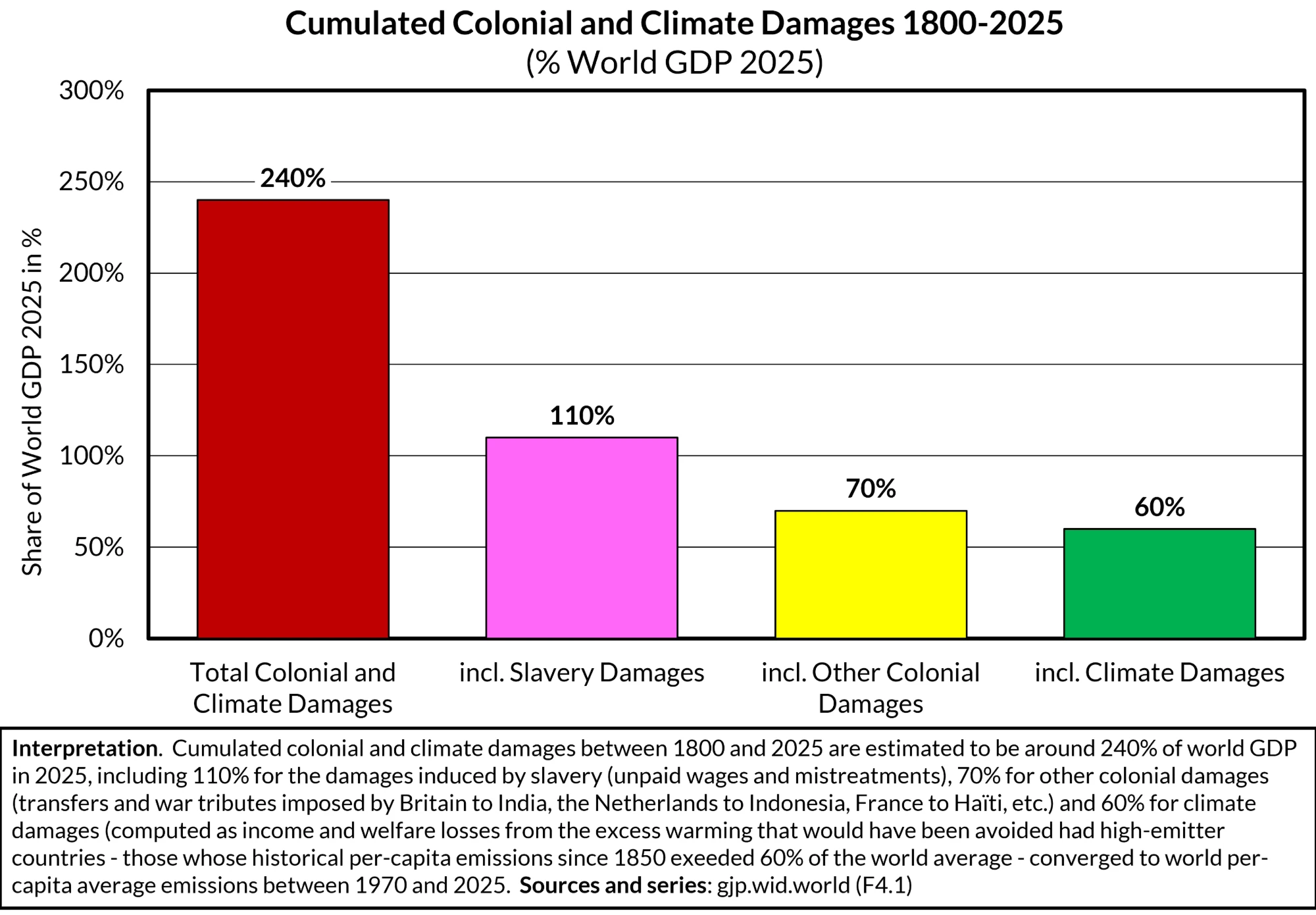
What matters most for global warming is the historical stock of carbon emissions, and the Global North has already used up far more than its fair share of the global carbon budget. Equally important are the colonial damages imposed on large parts of the Global South, including (but certainly not limited to) the costs of the transatlantic slave trade, fiscal transfers such as the “home charges” imposed on India by Britain, and the debts and indemnities imposed by colonial powers, for example by the Netherlands on Indonesia or by France on Haiti. These historical climate and colonial damages are very large: conservative estimates presented in the report put them at more than 200 percent of today’s world GDP. The argument that this is not the responsibility of today’s generations is unconvincing: people in rich countries today inherit the wealth, infrastructure, and education that historical emissions and colonial extraction made possible.
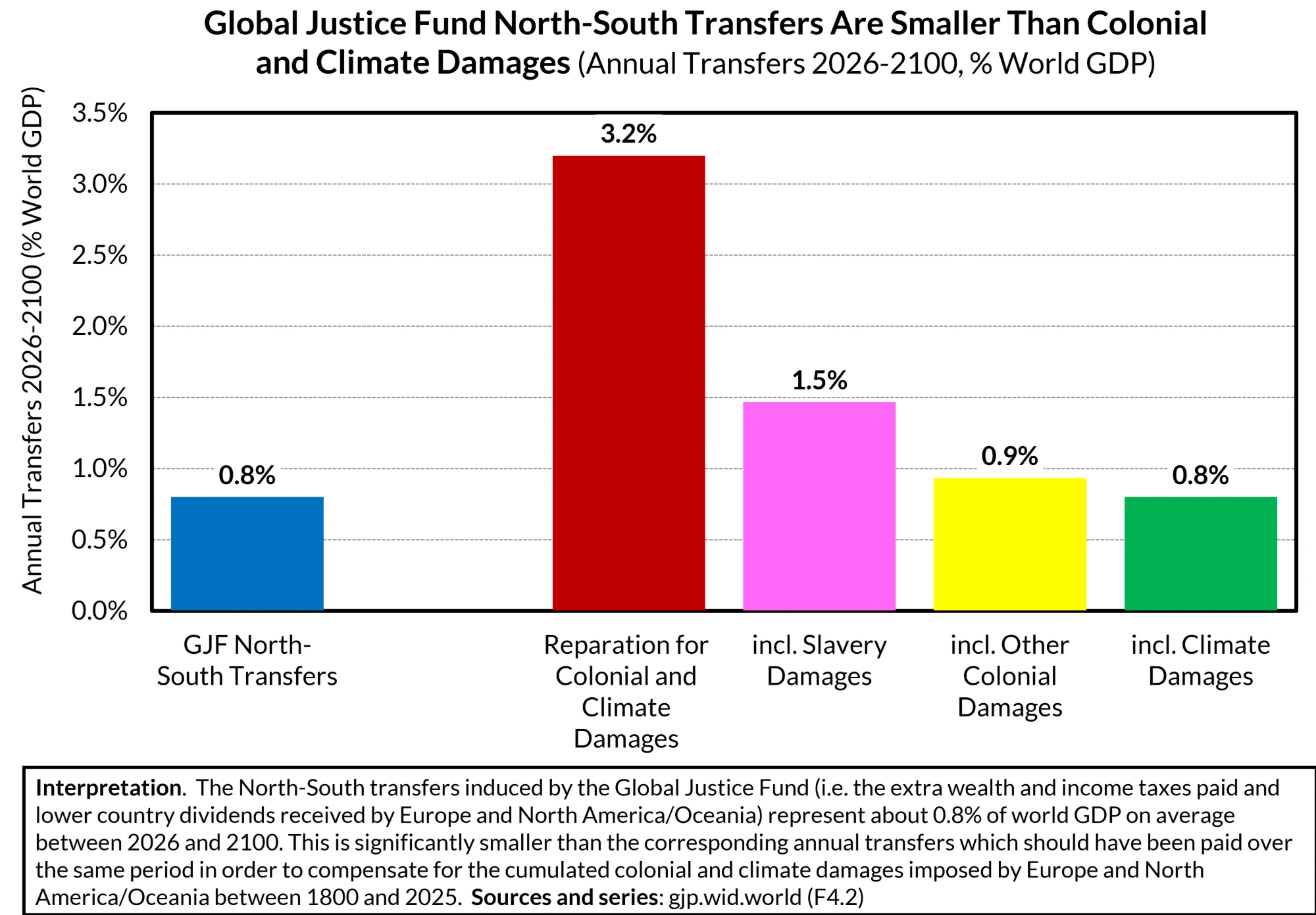
If anything, once we take these historical responsibilities into account, the Global Justice Platform does not go far enough. The notion of justice built into the platform is a “universalist, forward-looking” vision. Global income and wealth taxes are defined based on one’s position in the global income and wealth distributions, not on place of birth or residence. Similarly, country dividends from the Global Justice Fund are to be distributed on an equal per capita basis to all countries, implying equal per capita dividends for all global citizens. We chose this approach because a platform based on historical compensation would require a shared narrative about the past between North and South, which does not yet exist. Nonetheless, given that the vast majority of the ultrawealthy and rich live in countries of the Global North, the global wealth and income taxes would result in North-to-South transfers of about 0.8 percent of world GDP a year over 2026–2100. But these transfers are still nowhere near the 3.2 percent of world GDP that would be needed to fully compensate for our estimate of historical colonial and climate damages, which would require a Global Justice Fund four times larger than the one we propose.
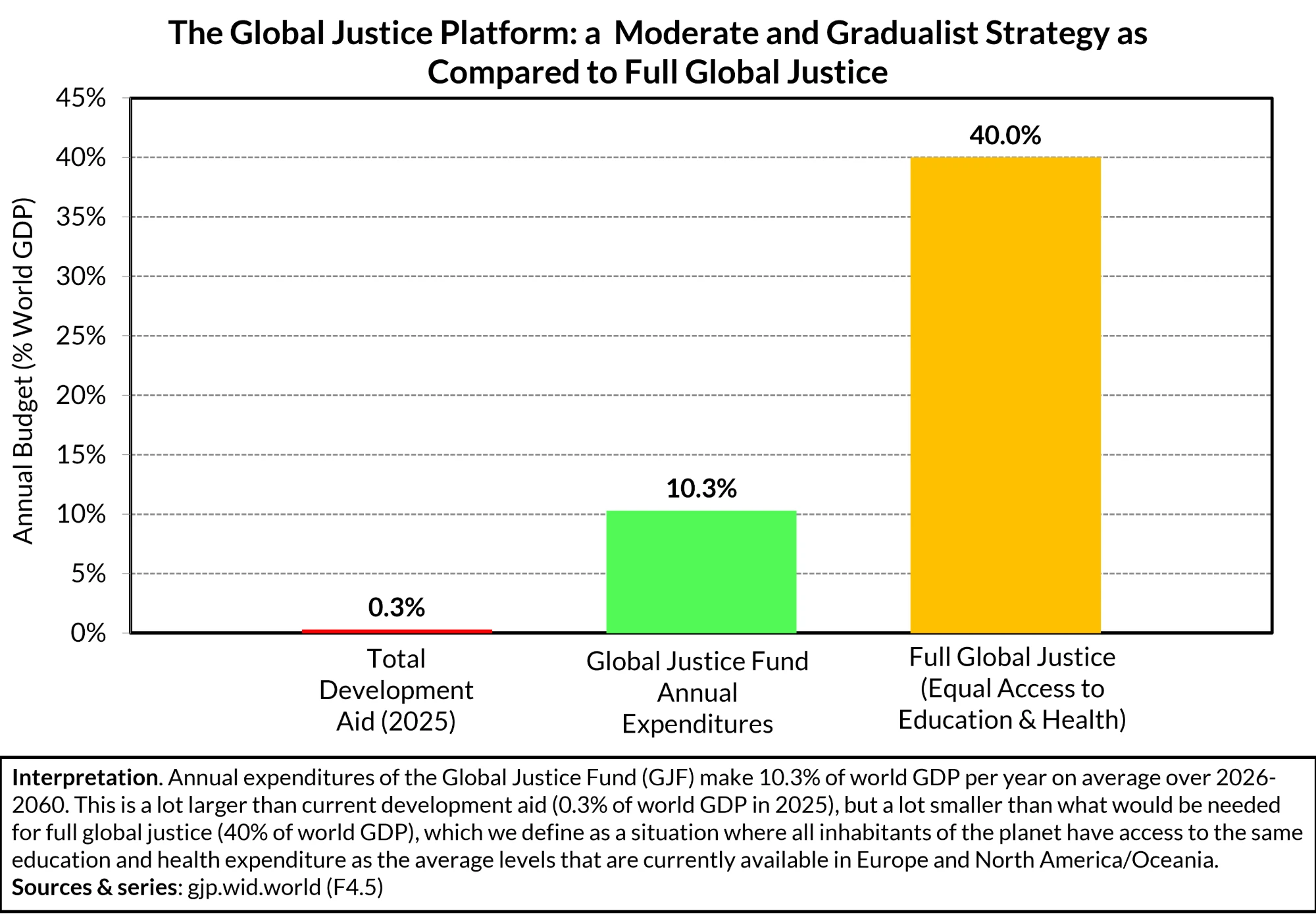
We reach a similar conclusion if we assess the scale and speed of the Global Justice Platform from a different perspective. In particular, even under our benchmark scenario, it would take the entire rest of the century to equalize per capita education and health expenditures across regions. In other words, we will have to wait another seventy-five years before equality of opportunity with regard to health and education access can be achieved. A more ambitious scenario would involve faster implementation of the principle of equal access to education and health. This would require an annual budget that is up to four times larger than the one proposed in our benchmark scenario (about 40 percent of world GDP rather than 10 percent). Therefore, from at least two perspectives, some readers will find the Global Justice Platform too gradualist or moderate. We recognize this limitation of the platform and hence strongly support all strategies to scale up the size and scope of the Global Justice Fund and to complement the platform with other policies, including country-specific transfers and reparations.
Toward Postcolonial and Ecological Democratic Socialism
Let us conclude by stressing that the Global Justice Report has limitations and that we very much welcome all contributions and suggestions that could help us improve this work. In particular, our description of what living standards could look like in the future needs improvement. It is arguably more precise than that of existing climate scenarios (thanks to more detailed sectoral decompositions and inequality analysis), but it is still far too crude. We use eight core sectors to decompose economic activity, together with up to fifteen energy subsectors. In the future, we would like to develop a more disaggregated analysis, for instance to explore in greater detail the possible transformations of consumption and production patterns within food/agriculture, manufacturing, construction, and so on. In our view, this disaggregation is crucial, especially to move away from one-dimensional income categories and focus on actual material indicators of well-being.
Next, it is critical to do more work on the class alliances, political coalitions, and collective organizations that could support the “Sustainable Convergence” trajectory. The basic tenet of the Global Justice Platform is to reconcile the interests of the working classes of the North and the South. It is clear, however, that such a perspective requires much more collective work and strategic thinking — in particular regarding the relationship between this platform and the agenda for democratic socialism.
In the current version of the Global Justice Platform, we mostly emphasize the role of the Global Justice Fund (financed by sharply progressive wealth and income taxation) and the democratization of the international order (including the end of GDP-based plutocratic voting rights in international organizations and the creation of a UN currency). We also make clear that our own preference would be to combine these institutional transformations with an ambitious reset of the property regime, including a radical extension of workers’ rights and the rise of worker-managed firms, but we do not make it a precondition. One option would be to give workers’ representatives 50 percent of the voting rights on the boards of all companies (small or large, and independently of any equity ownership by employees), together with a 10 percent cap on the voting rights of individual shareholders in large corporations (with a gradual cap for smaller firms).1 There are many other possible options that should be discussed, including the use of Meidner-type labor-managed funds to gradually transform capitalist firms into worker-managed entities.2
Generally speaking, our own preference would be to move as far and fast as possible toward worker-managed organizations and participatory governance, within a broader process of decommodifying the economy. But this is also an area where much can be learned from the diversity of countries’ policy experiments, and there is little reason to restrict in advance the directions this collective learning process should take. There are many possible roads toward democratic socialism, and there are also some countries and actors who do not recognize themselves in this label (at least for the time being) but who might nevertheless be ready to participate in the Global Justice Platform (or a similar platform). These are important strategic issues that deserve extensive discussion.
In the end, the central message of the Global Justice Report is a positive one. We find that it is possible to combine shared prosperity for all with planetary habitability. But this would require a shift away from material consumption, a reduction in working hours, rapid decarbonization of energy systems, and a sharp compression of inequality within countries. The report puts forward a new vision for global progress in the twenty-first century, grounding human development and equality in planetary habitability. Yet there is a wide range of possible futures, and with the climate crisis looming over our heads, it is more urgent than ever to democratically debate the kind of shared future we collectively aspire to.