Life Beneath the Melting Glaciers
Remote mountain communities in northern Pakistan have contributed almost nothing to global warming, yet glacial floods are sweeping away their homes. Jacobin traveled to talk to the families who are rebuilding with little help from the state.
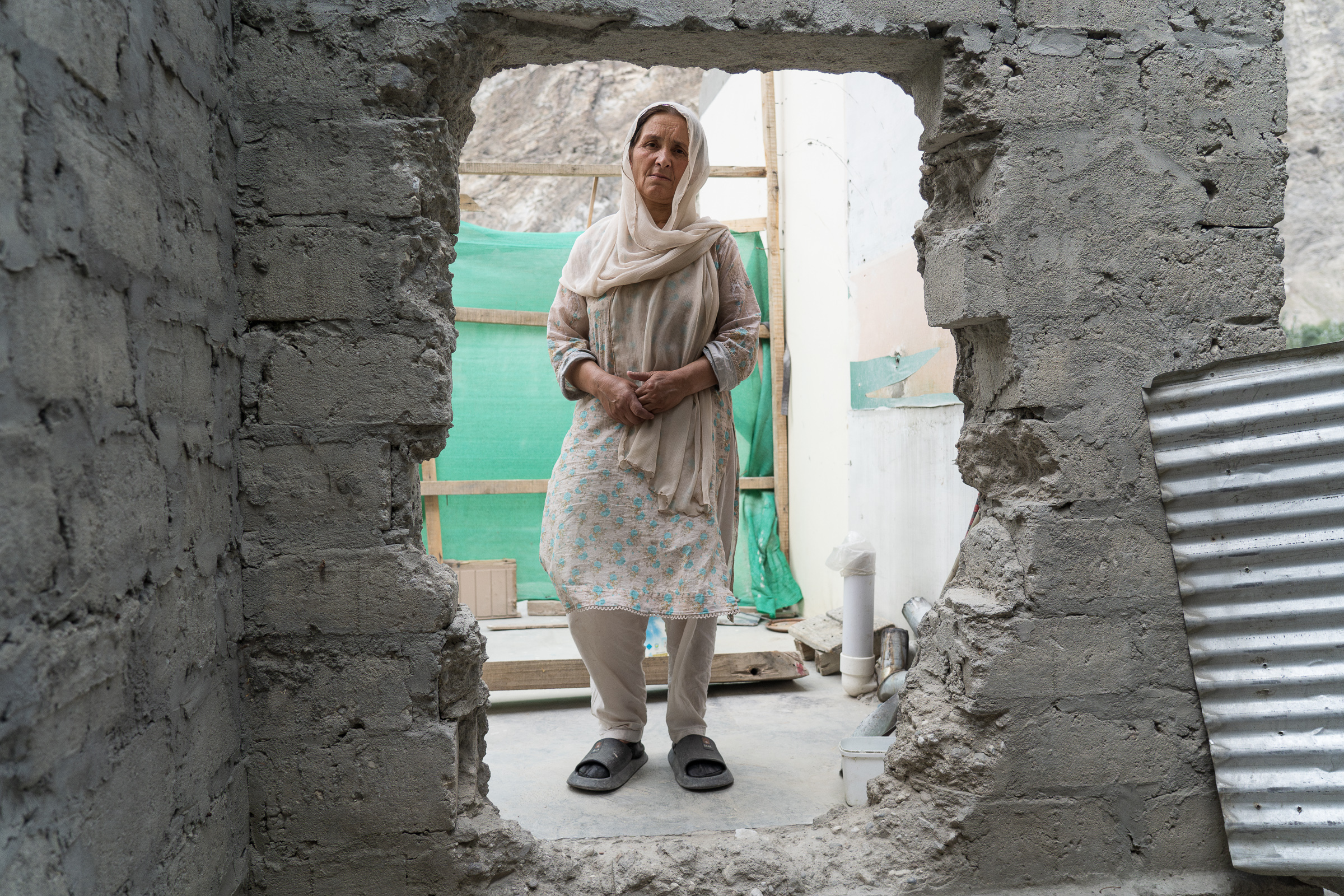
As glaciers shrink worldwide, our correspondent reports from Pakistan’s Gilgit-Baltistan, where glacial foods have devastated villages and livelihoods. (Jaclynn Ashly / Jacobin)
Bulbul Kaie remembers when summer in Hassanabad revolved around a stream.
The village lies in the mountains of Gilgit-Baltistan, a disputed territory in northern Pakistan bordering China, Afghanistan, and Indian-administered Kashmir. Kaie’s family would carry chairs down to the stream fed by meltwater from the glaciers above, where a cold breeze rose from the water. They would spend afternoons on its bank among orchards heavy with apricots and cherries.
“We would sit together, drink tea, and enjoy the sound of the stream until it got dark,” recounts the mother of four. “We used to look forward to summer. The sound of the water made us feel calm.”
Now summer brings dread. “We fear what will happen each year,” the fifty-year-old says.
Pakistan has more than thirteen thousand glaciers, one of the largest concentrations outside the polar regions, many of them in Gilgit-Baltistan. As climate change drives temperatures higher in these mountains, where warming is outpacing the global average, the ice melts faster and rain falls harder and less predictably. Cloudbursts — intense, localized downpours that experts say were virtually unknown here until recently — can now destroy a village in an afternoon.
Last year, Hassanabad was among dozens of villages across Gilgit-Baltistan hit by one of the region’s deadliest flood seasons in years. At least seventy-two people died, and more than a thousand homes were destroyed or damaged.
The floods destroyed half of Kaie’s home. She has yet to rebuild. “I’m only staying here because I have no resources to go elsewhere,” she says, her voice breaking. “I fear for my children’s lives and mental health.”
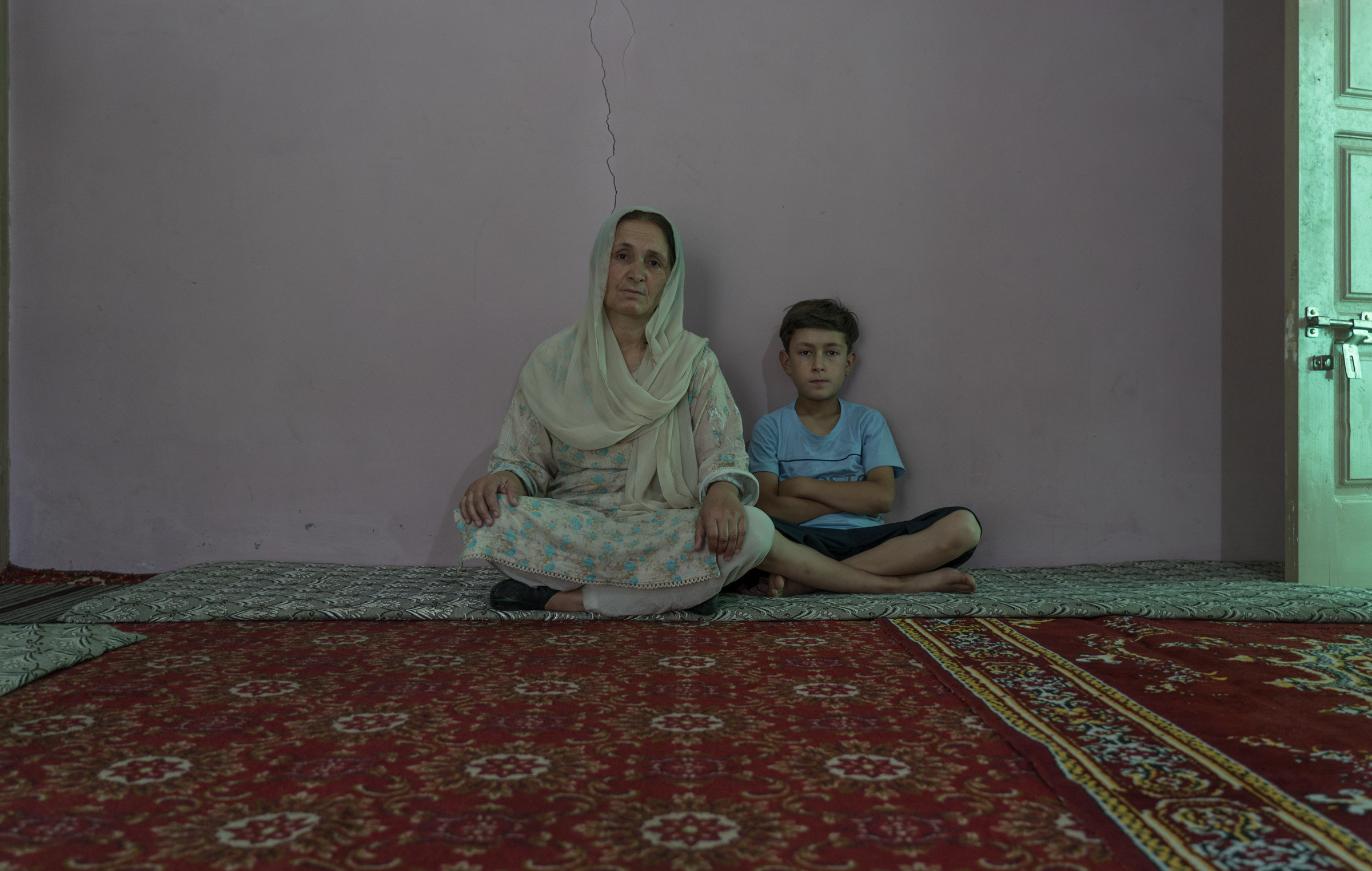
Kaie is one of thousands still trying to recover. Some live in tents or cracked houses they fear could collapse. Others have been moved onto bare government plots with no land to farm and no way to earn. Few can afford to start again, and the next disaster is rarely more than a season away.
The people living among these glaciers bear almost no responsibility for the greenhouse gas emissions driving global warming; Pakistan itself accounts for about 1 percent of global emissions. Yet it is among the countries most affected by extreme weather, and in its remote mountain communities, homes are being washed away, farmland is disappearing, and livelihoods are collapsing.
At the Glaciers’ Mercy
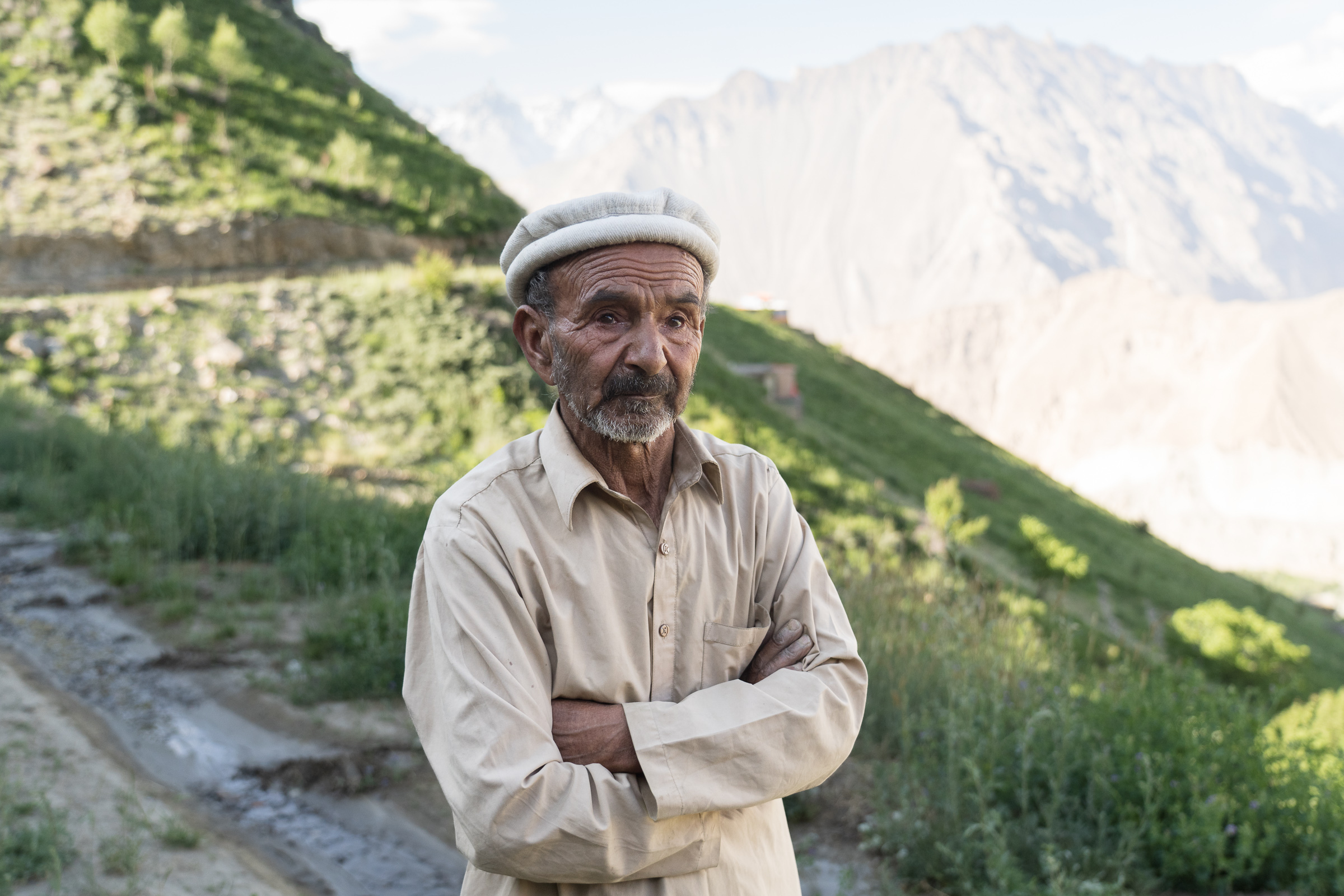
Behram Shah gathers cherries from a tree outside his Hassanabad home and carries them to the table in a woven basket. “We rely on the glaciers for everything,” says the seventy-six-year-old, who has lost about nine acres to floods in the past decade. “Our livelihoods, and even our drinking water, depend on them. We are completely at the mercy of these glaciers.”
Every spring, before the summer melt, villagers would gather at the watercourses to pray over the year’s flow, asking God for protection and enough water for the months ahead, Shah recounts. These days, few still make the journey.
“We used to see the glaciers as the source of our lives,” Shah says. “Now, because of the floods, we associate them with destruction.”
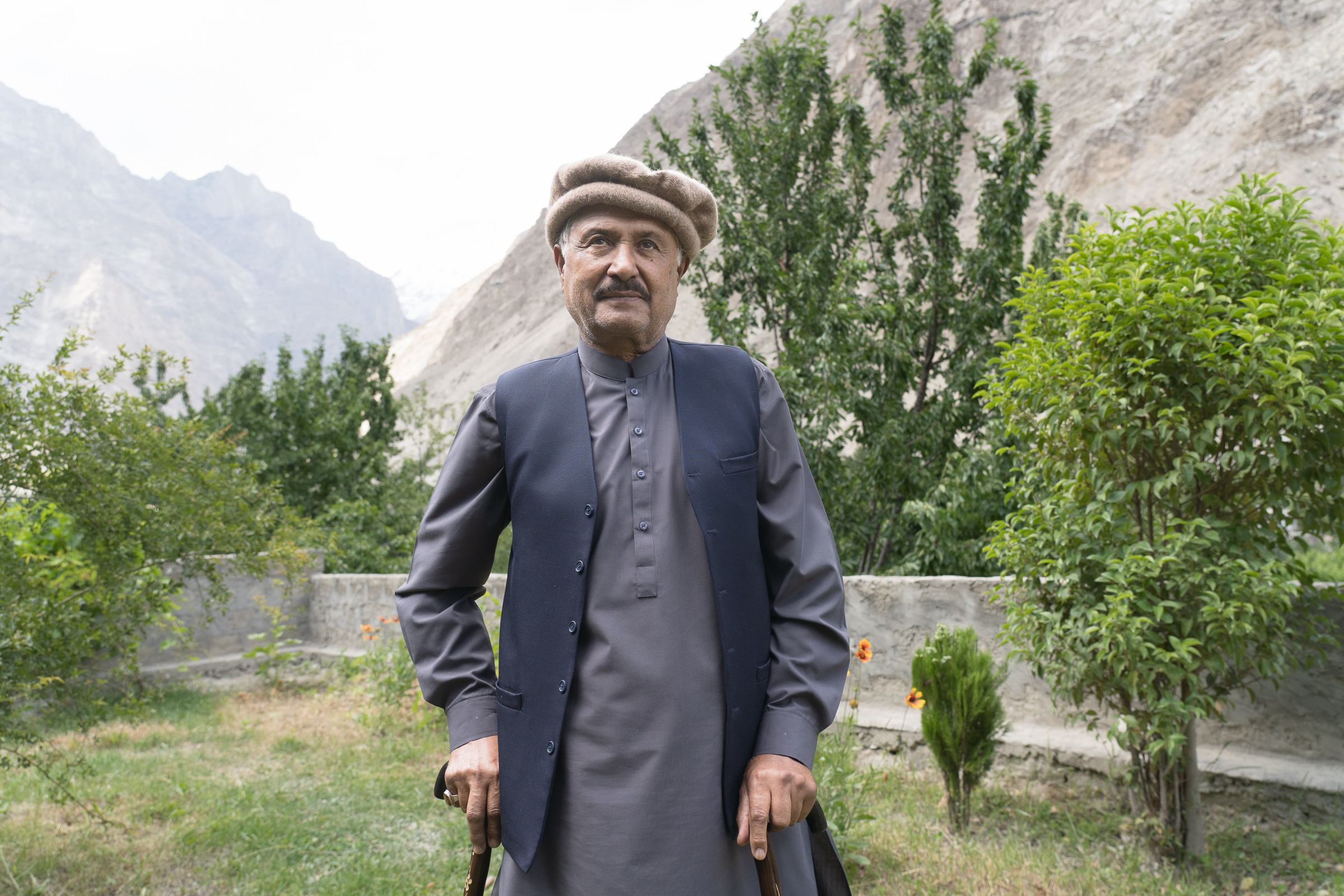
“The cycles that kept us in balance for centuries are being disrupted,” he adds. “All we can do now is pray and leave everything to God.”
Hassanabad sits in the Hunza Valley, in the Karakoram — one of four mountain ranges that meet in Gilgit-Baltistan and contain some of the world’s highest peaks. Its roughly 175 households are scattered across the mountainous terrain, clustered on either side of the stream and up the slopes. Most residents are Ismaili Muslims who farm fields and orchards passed down through generations.
Three miles above the village, the Shisper and Muchuhar glaciers, once branches of a single glacier, eventually drain into the same stream, which runs about four miles down the valley to join the Hunza River. Their meltwater feeds the irrigation channels that keep Hassanabad alive.
In 2018, the Shisper began to surge, exhibiting behavior of a type of glacier that can sit almost motionless for decades or centuries before suddenly lurching forward. It advanced nearly a mile, at one point moving nearly sixty feet a day, before pushing across the ravine and damming the stream draining the Muchuhar.
The lake that formed behind the ice burst four times in four years, sending floodwater down the valley that scoured the ground along the stream’s banks. The last, in 2022, swept away the Karakoram Highway Bridge, cutting Hunza off from the rest of the country for two weeks.
By last summer, the danger was supposed to have passed. The ice still lay across the ravine, says Sher Muhammad, a cryosphere scientist at the International Centre for Integrated Mountain Development, but a wide tunnel had opened through it and water was flowing freely.
Then the heat came. One town in southern Gilgit-Baltistan hit 119 degrees Fahrenheit (48.3 degrees Celsius), its highest temperature in nearly three decades. Across the region, streams were already running high as unusually warm conditions accelerated snow and glacier melt.
Chunks of ice broke off and fell into the stream, blocking the flow, Muhammad says. Water accumulated behind the ice blockages until they failed, releasing the impound water downstream. It happened twice, in July and August, damaging houses and farmland, ripping out a section of the Karakoram Highway, and cutting the water supply to Aliabad, Hunza’s main commercial town, and nearby villages.
Over the years, dozens of homes in Hassanabad have been destroyed or dismantled before the floods could reach them.
The Floodwater Threat
What came before the floods, Kaie says, was not a roar. It was a silence.
“It’s very ominous,” she says, sitting on the floor of her home, cracks running down the walls. “The entire flow of water suddenly feels like it stops. And there’s silence for about half an hour.”
In those minutes, the family would run to the bank to see what was coming. If the water looked dangerous, Kaie would send the children uphill to a relative’s house and go back for whatever she could carry.
“When the floodwater comes, it is so strong,” she says. “It carries boulders the size of houses. If it reaches your home, it will pull it from its foundations.”
They have lived this way for years, fleeing when the water rises, returning when it drops. When I visited in August, the family had already fled several times that summer. Their fridge and other belongings were still at a relative’s house up the hill.
Last year’s floods were the worst this part of Hassanabad had seen, residents say. They tore through the orchards between Kaie’s house and the stream and destroyed half the home she and her husband had spent seven years building. The couple had sold most of their farmland to afford it.
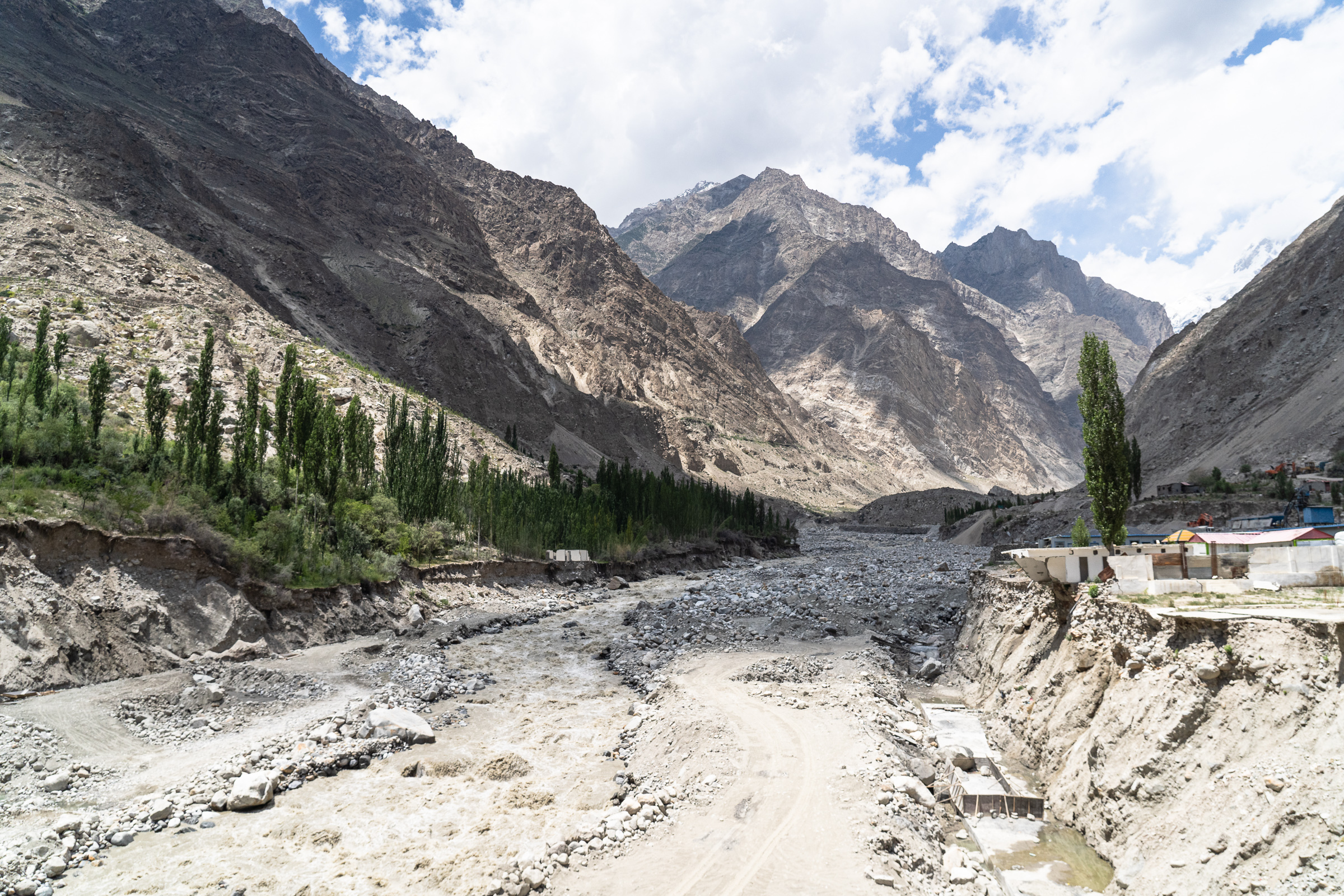
She scrolls through her phone to a photograph from before: rows of fruit trees running down to the water. “It was a very beautiful home,” she says, holding up the screen. Outside, the same ground is dry and stripped bare.
Later, the highway was rebuilt. It had always run a couple of hundred feet below the houses until last summer’s flood swept away part of it. The rebuilt section was laid higher up the slope, directly in front of Kaie’s house.
Now cargo trucks hauling goods between Pakistan and China pass a few feet from her door. They shake the walls, rattle the windows, and widen the cracks. Dust hangs in the air.
Her twelve-year-old son sometimes wakes at night, hears the trucks, and thinks the flood has come back, she says. He runs outside, and the family has to find him in the dark.
“This constant uncertainty is causing a lot of psychological issues for my children,” Kaie tells me, her son sitting quietly beside her. “I try to calm them down and assure them they are safe, but they are still terrified of every sound.”
She wants to leave, but her husband drives someone else’s car for a living and does not earn enough to move elsewhere. And no one will buy a house in a village beset by recurrent floods.
“If someone came and gave us money, we would leave immediately,” Kaie says, sniffling back tears. “It feels like torture knowing any day the waters will return and destroy our home we worked so hard to build. And it’s not a question of whether it will happen again; it’s guaranteed.”
Other families have stopped waiting for the water. Each summer, they take their houses apart, carrying off beams, windows, and doors before the floods can claim them.
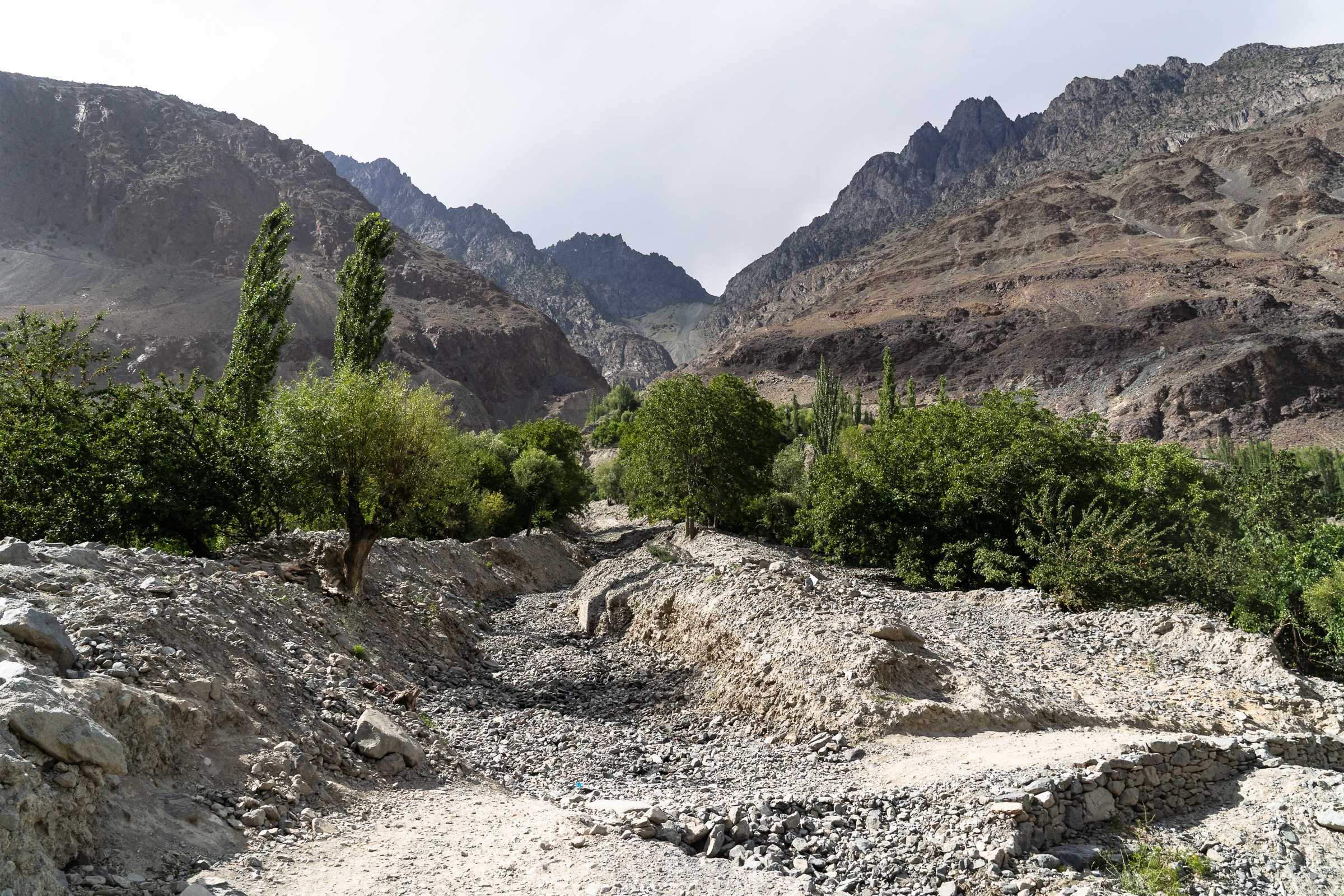
Around the stream, the floods have carved a deep canyon into the land, with another Hassanabad neighborhood sitting beside it. On a flattened patch scattered with debris, the remains of the area’s jamatkhana, the Ismaili house of worship and community gathering, lie among the stripped shells of dismantled homes.
Living on the Edge
Sultan Ali, seventy-five, an elder and community leader, walks me along the cliff, shouting whenever I get too close to the edge. “The ground is not strong here,” he warns. “It can collapse at any moment.”
He gestures at the canyon below. “You see all of this? This was the most beautiful part of our village,” he says, shaking his head.
Nearby, Dilshad Bano, fifty-three, has come to pick cherries on a plot she abandoned about seven years ago. Floods destroyed half her house in 2019. The family dismantled the rest. “It took many years and a lot of hard work to build that house; we used up all our savings,” she says, standing in the ruins. “Then all of it was gone in a single day.”
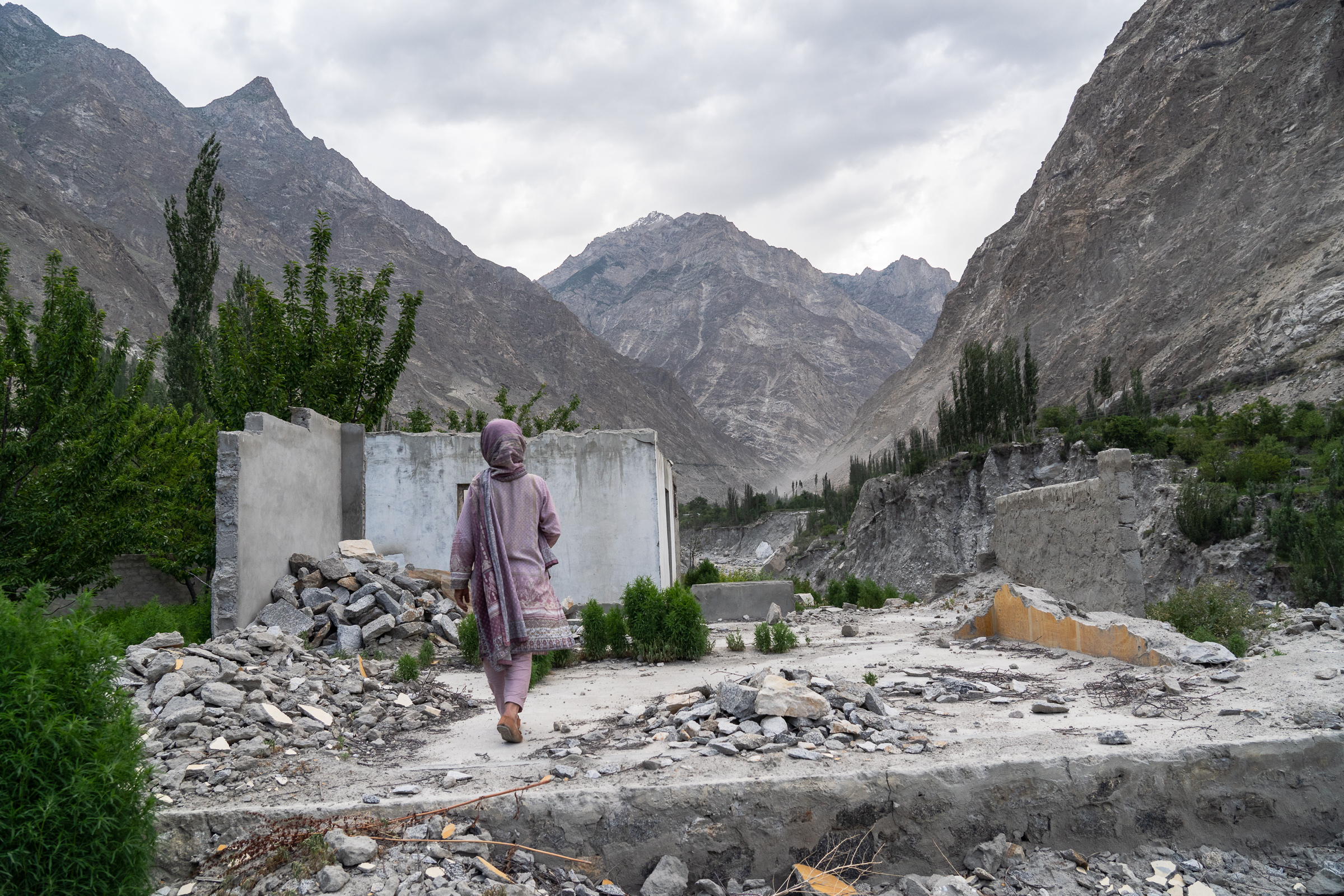
They have moved higher up the valley, to a house twenty-five minutes’ walk through the mountains from the nearest road. “When we have health problems, it becomes extremely difficult,” she tells me.
Bano and her brother-in-law, Muhammad Abbas, fifty-five, each received about $900 in government compensation a few years ago, they say. Abbas’s four-room house is now a strip of orange-painted wall at the edge of the drop.
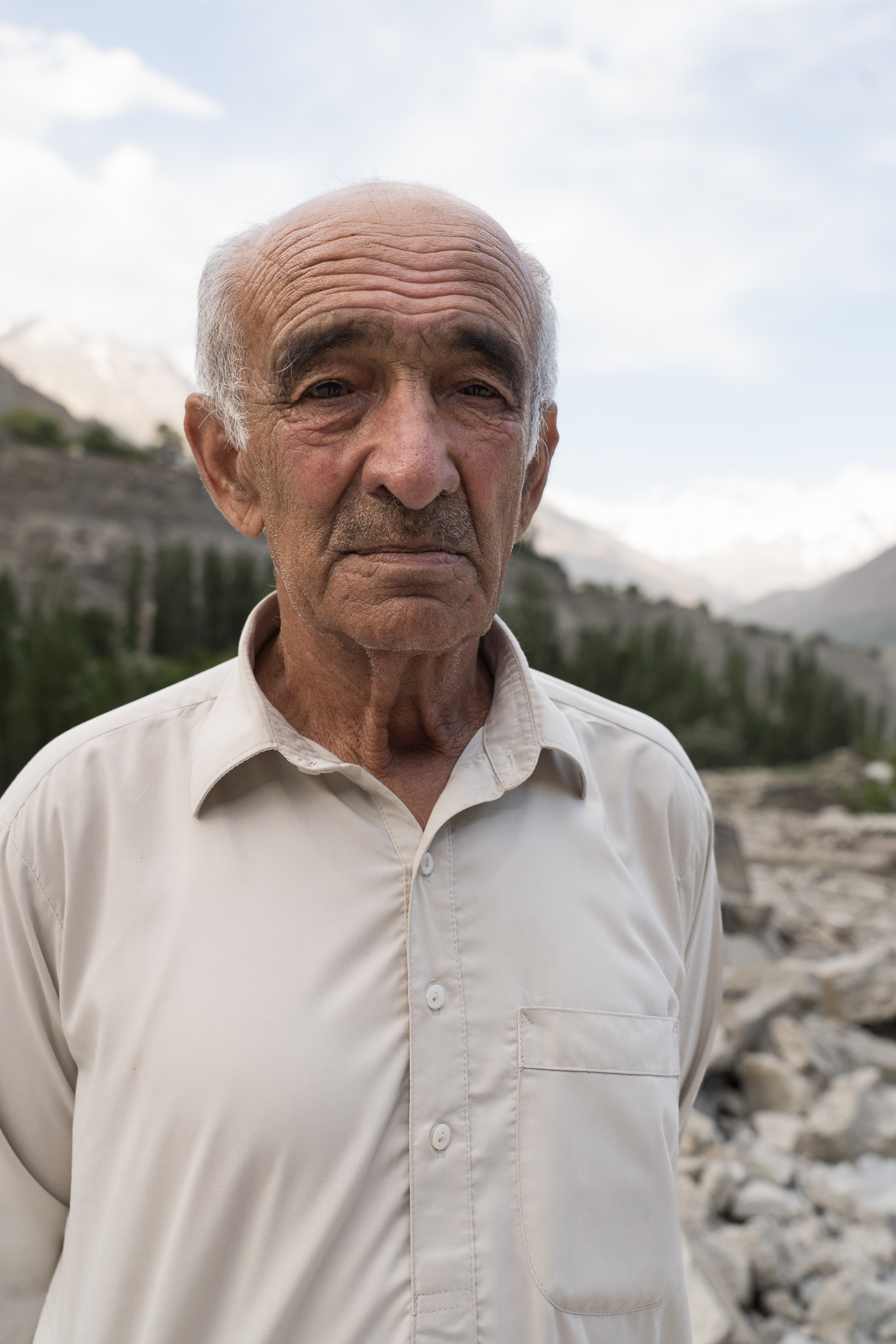
“That money was a joke,” he says. “You can’t rebuild your life with that.” He took out a bank loan and built three rooms at the far end of the village on the only plot he could afford. It floods and erodes like everywhere else.
Beyond some compensation for affected families, officials have done little for Hassanabad, residents say. The state has evacuated families and sent food and medicine after each flood, and rebuilt the road and the bridge. But no one has been relocated, and residents say most of the assistance they received afterward — temporary shelters, food, and bathrooms — came from the Aga Khan Development Network.
“The government is not helping us,” Ali says. “They need to relocate these families because this is a very dangerous place to live. We’re mostly farmers and shepherds and don’t have the resources to rebuild after losing everything.”
There was supposed to be a warning, too. Hassanabad is one of two dozen valleys covered by GLOF-II, a UN Development Programme project with Pakistan’s climate ministry that installed weather stations, river gauges, and sirens across the north. During last summer’s floods, residents say, no sirens sounded.
Muhammad, who was in Hunza at the time conducting a training session attended by officials from the meteorological department who manage the monitoring station, says the sirens are triggered when the water level reaches a predefined threshold. The stream in Hassanabad did not reach the threshold required to trigger the siren, he says. Residents say the siren on the bridge was later swept away by the flood.
Villagers must rely on one another instead. On the hottest days, when the melt runs high, volunteers from the community post themselves along the stream. When they see dust rising from the ravine, a sign that water has broken loose upstream, they quickly warn residents.
“Despite all these disasters and uncertainties, we are more united,” Ali says. “We all realize we are in the same situation, and we only have each other.”
“My Enemy”
Nargisa Khatoon was married in a mud and stone house, with carved wooden beams, that had stood for two centuries. “It was beautifully decorated,” says the eighty-three-year-old.
Her family has lived for generations in Tokorkot, a village in the Nagar Valley across the Hunza River from Hassanabad. They were landowners under the mirs, the princes who ruled Nagar until Pakistan abolished the monarchy in the 1970s.
In 2022, a summer of debris flows struck part of the house and swept away most of the family’s land and trees. For two years, they slept outdoors in a garden beneath a tarpaulin rigged against the rain and sun, or with relatives when there was room, before building the small house Khatoon lives in now.
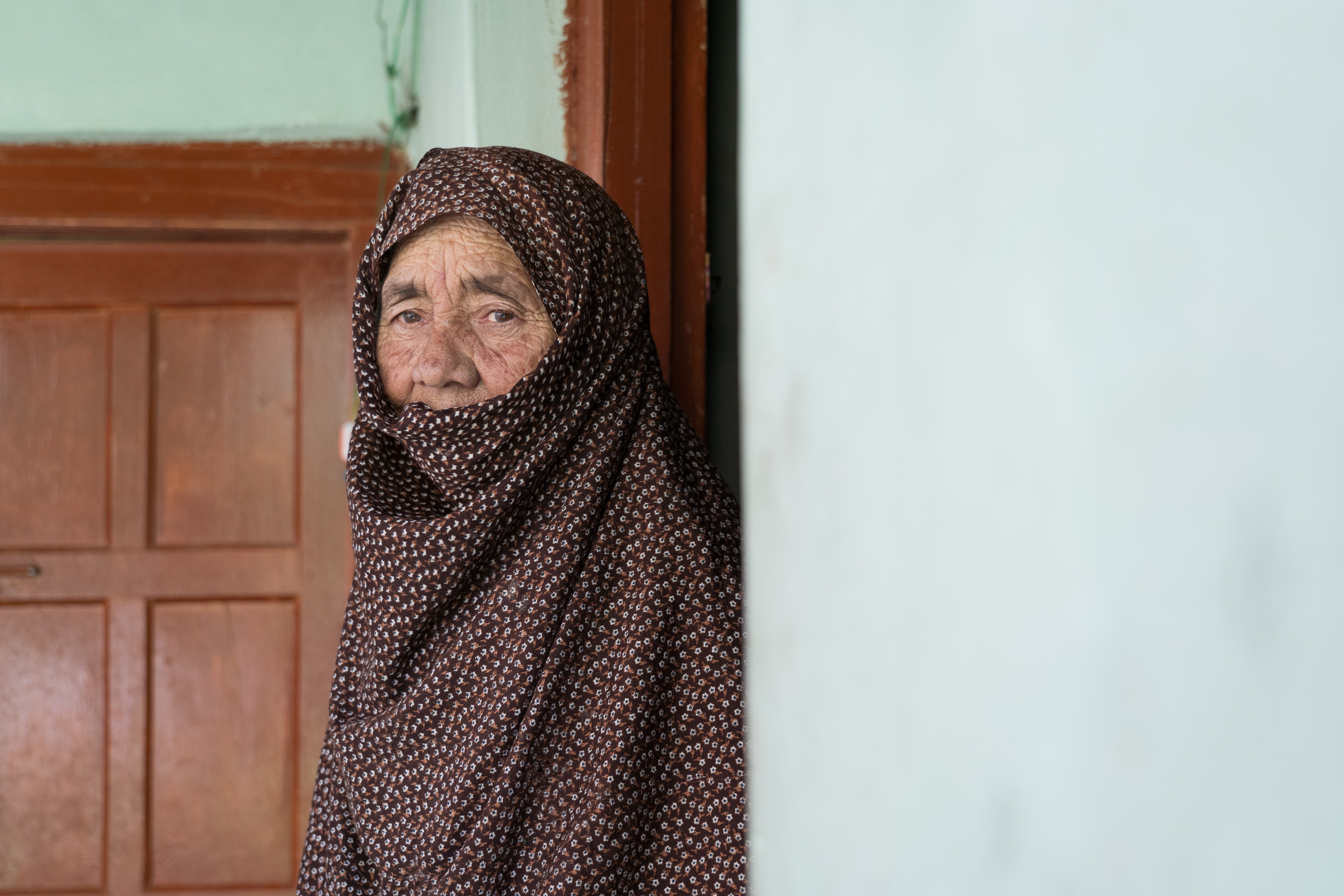
“I don’t like to remember that day,” she tells me, shuddering. “To see my home swallowed by the water, right in front of me. . . . I was shocked.”
For months after, fear kept the village awake. People walked the riverbank at night, watching the water, wondering whose house would go next. “I still have dreams about those days,” she says.
Khatoon grew up seeing the water as a blessing. It irrigated the fields and grew the walnut trees. “But after the floods destroyed everything around us, I became afraid of the water,” she explains, leaning against the side of her house.
“Now, I see it as my enemy.”
Unlike Hassanabad’s Ismailis, people here are Twelver Shia, the largest religious community in Gilgit-Baltistan. The village of a few dozen families sits where two waterways meet: the Hispar River and the Hopar Stream, which comes down from the glaciers of the Hopar Valley above. The village is hemmed in by flood-prone streams on either side and the river in front. Residents say there is nowhere to go.
The Hopar Stream had flooded now and then for as long as anyone could remember. But in the summer of 2022, extreme heat followed by heavy rain likely destabilized the Daranchi Glacier, according to a study published last year, sending more than twenty debris flows — torrents of water, rock, and mud — down the stream in a single month, a frequency the researchers called unprecedented.
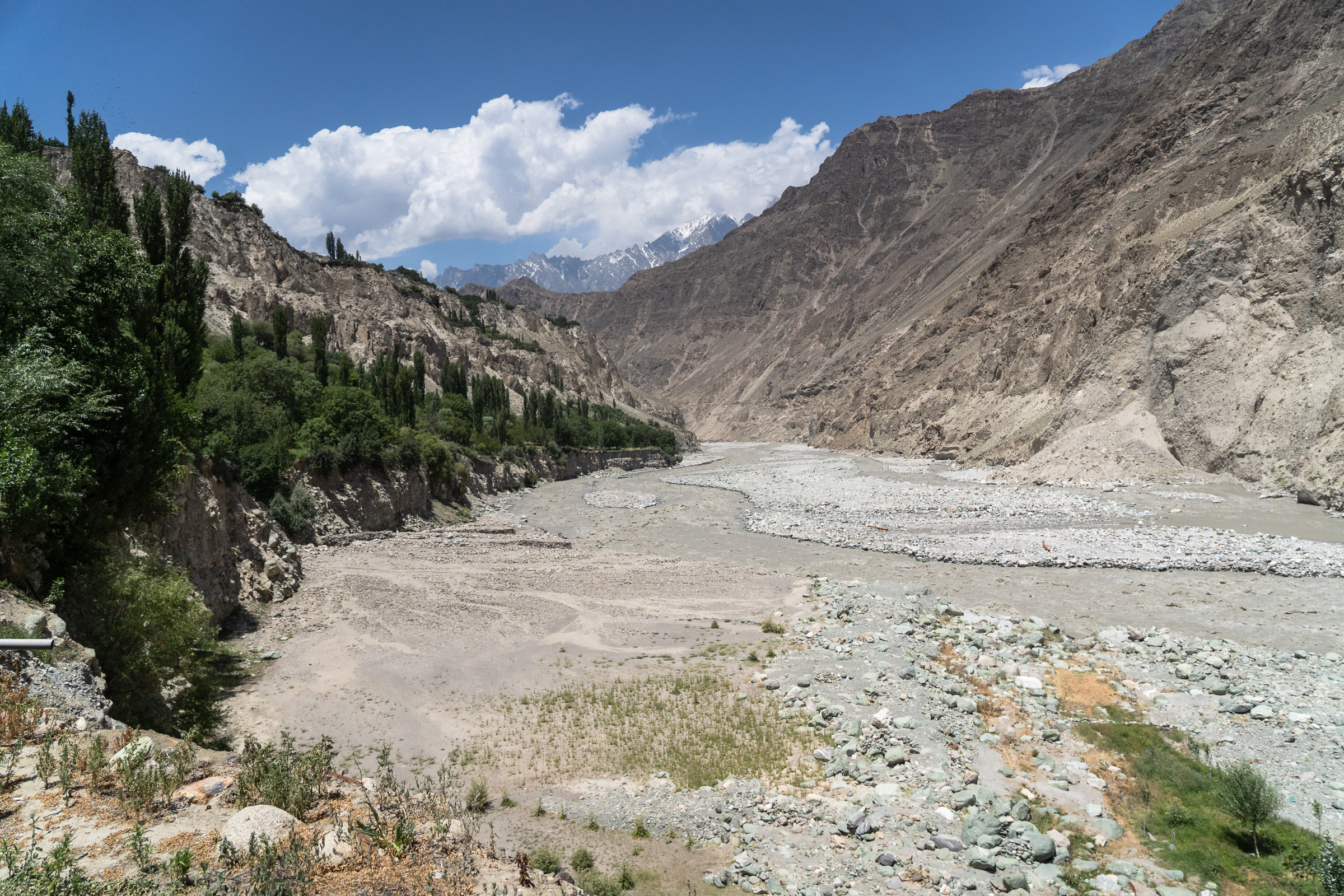
Across Tokorkot and four other villages along the stream, at least twelve houses, schools, forty irrigation and water channels, bridges, and about seventy-five acres of farmland were swept away. The district administration sent some tents, according to residents, and families spent the rest of the summer in them.
When the floods returned last year, destroying a bridge and cutting the road to Tokorkot, families took shelter in the same tents. On the hottest days, families still leave for higher ground, carrying food and sleeping together in tents.
In Tokorkot, the fear is too much water. In the valley above, among farmers whose fields the glaciers feed, it is too little.
Qurban Ali has watched the ice vanish over his lifetime.
When the seventy-two-year-old farmer was young, his family worked fields low in the Hopar Valley, fed by meltwater from the Barpu Glacier. As the glacier thinned, its surface sank and the meltwater level fell with it, until the water dropped below the mouths of the irrigation channels that carried it to their fields. The family abandoned those fields and moved higher, onto land watered by the Daranchi — the glacier behind Tokorkot’s 2022 debris flows.
“The glaciers are going deeper underground day by day,” he says. “So we cannot reach and bring up the water.” Farmers say the Daranchi is thinning too. Satellite measurements show the glaciers here losing mass every year since 2000, with the heaviest losses at their lower ends, where farmers draw their water.
“Our entire life here revolves around the glacier water,” Ali tells me. “If there are no more glaciers, then there’s no more life.”
Hopar sits on a terrace of fields about 330 feet above the Bualtar glacier, known locally as Hopar. From a lookout at the head of the valley, its ice lies directly below, blackened with rock and dust.
When a geographer surveyed Hopar in the mid-1980s, its five villages and roughly four thousand people were irrigating some seven hundred acres of terraces through more than 180 miles of hand-dug channels, with more meltwater than the fields needed for most of the growing season.
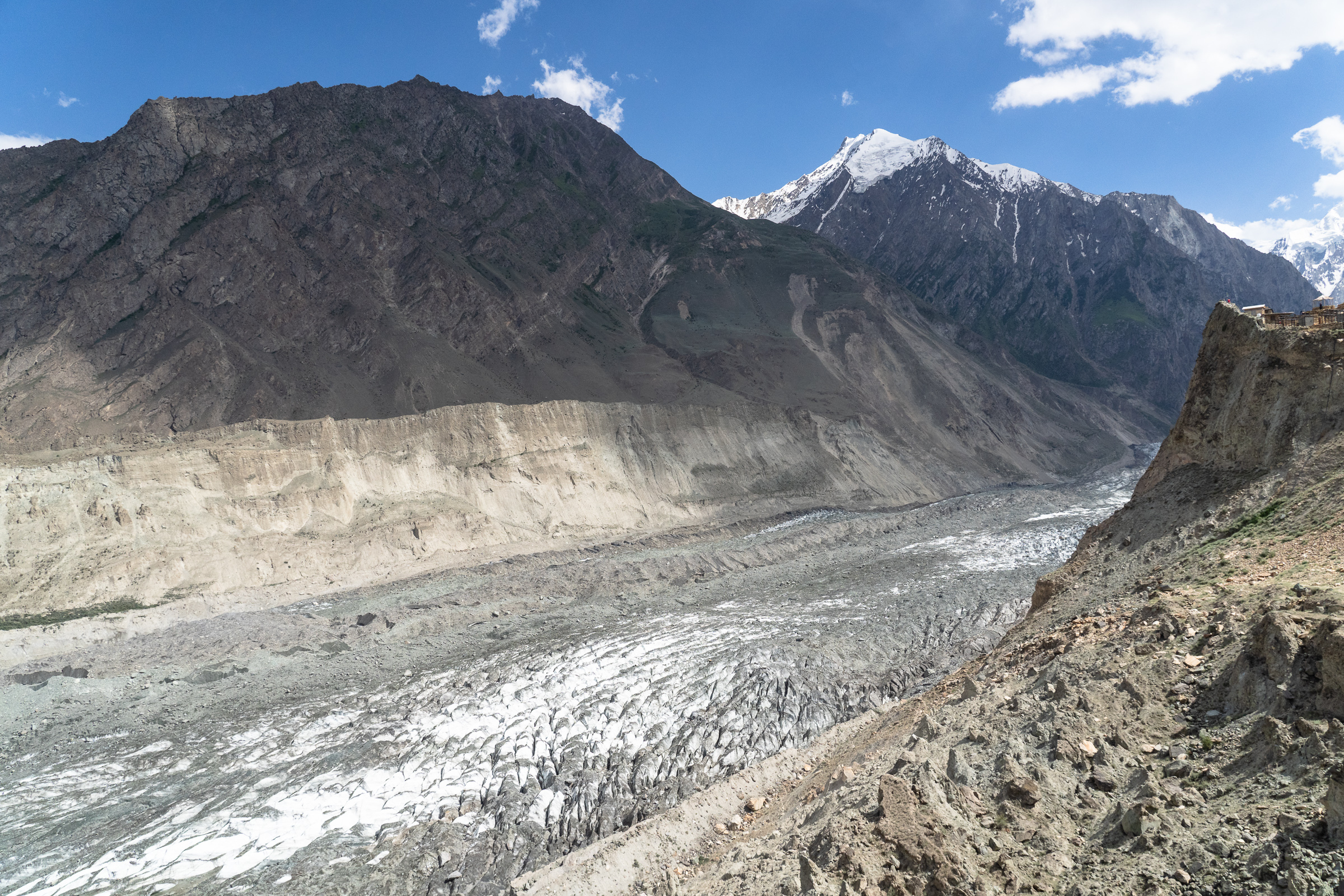
Satellite records since 1993 show the snow and ice here shrinking by more than two-thirds, and researchers have also documented fields in the valley being cut off from their water.
But as the melting increases, the same valley is being hit by the floods that have torn through the rest of the region. Lower down, where families live and farm along the Hopar Stream, the water arrives all at once.
Left With Nothing
Rashida sits outside her tent and washes the family’s clothes by hand in water carried up from the Ghizer River, one of the region’s main rivers. It quickly turns brown with silt. She stops, takes a deep breath and wipes sweat from her forehead.
“At our home in the village, we had a washing machine and clean running water,” the thirty-seven-year-old says. “I’m not used to living like this.”
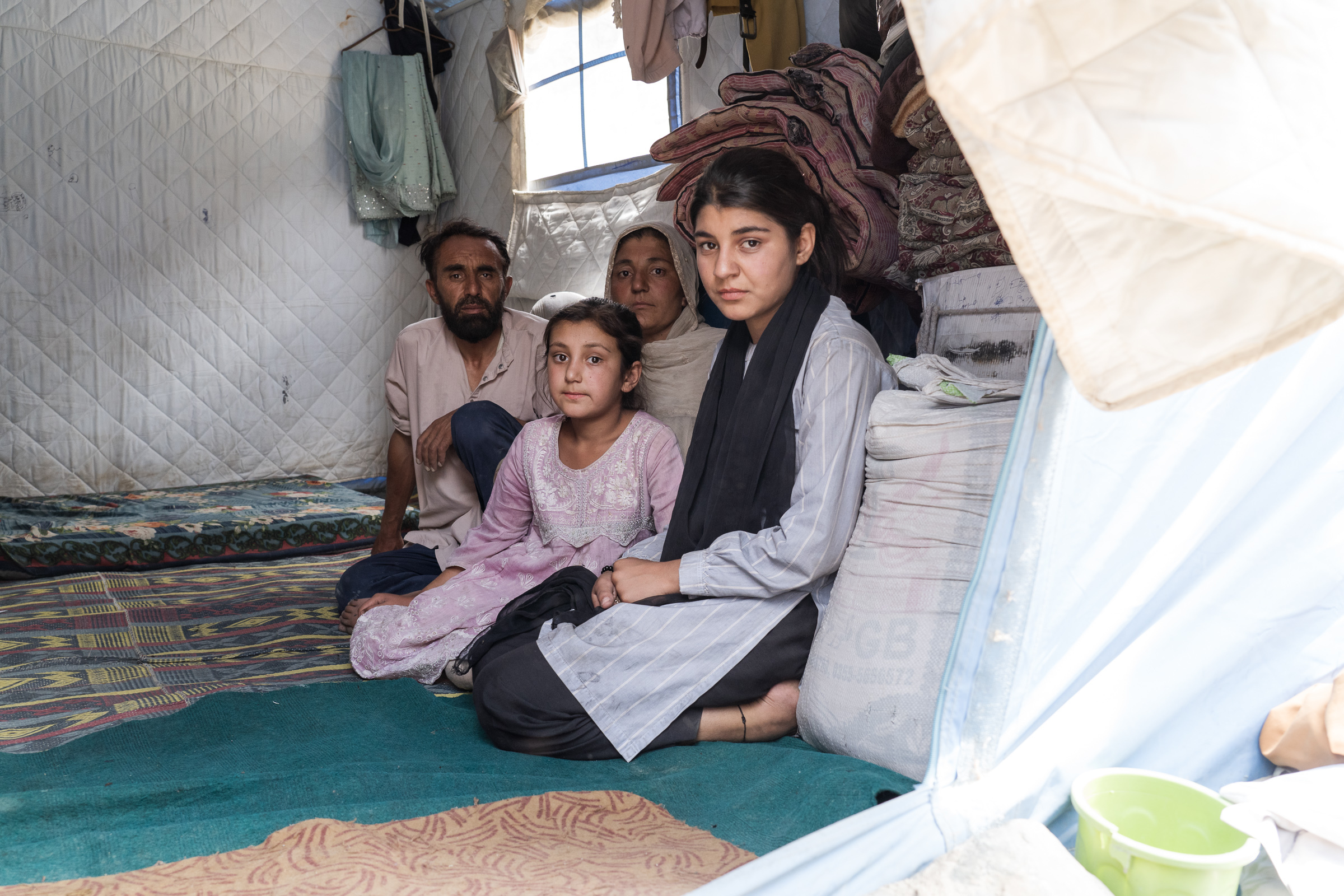
Rashida’s family has lived in this tent settlement since last year, when they were displaced from their village, Hakis Thingi, in the Gupis Valley of Ghizer district, in western Gilgit-Baltistan.
At about 3 a.m. on August 22, a glacial lake in the mountains above Talidas village, in the Raushan area, burst. Officials blamed high temperatures. Water poured down a side stream, triggering landslides on both sides of the valley and sending a powerful debris flow through Talidas, flattening it. The debris then blocked the Ghizer River.
For about six hours, the river stopped flowing as water backed up behind the blockage. By daylight, the ensuing lake was several miles long. Across six villages, the flood destroyed or damaged hundreds of houses and large tracts of land. It also submerged part of the only road connecting the area to the rest of the region.
No one, however, was killed. Shepherds high in the mountains spotted the flood coming and phoned down to the villages below, where trained volunteers moved families out before the water arrived.
About 80 percent of Talidas was destroyed. Upstream, the rising water swallowed houses in Hakis Thingi village and nearby settlements. More than three thousand people from 330 households were displaced — the second-largest displacement in Gilgit-Baltistan since the Attabad disaster in 2010, when a landslide dammed the Hunza River and submerged a string of villages.
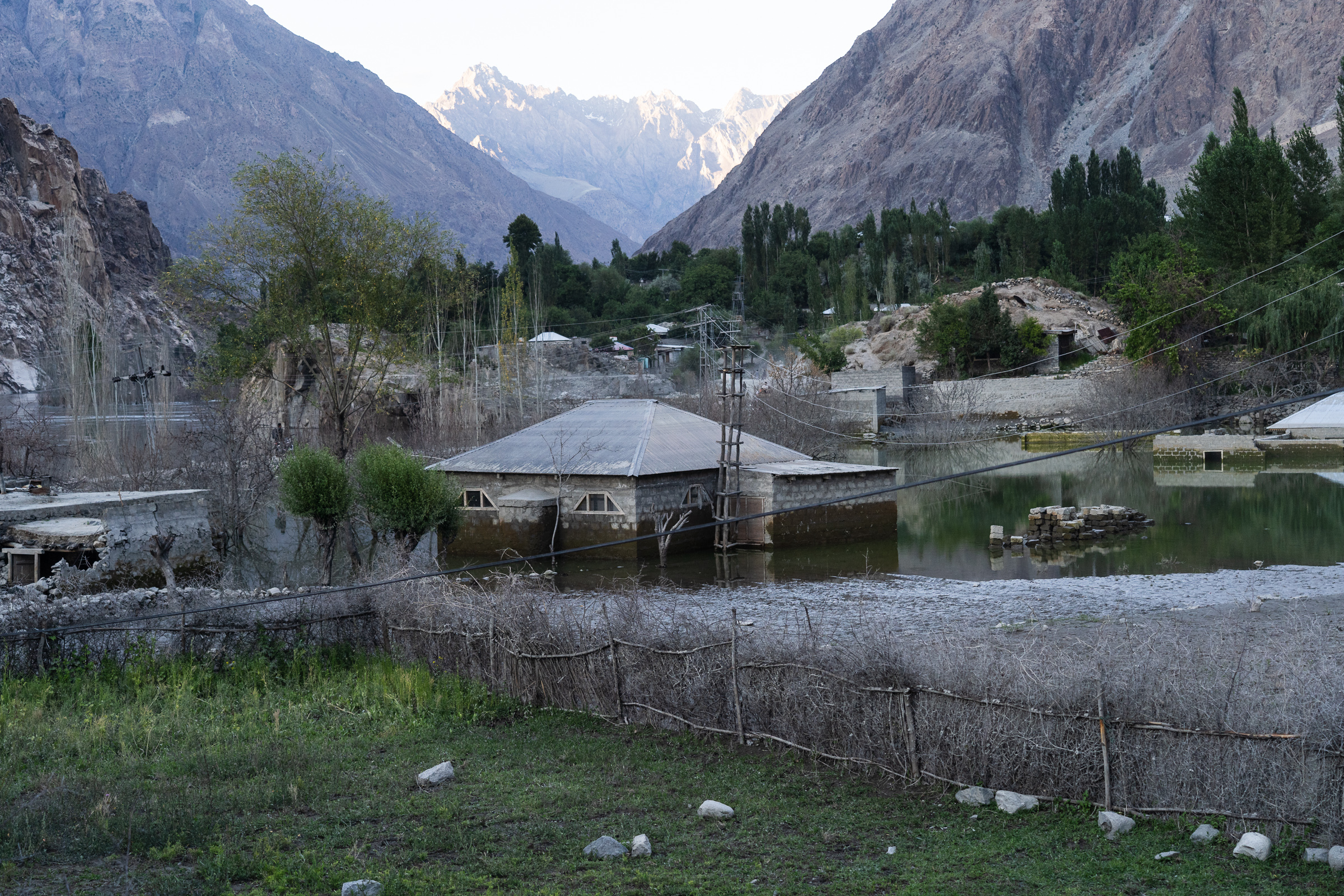
A year later, the floodwater in the Raushan area still stretches across parts of the valley, rooftops jutting above its surface.
A resettlement site was built high in the mountains for some of those displaced from Talidas, isolated from the villages and services below. Residents say the government provided the land. The University of Lahore, a private university, funded the houses at about $720 each.
Around sixty-five homes were washed away in Talidas, but only some families were provided plots, residents say. The rest are staying with relatives or in tents.
About twenty-three families from Hakis Thingi, meanwhile, still live in a sprawling tent settlement across the river from their drowned village. Residents say the government has allocated each family about a twelfth of an acre, and aid organizations are providing materials for a one-room shelter with a kitchen and bathroom. But the families, who lost their land and livelihoods, must provide the labor themselves.
The barren plots are only big enough for the shelters, residents say, and they cannot farm because the surrounding land is government-owned. They have relied on private aid, which dried up at the start of this year, and on whatever daily work they can find in construction, farming, or local shops.
When I visited in August, not a single shelter was finished, and the entire community was still living in tents.
“My whole life is different now,” Rashida says, settling onto the ground inside the tent beside her husband.
Nowhere to Turn
In Hakis Thingi, each family had scattered plots planted with almonds, apricots, apples, cherries, and mulberries. They grew their own vegetables, kept cows for milk and sold dried fruit at local markets for the cash they needed for clothes, household goods, and school fees.
For Rashida, her children’s education mattered most. She says all of them did well at school. “Before, we could easily afford to send them to very good English-medium schools,” she tells me. “Now we have to ask [nongovernmental organizations] for help with the costs of government schools.”
“I used to have very big plans for them,” she adds, as her children pull back the front of the tent and peek shyly inside. “I believed they would all go to university.”
“Now I’m just worried about how to feed them each day.”
Residents here say living so close to the Ghizer River — the river that took their homes — also leaves them constantly frightened.
A couple of miles upstream, others never left. Their houses still stand on the edge of the lake. About twenty-four of their neighbors’ homes remain submerged, occasionally reappearing as the lake recedes. Water drains through a natural spillway in the debris and officials have declared the lake no longer a threat.
Zarnisa, sixty, and her husband, Abdul Qayum, eighty, have moved between their home and the tents for more than a year. Their house stayed flooded for about six months, only its roof visible. When the water fell in January, they returned; three months later, it rose again. A few days before I met them, the spillway had widened, the lake dropped and they went home again.
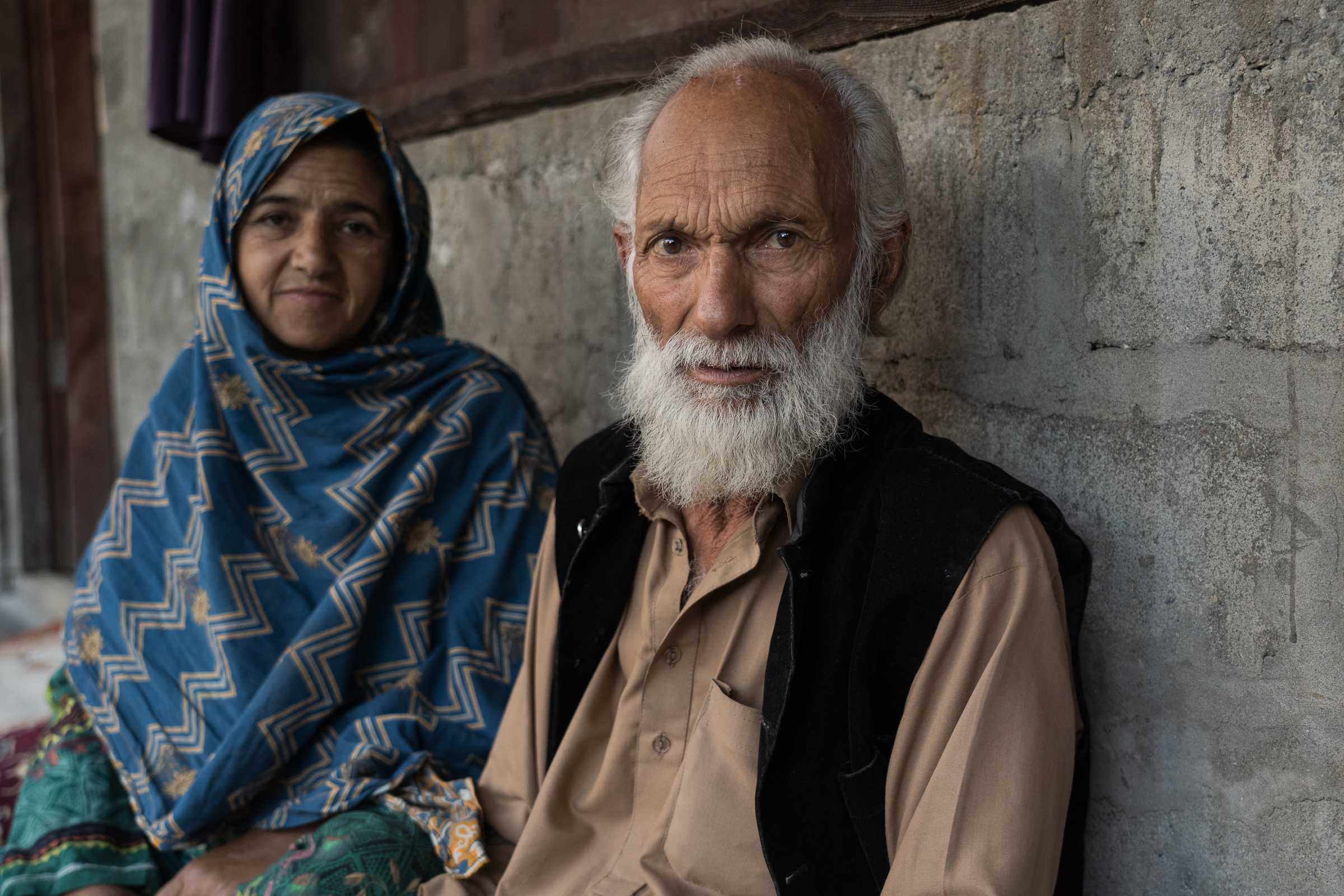
“We are always afraid,” Zarnisa says, guiding me to the edge of her small yard and pointing to the water just a few feet away. “Maybe in a few days the water will rise again, and we will have to flee.”
Zarnisa’s husband has fallen into depression after being repeatedly displaced from their only home. “He’s constantly having panic attacks,” she tells me. From their yard, the roofs of sunken homes rise above the water, a perpetual reminder of what will eventually happen again to their own.
“It gives me a lot of anxiety,” she says. More than her own house, however, she worries about the neighbors whose homes are already gone. “My neighbors were all like family to me. I’m always thinking about them and feeling sad.”
Those neighbors now live in tents on higher ground or in the homes of relatives. They have not been given plots or shelters. One of them is theity-five-year-old Zaibunisa. Her family owned three houses with shops attached, and she ran a small early education school for local children. All of it is now under the lake, along with their land.
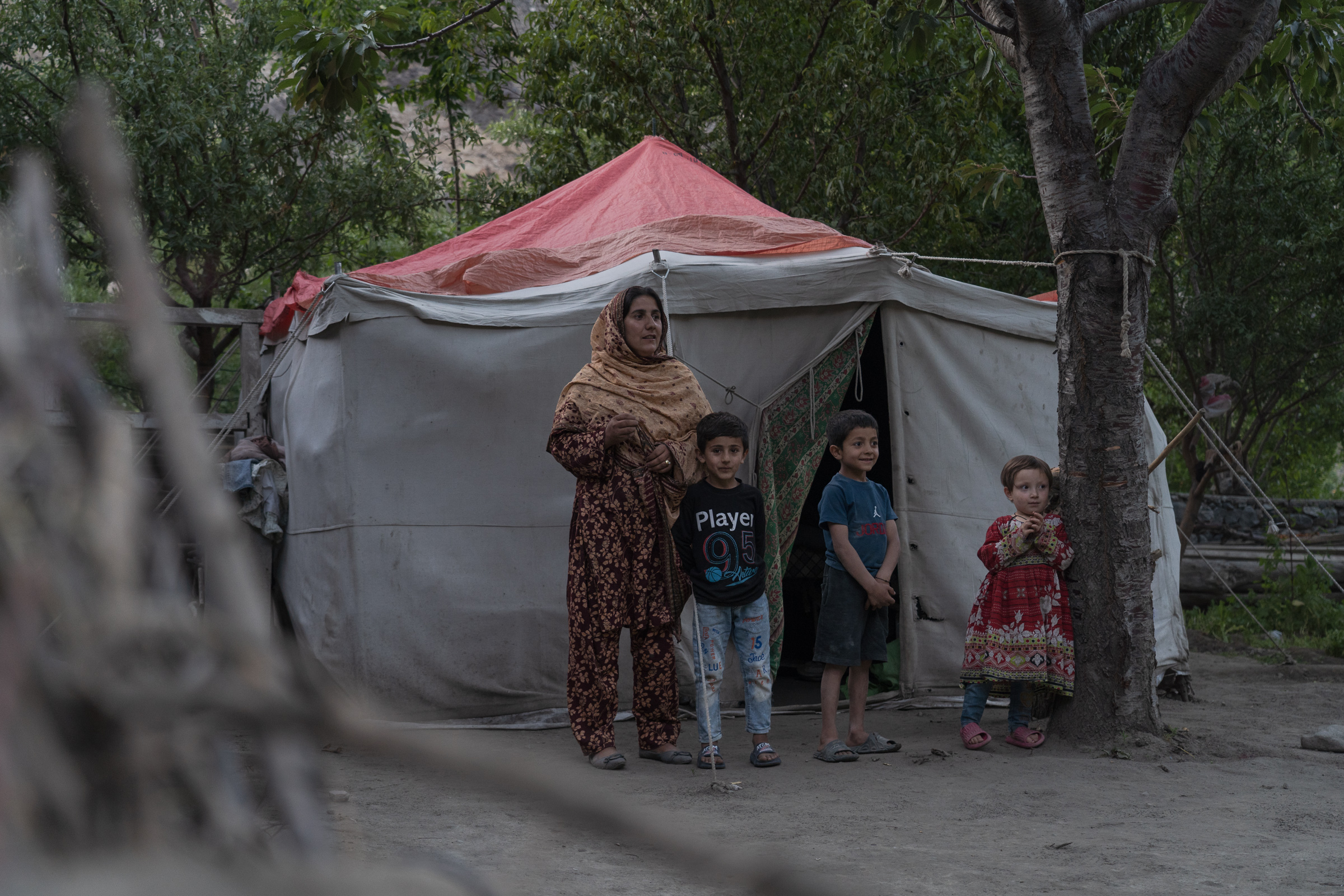
“When the flood came, we didn’t have time to grab anything, not even our phones,” Zaibunisa says. “We were left with nothing but our lives.”
With no other land, she pitched a tent outside a relative’s house. “We feel stuck,” she tells me, standing outside the tent she shares with her husband and their three young children. “We need help.”
“No Safe Area”
About a week before the glacial flood, a different kind of disaster struck elsewhere in the Gupis valley.
In Khalti village, the ground is a field of boulders and rocks. “Nobody here had ever feared floods; this side of the valley has no glacier above it,” says Karim Beig, seventy-three, a village elder. “The danger, in living memory, was always avalanches.”
On August 14, cloudbursts hit thirty-seven locations across Ghizer. At least thirteen people died. These downpours can dump four inches of rain or more in an hour over an area just a few miles across, sending walls of water and mud down the slopes within minutes.
One hit Khalti. Residents say eight houses were destroyed in about ten minutes and about four more were damaged. Six members of one seven-person family died. Villagers who reached the wreckage say they heard a small boy crying beneath it and dug him out. Beig and his younger brother, also in his seventies, lost half their house and most of their orchards and land.
Beig leads me through the rubble, then crouches and motions for me to follow him down a crevice. A small backpack and other belongings lie beneath the debris, left behind by families whose homes were crushed by the rocks and floodwater.
Cloudbursts are a “very new phenomenon” here, explains Syed Najam Hassan, an assistant professor at Karakoram International University in Gilgit who uses satellite data to map the region’s glacial lakes. They are associated with the monsoon, which until recently rarely reached these altitudes.
Ghulam Rasul, former director general of the Pakistan Meteorological Department, says the mountains are warming faster than the plains below, strengthening the forces pushing the monsoon north. The Himalaya runs east to west, blocking its path. But toward the west, the wall of mountains ends, and the monsoon is now pushing through into the high Karakoram.
“Now we all feel exposed,” Beig says, balancing on one of the rocks scattered across the village. “Every night when it rains, no one can sleep. Some of us come outside and watch the clouds for any sign of what might happen.”
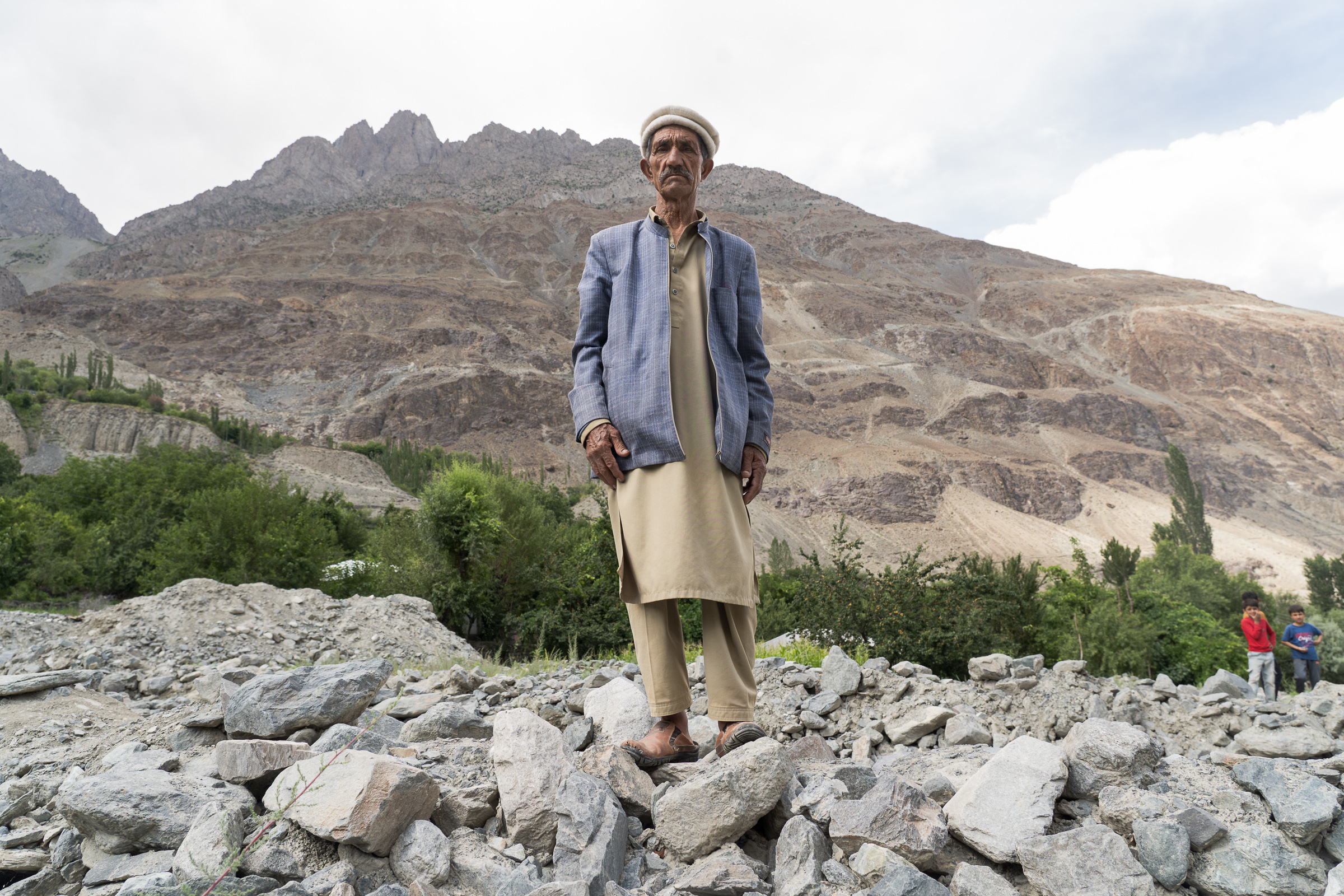
Communities here have read the signs of approaching glacial floods for centuries, but nothing passed down by their elders tells them what a cloudburst looks like before it comes. Even researchers struggle to predict them, Najam says. A village can be sitting under clear skies while a storm builds over the ravine above, with the water arriving half an hour later.
“Everything has changed since that day,” Beig says. “It’s like we’ve been invaded by something unfamiliar, something we don’t understand and that could attack us at any moment.”
Theses dangers extend throughout the region. “Across Gilgit-Baltistan, everywhere is at high risk,” Najam tells me. “With the climate changing, there is no safe area.”
While the water can eventually recede, the trauma cannot. Nargis Asad, who chairs the psychiatry department at Aga Khan University in Karachi and has studied the mental health of displaced people in Pakistan since the 2005 earthquake, says these communities are not recovering from a single disaster but living in a state of chronic exposure.
“When you are continuously exposed to a threatening situation, there is an ongoing state of worry and apprehension about an impending disaster that can come at any time,” Asad explains. “It becomes a very fearful existence, affecting your psychological, cognitive, and physical well-being.”
“Losing your livelihood and your source of income is also a real trauma,” she adds. “It is a major hit to your identity and creates a sense of helplessness, especially when it is land your family has lived on for generations.”
The toll is physical, too, she says: cardiac problems, disrupted sleep, and illnesses that emerge long after the flood has receded. And the effects can extend to the next generation. “When children live under constant fear, their learning capacity, sense of safety, and sense of trust are all affected,” she says.
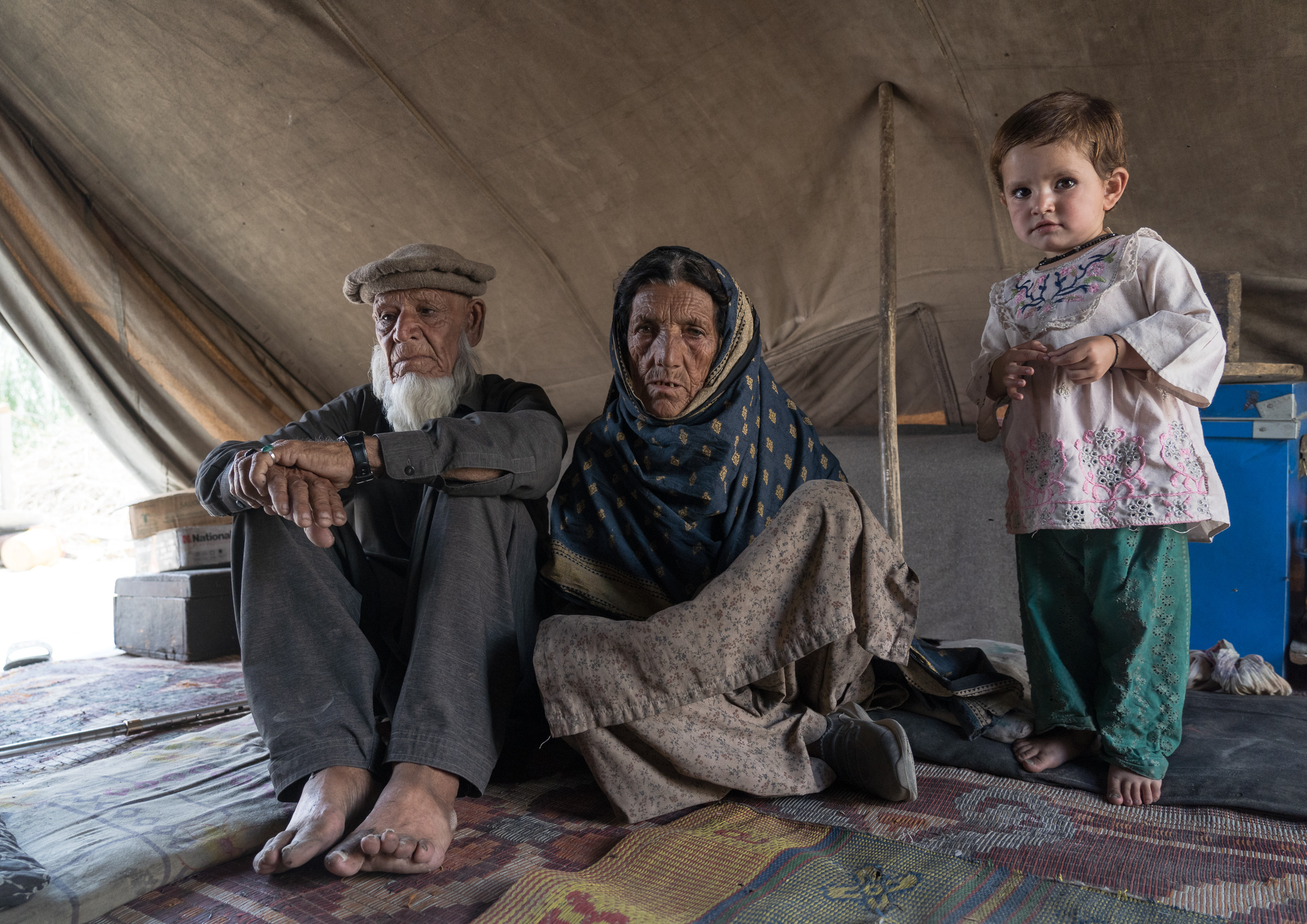
At the camp for displaced families from Hakis Thingi, Sher Wali, ninety, sits in his worn tent with his wife, Jamali, sixty, grieving decades of lost work. “All my life, I worked to build on what my ancestors gave me, to give my children more than I had,” he says, his voice rough with exhaustion.
“I lived off the land and cows and had a happy life,” he continues. “But now our children don’t even have milk for their tea or any fruit to eat.” He points through the tent opening to the treeless land outside, the sun beating down.
At night, he takes stock of everything he lost in the floods. “I remember every section of my land, every fruit tree and every piece of property I no longer have,” he tells me. “It pains my heart, and I can’t sleep well.”
“I’m an old man. . . . my life is almost over,” he adds. “But I fear for future generations. Without land or jobs, I’m afraid many of our young people and children will just be left to die.”