The Jensen Huang Scandal: A Gift to China Hawks and AI Giants
The exact truth behind Jensen Huang’s ouster from Nvidia remains murky. But one thing’s for sure: it’s been a huge boon to China hawks like Marco Rubio and other enormous AI firms.
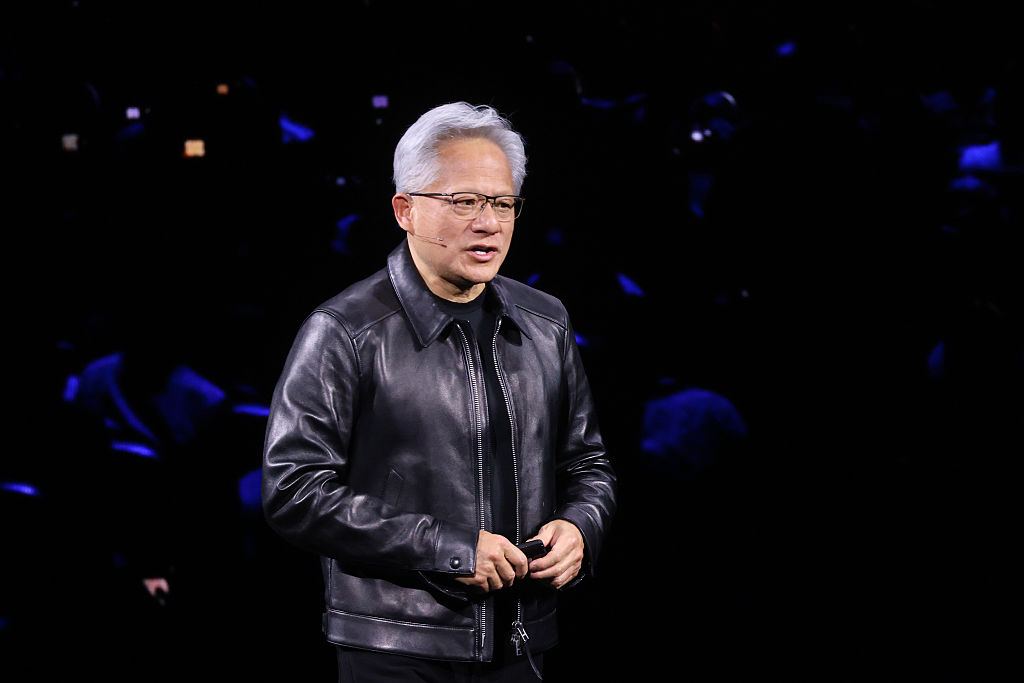
Because of a combination of the way we’ve structured our economy and Washington corruption, one man’s horniness can risk bringing down the US economy and ramping up conflict with China. (Alex Kraus / Bloomberg via Getty Images)
Often, when people cheat on their spouses, they get kicked out of the house and strain their families. Not many can say they wiped out $1.8 trillion worth of share value and made the economy wobble.
Yet this is exactly the case with ousted Nvidia chief executive officer Jensen Huang and the scandal surrounding his various infidelities, including to a woman who is allegedly a Chinese spy. (Or is she?)
The uncertainty around that question is part of the general murkiness of this entire affair (no pun intended), one tied into a knot of three separate political threads: the economy’s outsize reliance on the artificial intelligence industry, ruthless corporate anti-competition, and the simmering new Cold War with China.
While Huang had a number of infidelities, it’s his affair with business executive Alice Huang that is central to both the global attention this has drawn and to his ouster from the company he had founded over a Denny’s meal with only $40,000 of capital, thanks to his paramour’s alleged role as a spy for the Ministry of State Security, roughly China’s equivalent to the Central Intelligence Agency. Even as the infractions piled up, it’s hard to imagine Huang — a widely admired, politically connected CEO who commanded intense loyalty from his employees — being pushed out of his own company over infidelity if not for the possibility, leaked to the press, that he fell for a Chinese government honey trap.
So it’s notable that no one seems to really know whether or not Alice Huang truly was a spy. CNN reports that US intelligence agencies aren’t actually sure, with some officials viewing media reports alleging that she is as overstating the reality. At the same time, Donald Trump, Vice President J. D. Vance, and Attorney General Todd Blanche have all publicly claimed uncertainty about this central allegation. The Singaporean government went out of its way to explicitly deny The Wall Street Journal’s reporting that its officials had been concerned about her alleged spying for Beijing and investigated it.
Most explosively, The Washington Post reported that the spy claim came from one official in particular: China hawk Marco Rubio, who personally reshaped the CIA’s more ambiguous intelligence into a memo forcefully making the spy allegation and circulated it around the administration all the way back in May, to little effect.
Let’s take a moment now to note how odd it is that the details of that memo then somehow made their way to the press. Let’s also take a moment to note how odd it is that neither this administration, which has zealously investigated and thrown the book at leakers, nor Rubio, who has called leakers “criminals” and once tried to throw some in prison for a decade, seem to particularly care about this leak.
A Win for Hawks
So what exactly is going on here? It’s too early to say for sure. But one thing we can say with certainty is that Huang was long given the side-eye by Washington’s China hawks owing to his unabashed advocacy for doing business with China, his closeness with the president, and the fact that he had used that closeness to get Trump to let Nvidia skirt US export controls and sell its chips to China. For those hawks, who Huang publicly lambasted as carrying a “badge of shame,” this was a grave offense and a threat to national security, with the possibility that China could use the advanced chips to win the “AI race” that this crowd is obsessed with.
Another certainty is that these same hawks have wasted no time in seizing on the affair to push for harder-line policies against China, at a time when Trump had been edging toward a more conciliatory posture with the country, drawing growing pushback from Washington. The Trump administration has now tightened export controls on AI chips in the wake of this scandal, and a consensus is now emerging in Congress to go beyond this. China hawks are making a renewed push to tighten them even further, with parts of a fourth bill doing so now set to be added to the National Defense Authorization Act (NDAA) for 2027.
Commerce Secretary Howard Lutnick, reportedly the main figure within the administration resisting a crackdown on the export of Nvidia chips, is being publicly undermined by one of his own fellow cabinet members, facing the possibility of being investigated, and may see his head roll over the episode, all as lawmakers demand he clamp down on the chip exports. China hawks “are thrilled right now” and are “gonna win the day,” one Trump official told The Washington Sun, while an economist who backs the stricter controls told the outlet that with Lutnick and Nvidia “sidelined, the center of gravity has shifted to Rubio-world,” since they “were the main opposition to any sort of export controls.”
A Win for AI Monopolists
China hawks aren’t the only ones who stand to benefit from Huang’s ouster. The battle over China’s access to high-end AI chips is, in part, a proxy for a whole other battle being fought within the industry.
The removal of Huang is viewed as a blow to the movement behind open-source AI models — those that the general public can download and tinker with, as opposed to closed-source models like OpenAI’s ChatGPT or Anthropic’s Claude, where the developer has exclusive control but chooses to make the model available for public use. Open-source models also happen to be mostly the kind developed by Chinese companies, whose cheaper models US companies are increasingly turning to.
Huang also happened to be a major champion for — and, more importantly, financial backer of — such models, probably because the proliferation of more AI models also means more business for Nvidia. One venture capitalist who invested in some of the same start-ups as Nvidia told the Financial Times that Huang getting the boot means “we may end up in a much more concentrated world of model providers.”
That put him at odds with companies like OpenAI and Anthropic, whose commercial interest lies in trying to dominate the AI market and preventing the spread of open-source models that would make people less reliant on their products. Anthropic has long been an outspoken proponent of the export controls on AI chips that Huang chafed against, breaking from other industry players over the issue by backing the three restrictionist bills included in the NDAA for 2027.
OpenAI, meanwhile, pulled back on its advocacy for export controls, both as Huang’s dealmaking saw it become more financially intertwined with Nvidia and to align more closely with Trump as he came under Huang’s influence, costing China hawks what they had counted as an important industry ally. But Huang’s ouster has “loosened them up a bit,” a source told Politico, with OpenAI now back to arguing in favor of those same three export control bills in the defense authorization bill for next year.
In fact, it goes much further than this. Because filings show that both of these closed-source firms have thrown a small mountain of money into lobbying various arms of the federal government on this issue, including the very two organs — the State Department and the National Security Council (NSC) — that happen to be headed by Marco Rubio, China-hawk-in-chief and the main figure responsible for the spy claims about Huang’s mistress.
Starting from the third quarter of this year, dating from July to the end of September — the period that came after Rubio reportedly circulated his spy allegation memo in May — OpenAI spent a whopping $1.5 million lobbying on issues that included “foreign AI capabilities and national-security risks,” lining up with Politico’s reporting that the firm had started voicing its support for export controls to Congress in recent months. This was a notable shift from 2025: that year, OpenAI’s in-house lobbying outfit had spent substantially less than this amount per quarter and hadn’t lobbied the State Department, nor does that phrase appear as a lobbying issue in that year’s filings.
In other words, it’s not just that OpenAI started pushing for restricting the export of chips right after Rubio circulated his questionable memo linking Nvidia’s CEO to Chinese spying, and that it was that CEO’s removal that had “loosened them up” to do it. They also lobbied Rubio’s own department, and did it just months before that memo mysteriously leaked to the press, forcing his ouster.
There is a similar pattern with the other closed-source AI giant, Anthropic, which, in that same July-to-September period paid several Trumpworld lobbying firms to work on this matter.
One was Navigators Global, which that very same quarter started lobbying Congress on behalf of the AI firm on the export control provisions in the NDAA. Navigators Global’s cofounder happened to be Rubio’s very first chief of staff when he was a senator, while one of the lobbyists who worked on this issue is Andy Keiser, who for fourteen years served in various roles for ex-congressman Mike Rogers, the Trump ally who ran for Michigan’s Senate seat this year and in 2024.
Sit for a moment with the fact that Anthropic was pushing this issue using a lobbying firm closely connected to the very figure arguably most responsible for driving Huang’s ouster.
It’s a similar case with Ballard Partners, founded by a longtime Florida lobbyist who counts Rubio as a friend and where Trump’s recently ousted chief of staff Susie Wiles was managing partner for years before joining up with Trump in 2019 — a firm so connected that one departed Trump official has charged it “controlled” White House policy. In the third quarter, it started lobbying for Anthropic on “advocacy regarding US policy regarding AI” to the tune of $380,000, including at Rubio’s NSC, for which it employed two recently departed Trump national security personnel, one of whom had just worked at Rubio’s State Department.
Another specifically Rubio-connected lobbying firm used by Anthropic for this was Continental Strategy, one of whose managing partners is Alberto Martinez — a “trusted advisor” to Rubio who worked in various roles for the former senator over the course of a decade, including chief of staff and senior strategist on his first Senate race — and which promoted Wiles’s daughter a day after Trump hired her. Martinez was among the lobbyists Continental used to lobby agencies that included Rubio’s NSC (from April to the end of June) and then Rubio’s State Department (in this just-passed third quarter) on “AI development and national security,” for which it was paid a total of $300,000 by Anthropic for these periods. Both Ballard and Continental’s roles were first reported by ZeroHedge, but this is based on my own separate analysis of Anthropic’s 2026 lobbying disclosures.
It’s remarkable that at the same time the interests of Rubio-led China hawks and firms like Anthropic were crossing over, the company was literally employing Rubio’s own former loyalists to lobby the government bodies he was in charge of.
This is on top of the $230,000 that Anthropic paid over the past year’s three quarters to Fierce Government Relations — a firm with a couple of Trump-connected employees — to lobby Congress and the Office of the President on export controls and the NDAA bills; another $180,000 over the same period to Aquia for the same issues; $60,000 to the Democratic firm Avenue Solutions to lobby Congress on the NDAA starting in the third quarter; and the nearly $6 million it spent in-house in that period to lobby on issues that included these topics. In that last case, it used a longtime staffer of Sen. Patty Murray, who had been demanding in recent months that Trump impose these stricter export controls.
So in summary, the two closed-source AI firms that view China’s AI industry as a threat to their own bottom line have done the following: lobbied heavily for these China-squeezing export controls this year; appear to have in some cases ramped up their lobbying on this after Rubio circulated the sensational but unproven claim that led to Huang’s booting; hired former staffers from Trumpworld to do that lobbying; and in particular, hired lobbying firms and used lobbyists with long-standing connections to Rubio specifically to do it.
The picture that emerges is of the unmistakable — some might say convenient — convergence of interests between Washington’s China hawks and AI giants, and the downright eerie overlap between the offices and personnel of what are in theory meant to be two different entities. Even more convenient, all of this has come to a head just as one of these AI giants, Anthropic, was set to embark on its initial public offering, which it did yesterday, raising $81 billion in the largest stock-market debut on record.
Like I said: convenient.
A Bet Without Consent
Less convenient is another thing we can say for sure, which is that, Anthropic’s blockbuster IPO aside, this entire saga is causing heart rates to spike.
That’s because Nvidia — and, owing to his domination of the company and personal role in every deal it struck, Huang himself — is a load-bearing force for an industry straining to stay standing up, passing out the necessary capital for flagship AI firms, start-ups, the building of data centers, and the neo-cloud firms that provide the computing power for firms that can’t build their own. In fact, Nvidia effectively came to the rescue of one of those neo-clouds, CoreWeave, when its bonds recently entered distressed territory after skeptical investors started dumping the company’s debt en masse.
Huang’s ouster throws the industry into uncertainty as it waits to see, first, if any one person is able to actually fill Huang’s shoes, and second, if the person who does has the same kind of appetite for risk that he did. So far, indications are that the interim CEO does not, and with the firm about to be dragged through an acre of thorns in the form of congressional hearings and other scrutiny, it would not be surprising if it embarks on a more conservative approach going forward.
That doesn’t necessarily mean that the AI industry is headed toward an imminent crash. But this is all spectacularly bad timing given the spate of setbacks and growing investor doubts it’s been weathering, the last one being an incoming US Congress dominated by politicians who ran and won on restricting the data centers that AI firms need to keep being built to stay financially viable.
At this point, you might stop to marvel at the absurdity that — because of the way we’ve structured our economy, the way it’s intertwined with US foreign policy, and the corrupting distortion of the Washington revolving door and influence-peddling — one man’s horniness threatens to bring down the US economy and ramp up conflict between two nuclear-armed powers. It’s just one of several layers of absurdity to a situation and industry that, without ever being consulted on it, we have all as a society been roped into staking our collective future on.
Huang is not the first or last CEO who will have a personal scandal that can be exploited by shadowy forces with their own ulterior motives. But because of the nature of the AI industry, whichever executive draws embarrassing headlines next, it’s gossip that we’re all going to have to care deeply about.