Grand Theft Auto Grew Up. America Didn’t.
The United States under Donald Trump has turned into a parody of itself, descending further and further into juvenilia. Grand Theft Auto VI, meanwhile, has turned more darkly serious and morally complex.
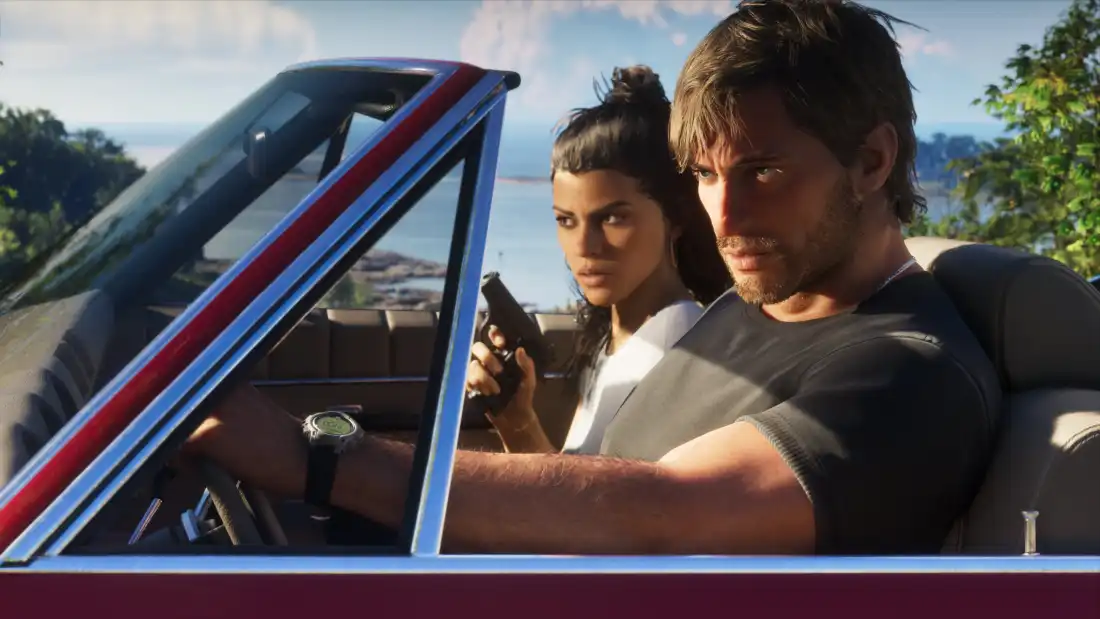
In Grand Theft Auto VI, the city is no longer a collection of victims waiting for you to beat up or exploit them. It’s a collection of people with their own short fuses — many of them as broke, frightened, and intoxicated as you are. (Rockstar Games)
Early in Grand Theft Auto VI, you and your girlfriend drive to the local branch of Fleeca bank on an errand that, by the franchise’s standards, is something of a novelty. Your job is not to rob a bank but to open an account at one.
Lucia Caminos, fresh out of prison, needs somewhere to deposit her check from her mandatory reentry job, and since her boyfriend, Jason Duval, has made it this far in life without a checking account, they’d like to open one. But after a quick financial review, the manager wonders whether they’ve considered maybe downloading an app instead, and you leave empty-handed.
There are any number of teenagers who could, with a few shakes of a PlayStation 5 controller, get these two out of a police pursuit and across three counties of South Florida without putting a scratch on the car. None, however, can get Jason approved for a checking account. As in real life, the credit score — not brute force or cunning — is the god of this universe.
It’s a telling moment, because the Grand Theft Auto (GTA) that I grew up with was two things at once. It was an adolescent male power fantasy, a sandbox where you could steal a sports car, mow down a crowd, and outrun the police with no lasting consequence beyond a few hundred dollars docked from your wallet. And it was a South Park–style satire of American life, all fake radio ads for penis pills and televangelists and talk-radio cranks. The jokes were broad, and the violence was cartoonish, and the upshot was that nothing meant anything, so everything was permitted. GTA III let you hire a prostitute and beat her to get your money back. GTA V let you torture a man with a car battery and then play golf. It all had a weightless quality.
Yet in the thirteen years since Grand Theft Auto V came out, something peculiar has happened: Rockstar, the studio that produces the game, and its subject have switched places. The United States has turned into a parody of itself, while GTA VI has turned more darkly serious. It plays less like a theme park and more like prestige television, something like HBO’s The Wire or Task crossed with It’s Florida, Man.
In VI, you alternate between the two leads: Jason Duval, an Army veteran doing errands for drug runners, and Lucia Caminos, his girlfriend and partner in crime, recently out of prison. Their relationship is the spine of the game, and a score is kept. If Jason behaves like a sociopath, Lucia notices. Push it far enough, and the game will decide you are, in its own words, “Irredeemable,” and you will be saddled with the suboptimal happy-never-after ending.
Protagonists for the 2020s
Perhaps even the idea of a happy ending is laughable. Jason and Lucia are not mafia dons or retired bank robbers in shiny new Miami mansions; they are among South Florida’s ever-growing lumpenproletariat, Karl Marx’s term for the drifting, disorganized underclass that sits below the working class and outside its institutions. They’re the deinstitutionalized, dealigned masses who hold no union card, no pension, no political loyalty, and often no permanent address. Together they must navigate the gig-work and shadow economy with one hand on their guns and one eye over their shoulders for a probation officer who could help take their young son away from them forever into the foster care system.
So, yes, you can still be a monster, and there are plenty of mindless action sequences and shoot-outs. But they’re tempered by real-world obligations (your son’s crib isn’t going to build itself) and the moral weight of your misdeeds.
Likewise, the world of Leonida, Rockstar’s faux Florida, is much more than a virtual crime laboratory. For twenty-five years, GTA’s pedestrians were furniture with legs. They walked, they screamed, they died. In GTA VI, if you accidentally bump into a man outside a gas station, he’ll square up and may throw a punch. Cut someone off on the highway, and they’ll chase you down in their own bout of road rage. Try to make small talk with a stranger, and there’s a decent chance she’ll tell you to go to hell — or worse — because in a place like this, hardly anyone talks to strangers.
The city is no longer a collection of victims waiting for you to beat up or exploit them. It’s a collection of people with their own short fuses, and many of them are as broke, as frightened, and as intoxicated as you are.
Because the city seems to have a soul, however shrunken, it’s striking what isn’t in Leonida. There are no churches, an observation by British critic Peter Hitchens, who once called GTA the Devil’s Bible. There are also no schools, no community centers, no food pantries, no nonprofits. To be fair to Rockstar, there were never caring institutions of any kind in Grand Theft Auto; the series has always been a portrait of America with the heart surgically removed. But in the older games, the absence read as a joke, a deliberate cartoon of a godless consumer wasteland.
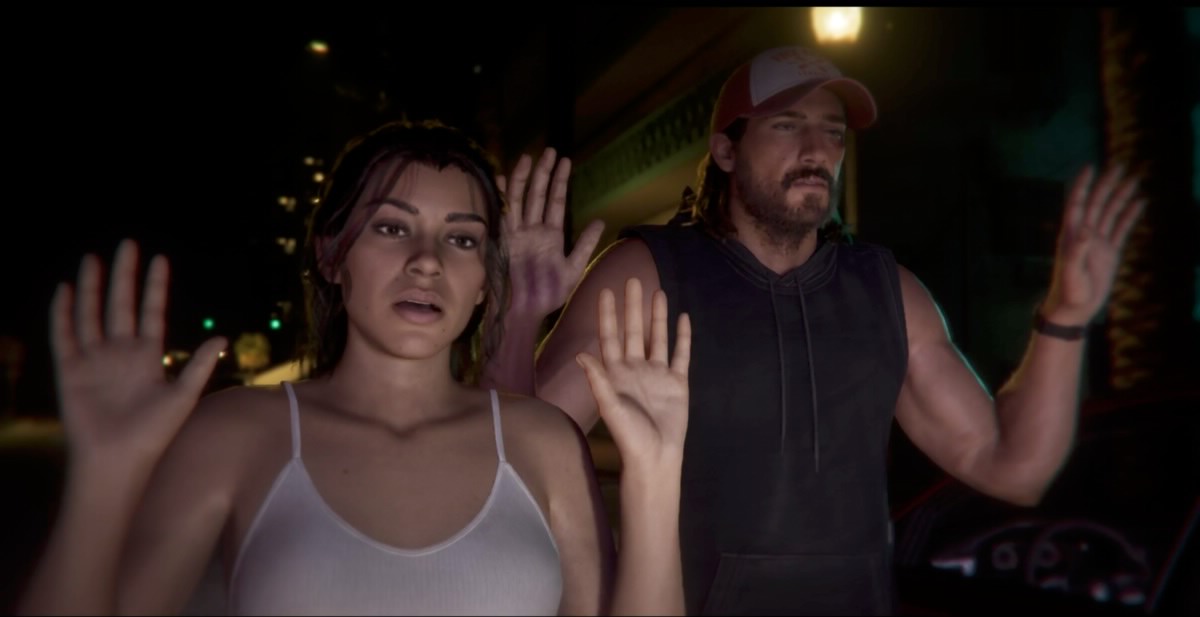
Here, in a world rendered with photographic fidelity, that absence feels like a statement. Every building you can enter exists to extract something from you — your money, your labor, your time. Pawnshops, payday lenders, strip clubs, car washes that launder cash. The only god in Leonida is the market, and you are a free agent navigating its moods, which are capricious and rarely in your favor.
For half a century, Florida has been where America goes to see its own fever dreams, from glamorous to gonzo. In the 1980s, it was cocaine-cowboy Miami: Scarface and Miami Vice, pastels and shoulder holsters, an image so seductive that Rockstar lifted it wholesale for Vice City in 2002. Later came Carl Hiaasen’s crooked developers and his hit man with a Weed Eater for a hand, Tom Wolfe’s Back to Blood, Harmony Korine’s Spring Breakers, the “Florida Man” headline construction, and Tiger King. From high culture to low, it all seemed insane and fun.
Not here. There were stretches early on when GTA VI made me queasy. Rockstar doesn’t open with the postcard Florida of South Beach sunsets or champagne-soaked nightlife, but with the ugly, uncinematic Florida: trash-strewn trailer parks, run-down motels with hourly rates, drug dealers too strung out to count their own money, and skeezy strip club owners who talk to Lucia like she could be part of the inventory. It’s Sean Baker’s The Florida Project, minus the Magic Kingdom glowing on the horizon. I’ve played every GTA since the series went 3D, and this is the first one in which I occasionally wanted a shower, as if the scum from the swamps I was wading through had rubbed off on me.
We’re at a strange moment in the culture wars. In 2026, the people defending Grand Theft Auto VI’s honor are largely progressives — even though one of its leads is a violent white man devoted to his straight, monogamous relationship — while it’s MAGA types who seem to want more anarchy and amorality in their games.
For a quarter-century, hating on Grand Theft Auto was one of the few things Washington could agree on. In 2005, Hillary Clinton demanded a federal investigation after the Hot Coffee scandal in GTA: San Andreas. After Sandy Hook, Joe Biden called video game executives in for a meeting. In 2018, after Parkland, Donald Trump held his own meeting: “The video games, the movies, the internet stuff is so violent. It’s so incredible,” he said. A year later, after El Paso, he blamed “gruesome and grisly video games” for glorifying violence.
Blaming Rockstar Games was once the bipartisan comfort food of American politics: cheap, filling, and nobody ever had to touch a gun law.
So you’d expect Grand Theft Auto VI, the biggest entertainment launch of the decade, to set off the mother of all moral panics. The timing could hardly be better: Republicans were just routed in the midterms and lost both chambers of Congress. Why not change the subject to a video game where you can rob a liquor store in a neon-soaked Florida?
Instead, we’ve mostly heard crickets, with a couple of notable outliers. Tennessee Congressman Tim Burchett told TMZ the game is “more of a how-to video” for stealing cars and shooting cops and said those who let their kids play it are bad parents. But he immediately added, “We’re not going to legislate it.” On Fox & Friends Weekend, Rachel Campos-Duffy said she was “gonna push back a little,” because she didn’t think the game was good for our culture and asked whether Lucia, one of the coprotagonists, was “the hooker.” (Surprise: sex workers are gone from this version.) Fox News Digital’s big GTA story last week was about the dangers of sleep deprivation from playing games all night.
Liberals? They gave up the video game hate beat years ago. Since the Gamergate wars of the 2010s, progressive game criticism has mostly asked who gets to be the hero and how women are depicted. How many cops you can run over hasn’t been the question, and a game with a Latina colead has largely inoculated itself on that front.
So why has the Right gone soft? Perhaps because the Trump White House is like a parody that Rockstar’s writers’ room would have rejected in 2013 for being too on the nose.
The day before GTA VI launched, the official White House account posted a montage of Donald Trump striding past fighter jets, rendered in the game’s signature font, set to Dire Straits’ “Money for Nothing” and captioned “WELCOME TO MAGA CITY XLVII.” This wasn’t shocking, because for more than a year the White House’s social media team has embraced a strategy of appealing to gamer bros.
Consider the back catalog. In September 2025, the account cut footage of Immigration and Customs Enforcement (ICE) arrests to the Pokémon cartoon’s opening theme, then closed on fake trading cards bearing detainees’ faces under the tagline “Gotta Catch ’Em All.” When the bombs started falling on Iran in March, the White House opened its war montage with a Call of Duty killstreak animation, as if the strikes were a reward for thirty kills without dying. Then, in September this year, came Arcade.gov, a set of retro browser games in which you can build the wall and deport people.
The Pokémon Company objected; Halo’s cocreator said a Halo-themed ICE recruitment post made him sick. The White House’s response? More or less its mission statement: “Nowhere in the Constitution does it say we can’t post banger memes.”
That line tracks with an administration that has governed as if life were a nihilistic M-rated game, with the president living out an adolescent male power fantasy: parading young blonde female aides on his arms, staging an Ultimate Fighting Championship fight card on the South Lawn for his eightieth birthday, and floating Nicki Minaj as press secretary after the previous one lasted five days in the job. Alligator Alcatraz might sound like a sick joke from GTA, but indeed, it was all too real: a dehumanizing makeshift immigration detention center in the Florida Everglades, complete with Florida Republicans selling branded merch to chuds.
Even outside of Mar-a-Lago, there are signs everywhere that America has hit a midlife crisis, descending into juvenilia — or, worse yet, psychosis. Grown men trade cartoon apes or dogs on the blockchain and lose their savings, while Hunter Biden gets in on the action with a $LAPTOP coin; bets on Jesus Christ returning for the Rapture in 2026 on Polymarket turn out to be a better wager. Even Las Vegas is dying, because everywhere in America is becoming like Las Vegas, a casino and a vape pen in every pocket.
One of our nation’s biggest young celebrities, sadly, is Clavicular, a twenty-year-old famous for smashing his own face with a hammer to “improve” his bone structure. Out on bail for rape charges, which he denies, stemming from an alleged assault shortly after a live stream, he’s complained about GTA VI being too “cucked” because it wants you to be kind to your virtual girlfriend.
The politicians and pundits worried about GTA corrupting America have it the wrong way around. These days, the game is the one that should worry about being corrupted by us.