The Steel Disaster in Taranto, Italy, Is a Warning to Europe
Italy’s top court has shut down the ILVA steel mill in Taranto, recognizing that it has become a disastrous health hazard. While European authorities boast about green investment plans, the site’s demise reflects the failure of their industrial policy.
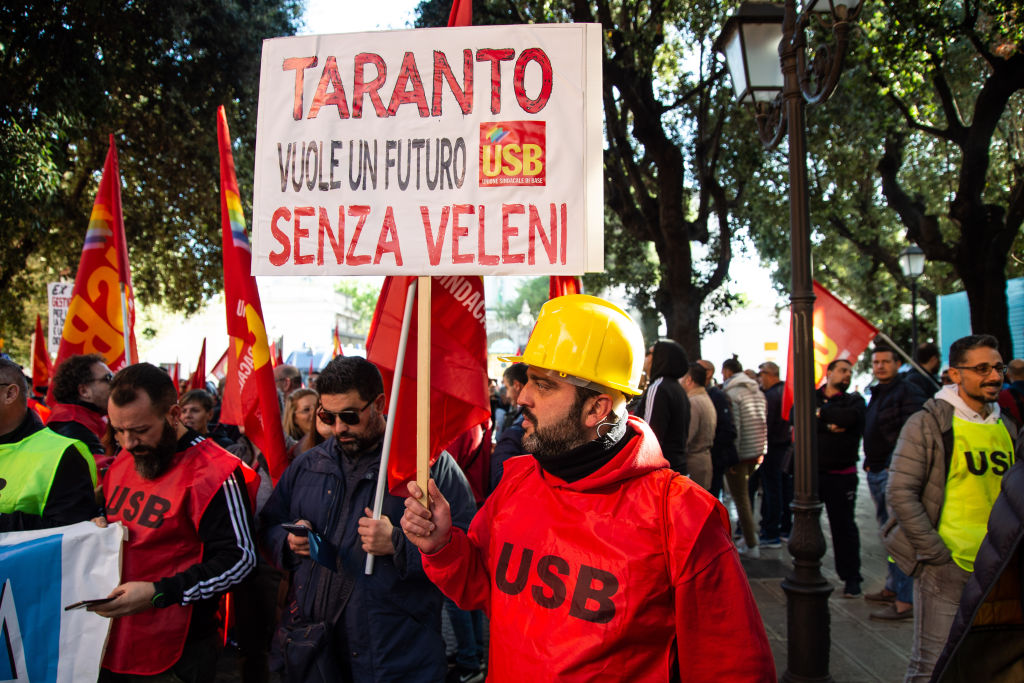
Steel production in Taranto, southern Italy, has long blanketed the city with toxic dust and carcinogenic dioxins. The plant is one of Europe’s worst environmental scandals, but governments keep failing to create alternative sources of jobs. (Ivan Romano / Getty Images)
For decades, labor unions and residents of the southern Italian city of Taranto have been mobilizing around the toxic emissions churned out by the local steel mill. A dedicated group fought for their right to good health through a yearslong legal battle that reached all the way to Italy’s top court. On October 29, the court finally ruled: the blast furnaces, which for decades have blanketed Taranto with fine particulate matter, dioxins, benzene, and asbestos emissions, must close with immediate effect. It represents a bitter-tasting victory after one of the great struggles of European industrial history.
ILVA, as Europe’s nominally largest steel mill is still called, stands right in the center of Taranto, a city with a population of nearly two hundred thousand. The steel mill was built in the 1960s, when Italy’s capitalist class dreamed of finally industrializing the South of the peninsula. The company is now called Acciaierie d’Italia (“Italy’s Steelworks”) and has been operating under state-imposed emergency measures since 2024.
The history of ILVA is one of Europe’s biggest environmental scandals. Local residents, unions, the mayor, and even the local soccer club have all demanded the closure of the blast furnaces. These efforts have consistently failed for want of government plans for financing alternatives.
In statistical terms, the people of Taranto suffer from pleural mesothelioma (a cancer caused by asbestos exposure) four times as much as the general population. In addition, the steel mill has been proven to cause elevated levels of particulate matter and emissions of micropollutants such as benzopyrene and dioxins, as determined by official health-impact assessments. Fans of the local Taranto soccer club have also been fighting against the plant for many years. They have written books, sold scarves with slogans such as “Fabbrica assassina, vergogna tarantina” (“Murderous factory, Taranto’s shame”), and rented public ad space to express their discontent.
With the abrupt closure of its largest employer, Taranto faces the threat of social crisis. More than ten thousand jobs depend on the steel mill; enormous health care costs and the cleanup of a toxic wasteland are deterring investors. The situation is fertile ground for the authoritarian right and its ability to turn disappointment, uncertainty, and frustration into votes.
The much-heralded return of European industrial policy also bears responsibility for ILVA’s demise.
In recent years, governments around Western Europe tried to coax “green” investments out of private capital through generous handouts. And yet, oligarchs and steel tycoons were in no hurry to comply. Although the plant is currently state owned, the government has no concrete plan for continuing production. The site’s future appears to be a painful choice between a complete sell-off to oligarchs or else outright collapse.
Europe’s Rusty Steel Empire
In an age of (sort of) flying cars, steel mills seem like relics from a bygone era. Appearances are not deceiving. The blast furnace process, used worldwide to produce steel for infrastructure, buildings, cars, and weapons, was developed in China over two thousand years ago. Steel truly took off thanks to the self-accelerating economic model of fossil capitalism: machines needed steel and coal; growing coal mining required more machines; and these, in turn, required more steel and coal. Today’s imperial core then began burning ever more fossil coal in ever-larger blast furnaces to produce pig iron — and greenhouse gases, too.
Starting in the 1970s, Europe lost ground to Japan’s rising steel power. Japanese steelmakers dared to build blast furnaces of unprecedented size and, in the process, created a global market for fossil metallurgical coal. Today more than one billion metric tons of coal are burned annually to produce steel. This makes the global steel industry responsible for one-tenth of all human-caused greenhouse gases, more than the EU as a whole.
By the time they were privatized in the late 1980s and early ’90s, European steelmakers were already lagging behind the competition, particularly their Japanese rivals. Global steel tycoons also took advantage of the wave of privatizations to snap up plants that were being sold off at bargain prices following the collapse of the Soviet Union. They downsized the plants’ workforces, established companies in tax havens, closed unprofitable sites, and generally generated good returns for themselves and minority shareholders.
Today Europe’s steel mills are outdated. No new blast furnace plants have been built since the 1970s, and only two blast furnaces have opened in the EU since 2000. From Eisenhüttenstadt to Fos-sur-Mer, Gijón, Kraków, IJmuiden, and Taranto, in a long list of former steel hubs, local residents suffer from air pollution and health problems. Investments to modernize these facilities and curb emissions are long overdue.
Derisking Has Failed
In Italy, at the height of the European Green Deal investment projects in the early 2020s, the prime minister was none other than Mario Draghi. He had previously been a key figure at Goldman Sachs and, as president of the European Central Bank throughout the 2010s euro crisis, a key figure in the troika that imposed austerity on the Greek government. Since 2024, Draghi’s name has come to symbolize EU competitiveness and the associated watering down of European environmental and human rights policies.
In the meantime, in 2021–22, Draghi served as Italian premier and developed a climate road map for the steel plant in Taranto. Beginning in 2019, Europe’s steel manufacturers successively announced decarbonization plans to transition from coal to hydrogen and electric furnaces in order to reduce greenhouse gas emissions. In Taranto, according to Draghi’s plan, €4.7 billion in largely private capital was to be invested to achieve full employment and increase production by 2025.
The political ideology in which economic policy levers are adjusted so that unattractive investments like “green steel” become viable business cases is called “derisking.” The European Green Deal aims to make the steel industry climate neutral and competitive again through such means. Specifically, this meant free emissions allowances, billions in state aid for steel and hydrogen, protective tariffs against China, public procurement of “green steel,” energy price subsidies, and more lenient reporting requirements.
In an attempt to make green investments attractive to private capital, several EU countries dealt with ArcelorMittal. The world’s second-largest steel company holds a de facto monopoly on blast furnace production in Spain, France, Belgium, and Poland and operates additional blast furnaces in Germany (Bremen and Eisenhüttenstadt). From 2018 to 2024, ArcelorMittal also operated the plant in Taranto. Yet governments underestimated the steel giant’s negotiating position; it abruptly announced that it could not invest at all locations, thereby provoking a subsidy race among member states.
Up to €15 billion in low-carbon subsidies has since been awarded to steelmakers, but even that is not enough. As a result of high energy prices following the invasion of Ukraine, ArcelorMittal put all hydrogen projects on hold at the end of 2024. Seven lost years after the Green Deal, only a few Swedish and German steelmakers in the EU are still pursuing significant decarbonization projects. Meanwhile, many locations are in an even worse economic position than before. The EU’s “derisking” project appears to have failed, at least for now.
Draghi is quite right to blame the industry’s struggles to a lack of competitiveness. Raw materials and energy mostly have to be imported. Labor costs are comparatively high due to Europe’s past imperial might but also its historic labor struggles. Europe’s historical advantage in innovation has long since been squandered; the innovation hubs of the steel industry are now in Japan, Korea, and above all China. Added to this are persistent global overcapacity and higher returns in the financial sector, which is why ArcelorMittal prefers to carry out share buyback programs rather than make forward-looking investments.
Yet instead of EU member states pursuing alternative and more democratic economic models, the lack of competitiveness serves as a pretext to pursue austerity measures and the upward redistribution of wealth. Europe’s steel-producing regions are thus kept in a state of perpetual crisis, which further exacerbates health and climate damage. The authoritarian right skillfully exploits the resulting uncertainty about people’s jobs and the economic survival of their hometowns. This too is a result of timid industrial policies. In turn, these same right-wing parties, building on neoliberal ideological assumptions, further undermine democracy.
Socialization Is Not Enough
A bold democratic alternative is urgently needed to ensure a stable supply of raw materials. The good news is that we’re not starting from scratch. In June, the French National Assembly voted for the second time to nationalize the French division of ArcelorMittal, but the measure has so far failed to gain Senate approval. In Germany, in a recent position paper, Die Linke advocates for state involvement in the steel industry. Some steel manufacturers, such as the German companies Saarstahl and Salzgitter, are either part-publicly owned or bound to social interests. In Austria, Voestalpine employees own 15 percent of the company.
Recent developments in France and Germany make it clear that momentum is finally building around the issue of ecosocialist industrial policy. Yet socialist parties are running late, and nationalization alone is not enough. Rather, the direction of these plants must be anchored in a solid transformation strategy.
Democratic management of industry requires that we wrest the systems of provision we need to meet our basic needs from the logic of capital accumulation. Such transformative supply systems must be protected from capital and structured in such a way that social participation has a self-accelerating effect.
This presents two fundamental challenges for the democratization of the steel industry. First, solutions are needed to protect socialized steel mills from the capitalist market. Only in this way can economic leeway be created for radical experiments in Europe’s outdated and contaminated facilities. Long-term offtake agreements with public infrastructure operators (such as water or energy utilities) could be a first step. Further socialization of major steel consumers could be the next.
The second is that the EU obtains most of its energy and raw materials through imports. Dependence on raw materials makes socialist experiments vulnerable to crisis-induced market fluctuations and acts of economic sabotage. Increased use of scrap steel and renewable energy within the EU can mitigate these risks. In the spirit of “resilience by cooperation,” solidarity-based alliances can be built beyond the EU, with the goal of dismantling colonial patterns in value chains and organizing the procurement of more socially and environmentally sustainable primary raw materials in the longer term.
In Taranto, the state and private capital are leaving behind a toxic wasteland that hangs over the future generations. Even beyond the enormous costs of repairing this situation, hopes of industrial transformation are also complicated by the presence of organized crime in every stage of the waste cycle and its frequent involvement in public-procured construction projects, as documented by Italian NGO Legambiente in its No Ecomafia campaign. Given these obstacles, democratizing production is likely the only way for Taranto to retain the site in the long term. Unions and the local population have already mobilized and have the only concrete plan for the plant’s future.
For the rest of Europe, Taranto remains a cautionary tale: a foretaste of what might come next.