The European Union Is Turning Away From the Green Transition
Europe has often called itself a global leader in fighting climate change, even promising to halt the sale of new gas-powered cars by 2035. Yet now it’s dropped the plan, as part of a broader retreat from the green transition.
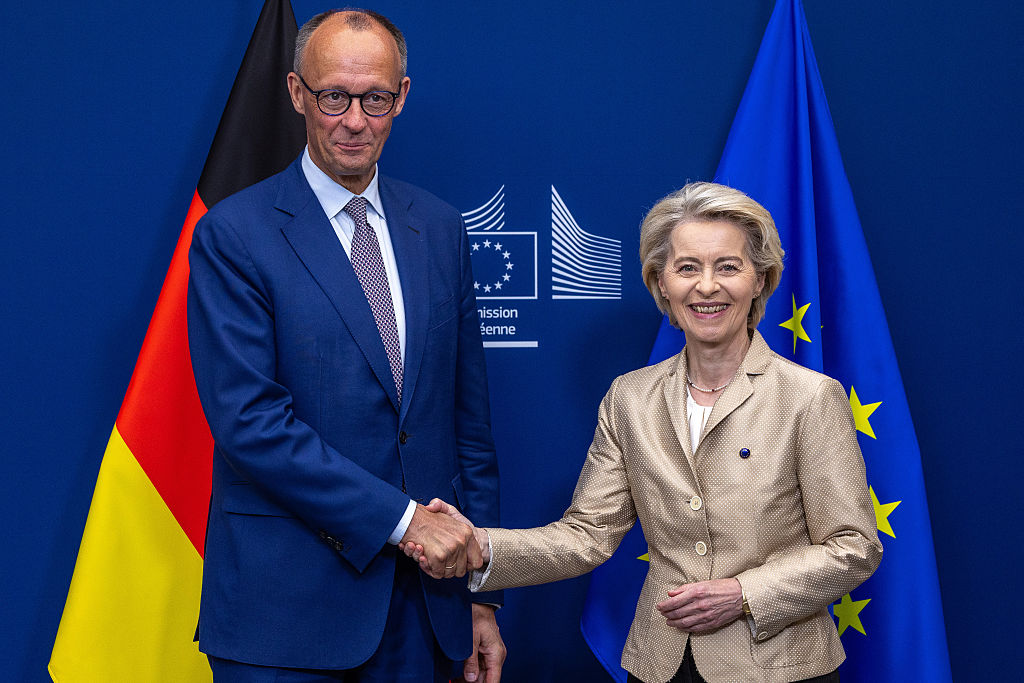
German Chancellor Friedrich Merz has succeeded in getting the EU to drop a planned ban on new gas-powered cars. It’s a stay of execution for his country’s auto industry but also signals Europe’s move away from green reindustrialization plans. (Omar Havana / Getty Images)
On Tuesday, the European Commission announced that it will drop the planned ban on new internal-combustion-engine cars from 2035, after pressure from the German government and the auto industry. The announcement came only a few weeks after a vote in the EU Parliament weakening the bloc’s previous broad climate agenda. Pascale Piera, a member of the EU parliament (MEP) for France’s Rassemblement National had called that vote the beginning of “the dismantling of the Green Deal.”
This legislative blow against the legislative package — approved by the European Union in 2020 to deal with the ecological crisis — went relatively unnoticed by ordinary Europeans. This is quite normal, given the technical appearance of the regulation adopted and the haze of opacity that obscures most decisions in Brussels. However, last month’s vote marked a major setback for the EU’s green agenda, as well as the clearest sign yet that mainstream parties no longer have a cordon sanitaire against the far right. The single largest bloc in the EU Parliament, the center-right European People’s Party (EPP) negotiated the legislative changes with far-right parliamentary groups. Such forces, stretching from Spain’s Vox to Poland’s Konfederacja and Germany’s Alternative für Deutschland had scored a record result in the 2024 European elections, securing one-quarter of seats and greatly increasing their influence.
The regulation approved in November was called the Omnibus Directive. Introduced by Ursula von der Leyen’s European Commission, it is meant to “simplify” the obligations imposed on companies by the European Green Deal. The objective: to improve “European competitiveness and efficiency,” the founding mantra of the Union, which enshrines “competitiveness” as a fundamental principle in Article 3 of the EU Treaty. The Omnibus Directive cuts the environmental obligations of large private firms in two ways. First, it drastically reduces the scope of the Corporate Sustainability Reporting Directive, which requires companies to publish evidenced reports on the social and environmental impact of their activities. Now only companies with more than 1,750 employees and a turnover over €450 million will be subject to the reporting obligation — meaning 92 percent of the companies originally covered are now exempt. Its introduction has also been postponed to 2027.
The Omnibus Directive has also watered down the Corporate Sustainability Due Diligence Directive, with even looser application thresholds: only companies with more than five thousand employees and a turnover topping €1.5 billion are obliged to prevent and remedy the adverse environmental or human-rights impacts of their activities. Polish far-right MEP Tobiasz Bocheński was right when he said the European Green Deal “has never suffered such a serious setback.” The alliance of conservatives and the far right to dismantle the Green Deal adds to the quieter steps the Commission has taken since 2024 to scale back the EU’s environmental ambitions.
A Silent Backslide
Brussels has also weakened anti-deforestation measures and the environmental requirements of the Common Agricultural Policy (CAP), a key policy that absorbs more than 20 percent of the EU’s budget. In 2023, the EU adopted a law to tackle deforestation by banning the import of raw materials linked to forest destruction. This promised globally pioneering regulation, as it placed environmental protection above free trade, a principle traditionally sacrosanct in EU institutions. However, pressure from industry and conservative parliamentary groups delayed its entry into force until this month, and a provisional agreement has been adopted to push it back another year. In the meantime, deforestation continues, worsening the climate and biodiversity crises.
Von der Leyen’s European Commission — a conservative-leaning set of commissioners, but which also including social democrats, liberals, and a far-right Hungarian representative — is also pushing to relax sustainability requirements for accessing CAP funds. This loosening comes on top of changes approved in 2024 amid farmers’ protests in several countries. The main complaint of farmers and livestock producers — who blocked roads and protested across half of Europe — was the difficulty of making a living, largely due to unfair competition enabled by free-trade agreements.
For this reason, farmers’ organizations oppose the free trade agreement reached in 2024 between the EU and Mercosur, a South American trade bloc that includes Argentina and Brazil. The deal is also rejected by environmental organizations, as it will increase imports of beef and soy into Europe, encouraging deforestation of the Amazon and harming European livestock producers, who are subject to stricter regulations. The European Commission could have responded to farmers’ protests by freezing negotiations on the trade agreement, but instead chose to relax environmental rules affecting agriculture and livestock. After all, competitiveness (of big corporations, one might add) is a fundamental principle of the Union — environmental protection and farmers’ quality of life are not.
Environmental backsliding has also become apparent — albeit more discreetly — in the EU’s stance at the most recent UN Climate Change Conference, COP30, held in Belém, Brazil last month. The EU has traditionally played a leadership role at these summits, pushing other countries to adopt more ambitious greenhouse-gas reduction targets. This ambition has been made easier by the bloc’s sheer economic capacity — which allows for easier financing of decarbonization policies compared to less developed countries — and by the offshoring of much European industry to Southeast Asia, which accounts for a significant share of the EU’s domestic CO₂ emissions reductions over the past two decades. On the other hand, Europe’s advocacy of big emissions-cutting goals contrasts with its weak commitment to financing adaptation and mitigation policies in the Global South. At COP29 in Baku, Azerbaijan, the most developed countries offered only $300 billion per year by 2035 — a figure described as “abysmally poor” by Global South negotiators.
The EU delegation arrived at COP Belém with a commitment to cut European greenhouse-gas emissions by 90 percent by 2040. At first glance, this looks big, but the member states — more divided than ever due to the presence of climate-skeptical far-right governments — managed to agree only on a 2035 reduction “between 66.25 and 72.5 percent.” Moreover, 5 percent of the reduction can be achieved through purchasing emission credits from other countries, a controversial mechanism that does not represent a real cut in CO₂ and other gases emitted by European economies. Beneath the strong green rhetoric that the Commission maintains on the international stage lies a weakening of the EU’s climate ambitions, now coupled with the dismantling of European environmental regulation.
The Far Right Is Not Alone
The November 13 pact between European conservatives and ultranationalist groups was rightly condemned as a dangerous precedent. For instance, the cochair of the Greens group called it “a sh-tty sign for Europe, for the fight against climate change . . . a very bad signal for the cooperation for the next four years.” The European People’s Party chose to look to more right-wing forces to pass the Omnibus Directive, even though the current composition of the European Parliament would have allowed an alternative — in fact, more traditional — majority together with more climate-policy-minded social democrats and liberals, and indeed the Greens.
Yet concerns about the breaking of the cordon sanitaire that has so far reduced far-right forces’ direct role in governing the EU should not hide a deeper reality. For it was Europe’s centrist parties themselves who began to roll back key elements of the green agenda, just a few years after the European Green Deal was triumphantly approved. The alliance of conservatives, social democrats, and liberals has taken other decisions with disastrous ecological effects, such as the Mercosur free-trade agreement or the weakening of Common Agricultural Policy environmental criteria.
The enthusiasm that Brussels elites and major party leaders showed in 2020 when approving the European Green Deal has quickly shifted to an arms-race agenda, in the context of the Russian invasion of Ukraine and Donald Trump’s growing hostility toward the EU. This March, EU Commission chief Von der Leyen presented the “Rearm Europe Plan,” which facilitates defense investments by member states; all NATO-member EU countries except Spain have committed to spending 5 percent of their GDP on defense by 2035. This astronomical increase would mean an additional €500 billion per year in military spending. For comparison’s sake: with such an injection of resources, the EU could fully decarbonize its energy sector in five years, drastically reducing emissions and, incidentally, its dependence on fossil fuel–exporting countries. The shift from green to the grey of weapons has not been driven by the far right, but by Europe’s governing elites — in Brussels and in the continent’s main national governments.
The European Green Deal was mainly conceived as a vehicle for investment in private business, mostly in renewable energy and electric vehicles. Although its key aim was to boost corporate profits, it did mark an important step insofar as it contributed to the decarbonization of European economies and reducing their environmental impact. Yet the rollback of environmental regulations since 2024, coupled with the new arms race, confirms that these climate-related objectives come second to questions of business competitiveness. The Green Deal investments are still in place, in an attempt to challenge China’s leadership in the technologies needed for the energy transition. Yet, EU leaders have made it clear that today’s priority is rearmament.
If the Green Deal offered green Keynesianism, Von der Leyen and European governments have found a substitute for this in military Keynesianism. This also helps unpopular leaders like Emmanuel Macron bolster their legitimacy through belligerent rhetoric and calls for national unity against the Russian enemy. The rising far right — fanatically opposed to the green agenda — is in this sense serving as a convenient pretext for European elites to cut back environmental policies they had approved in response to the ecological mobilizations of the late 2010s.
Yet, this priority — putting business competitiveness above any social or environmental concern — is not exclusive to the far right. Indeed, it is the constitutional DNA of the European Union. It is the principle that has guided the grand coalition of conservatives, liberals, and social democrats for decades, with few exceptions. The low media visibility of legislative debates in Brussels, often technical and far from ordinary people’s direct concerns, makes it difficult for citizens to know about and respond to this rollback. And yet the EU’s long-criticized democratic deficit makes it easier to quietly dismantle a green agenda, which is today more necessary than ever.