The Return of Industrial Policy
Industrial policy is back in vogue in recent years — but without the working-class power to discipline capital, it’s just public money flowing to private profit.
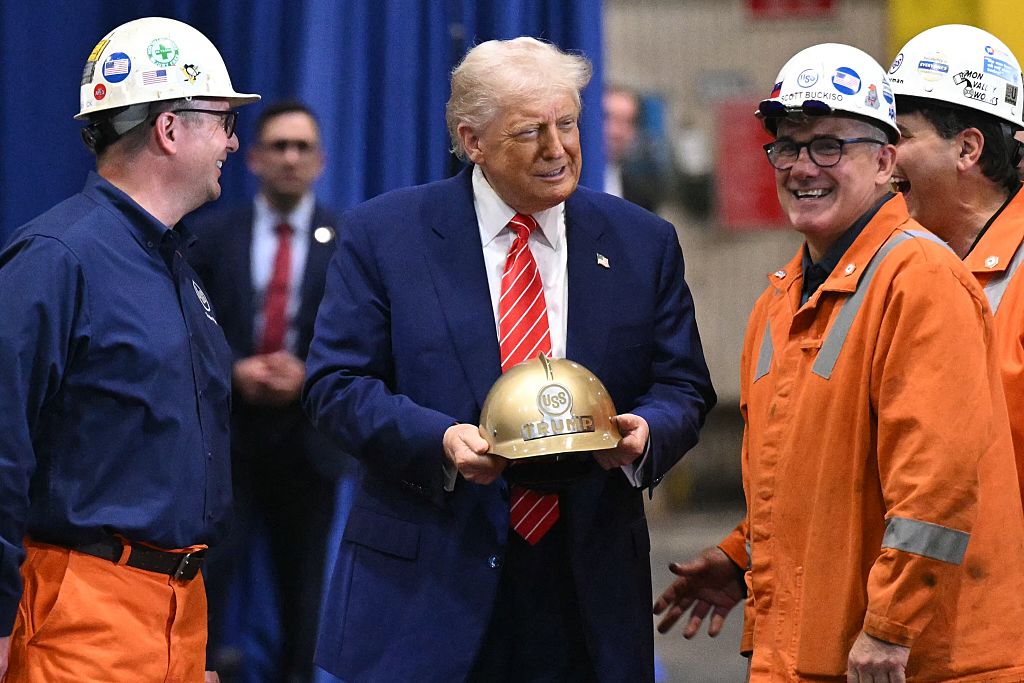
Advanced capitalist countries have recently rediscovered the role of industrial policy to build out key economic sectors like semiconductors and AI. But the “return of the state” won’t necessarily help workers. (Saul Loeb / AFP via Getty Images)
Advanced capitalist countries have recently rediscovered the role of industrial policy to build out key economic sectors like semiconductors and AI. But what happens if business is the one calling all the shots?
In this episode of the Jacobin Radio podcast Confronting Capitalism, Vivek Chibber discusses how developing countries used industrial policy in the past, why the United States and Europe are now turning to greater state intervention, and how one could build a new social democratic alliance between the state and labor.
Confronting Capitalism with Vivek Chibber is produced by Catalyst: A Journal of Theory and Strategy and published by Jacobin. You can listen to the full episode here. This transcript has been edited for clarity.
I was asked to speak on some relevant topic having to do with development inequality and the Global South. And it seems to me that industrial policy is something that is relevant not only because it brings all these matters together, but because it is also now in the air once again after a hiatus of many, many years. And I thought it would be interesting to explore what exactly it is, where it came from, what its prospects are, and what to make of it today in this world as we move on into, hopefully, a new era.
Now, the context in which industrial policy has come up today is very different from the last time that it was a major issue. And the last time in development studies that it was a major issue was in the mid-1990s. And interestingly, the World Bank itself came up with a report called “The East Asian miracle.”
This report was a landmark event, because even while it continued with the World Bank’s basic orientation — which was that development should be market-oriented and should avoid an extensively interventionist state — it did have to accept, at least grudgingly, that the Northeast Asian miracle economies, primarily Korea and Taiwan, but also some of the Southeast Asian economies that had done well, had relied to a great extent on state intervention. And the report had to go through all kinds of somersaults to both acknowledge that state intervention occurred and was not entirely disastrous, but at the same time keep to the orthodoxy that it should nevertheless be avoided.
Now, that was the mid-1990s, and that was the moment at which development studies was taking a turn under the influence of some very, very important works by scholars like Robert Wade and Alice Amsden. It was discovered and argued to great effect that not only was state intervention a regular feature of East Asian success in their development but was a foundation for that success. In the interim, the scholarly world deepened this argument and indeed confirmed it in many, many ways.
The irony, of course, is this was happening exactly at the moment when liberalization in the developing world was at its peak.
Just as the East Asian miracle report comes out, we see that across Latin America, South Asia, and in the East Asian miracle economies themselves, the developmental state was being rolled back. So not surprisingly, just as the Bretton Woods institutions acknowledge the importance of industrial policy, the actual practice of industrial policy starts to wane.
So how is it that today we find the topic coming back?
Well, not only has it come back, but the World Bank has a very different attitude toward it. It’s come back largely now because the advanced world is moving toward some sort of practice of state intervention. And because of the enormous influence that the United States and Europe has on the bank, lo and behold, the bank not only publishes now, in 2026, a report on industrial policy and its revival but is largely supportive of it.
It looks like something that was taken off the agenda for a quarter century is now back on the agenda.
So in this talk, I want to address four questions. First of all: What exactly is industrial policy? Secondly: What were the conditions that gave rise to it? Thirdly: Where did it come from? And fourthly: What were the variables, the factors that determined whether it was successful or not? Because it is indeed the case that it was not always uniformly successful. And having then explored this historical lineage of industrial policy, we want to ask the burning question for today, which is: What are the prospects for its success today and what forms should it take if we are to return to it in the sort of way we did in the postwar era?
How Industrial Policy Works
So let’s just start with the definition. What is industrial policy? Well, there are two basic components of this approach to development. One is that industrial policy seeks to protect local firms from international competition. The reason for that is that it is perceived that because local firms are uncompetitive — either because their country is just starting its path to industrialization or because the country is losing an edge that it used to have — those firms cannot effectively compete against international rivals.
And so in order to give them the space and the ability to build up their productive capacities, there needs to be some kind of attenuation, some kind of lessening of that international competition. They’re given all sorts of protections from it, mainly through things like tariffs, but also through things like exchange rate manipulation and interest rate manipulation. This is the protective aspect of industrial policy. This is complemented by its second essential component, which is various forms of subsidies that lower the price of inputs so that firms may be able to then hothouse their investment process.
The idea is that the protections and the tariffs clear out international rivals and create a space for firms to develop their capacities, and then the subsidies accelerate the process by which they can develop managerial skills, acquire new technology, learn how to use that technology, create the skills that their workforce needs, etc. Something that would take decades to achieve is hoped to be achievable in a matter of a few years.
These measures were essential to industrial policy but understood to be temporary. The idea was not to create a forever world in which local firms are protected and subsidized but to have it be an island, a brief moment in history, so that they can gather up their abilities and then throw them out onto the global economy so that they may compete effectively.
Not surprisingly, industrial policy was primarily practiced in the developing world, because this was the area in which manufacturing was not yet very much developed and in which it was felt that unless they were given a chance to build their capacities, the firms in these countries would forever be uncompetitive in relation to the advanced world. But it should be understood that there’s nothing intrinsic in industrial policy that confines it to the developing world.
Since the principle is to allow firms to build their capabilities to better compete on the global market, you can also see it being practiced in advanced countries. When? Well, when firms in those advanced countries that once had a competitive edge find themselves losing that competitive edge to new rival firms or countries where firms are developing their capabilities faster.
So you can have, and you have had, industrial policy in both parts of the world, both in the Global South and, for example, right now in Europe and in the United States, because it’s perceived that they are falling behind relative to newcomers — of course, primarily China.
Double-Edged Development
The problem with industrial policy, its central contradiction, was that the very instruments that were used to promote industrialization also had the potential of undermining that very goal. The very instruments — tariff protection and subsidies — that were essential to industrial policy had this one problem, which is they were intended to make firms more competitive, but precisely the fact of attenuating and reducing the competitive threat from rivals eased the pressure on local firms to build their competitive capacities.
What was happening with industrial policy was, because the global rivals were being warded off from the local market, the very importance and the centrality of building up their competitive edge was lessened on local firms because they were essentially given free and easy profits. Since international competition was no longer a factor, firms locally, even if they were uncompetitive, even if they did not emphasize efficiency, were able to capture local markets with relative ease.
That meant that implementing industrial policy also ended up creating the conditions for its failure. States, therefore, had no alternative but to try to develop instruments to ward off or to block firms’ inclination to accept the subsidies, to accept the free profits, and then refuse to upgrade their equipment, refuse to adopt best practice technologies because they didn’t need to, because the profits were coming in for free.
How could states avert that outcome? They did it, or they tried to do it, by developing administrative capacities, institutions within the state that had the job of monitoring those firms and then sanctioning them in the event that they did not use the subsidies in the way they were intended.
So alongside the adoption of industrial policy in the postwar era, there was a decades-long process of state-building and institution-building. Without those newly created institutions that might be able to monitor and sanction, that is to say, discipline local firms, there was a live chance that those subsidies that were being given to them would be frittered away or used in ways that were not initially intended.
This set up a conflictual process between those firms and the state. What states found, what state managers found, was that firms were very, very happy to accept all the gifts that were being given by the state, but at the same time rejected or struggled against the insistence on discipline and the insistence on using subsidies as intended.
Why would they do this? In these developing countries, precisely because the markets are protected through tariffs, there’s a big incentive to take the monies that are coming through cheap loans, cheap credit, easy inputs, and to then reallocate them to other lines and other sectors to capture what’s called first-mover advantage.
If I’m being given money to start up a new auto plant, let’s say, but I also know that it’s possible for me to acquire monopoly rights and first-mover advantage in building, say, machine tools, what I do is take the money that’s being given for auto, redeploy it toward machine tools, and now I have a first-mover advantage or monopoly presence in both sectors rather than just one. The reason I don’t have to worry about losing advantage in auto is that it’s already been protected from international competition, and I don’t have any local domestic rivals.
So the lesson that states everywhere learned was that what firms were looking for was not laissez-faire. They were not looking for a free market economy. They were looking for the first component of industrial policy while rejecting the second. They were looking for all the subsidies, all the gifts coming in from the state, but very resistant to the demand for reciprocity, very resistant to the demand for then abiding by the priorities that the planners and the state managers had accorded and instead reallocating them toward their own priorities and their own sense of where the money would be best used.
This was a direct consequence of the dilemma of protectionism and of closing off competition.
Interestingly, the two countries where you saw the most success of industrial policy, Korea and Taiwan, were successful precisely because the states managed to not simply give firms easy access to local monopolies and easy profits. They successfully had the firms take the subsidies and then commit to highly competitive markets where they would be forced to use them in ways that enhanced their capabilities. These were of course export markets.
For very specific and highly contingent reasons, Korea and Taiwan were different from most of the other developing countries in that in these countries, instead of committing simply to import substitution and growing in the domestic market, Korean and Taiwanese firms committed to what’s called export-led industrialization.
Export-led industrialization means that their investment practices were primarily geared toward the export markets in the United States and to a lesser extent Europe, not primarily geared toward capturing the domestic market, whereas in countries where there was more of an emphasis on import substitution, the freedom or the lack of exposure to export markets made it easier for them to not worry about competitiveness.
In other words, what export-led industrialization did was that it exposed local firms to cutthroat competition. Because they were exposed to cutthroat competition, they actually needed the coordination that came through state discipline, whereas countries like India, Turkey, and Egypt had firms that were rejecting state discipline, state coordination, and state directives.
Korean and Taiwanese firms needed it, and the reason they needed it was when they were trying to compete in export markets, they needed to make sure that inputs coming from upstream firms and linkages to downstream firms were actually timely, effective, and well coordinated. If they had been left to the free market and firms’ own decisions, that might have come about but would have done so in a way that was much slower, less predictable, and more risky than it was through the coordinating hand of the state. And so what export-led industrialization did was it made firms need the state.
The Political Foundations of Industrial Policy
These were the two universes of industrial policy in the postwar world. Most middle-income countries that resorted to it succeeded, but only moderately well, because a fair proportion of the gifts and subsidies that states were giving to the firms did in fact go to waste, did not in fact go toward upgrading their equipment.
While the miracle economies of Korea and Taiwan did much better because of these competitive pressures on them, overall, industrial policy was a success. Even among countries like Turkey and India, it did succeed in creating an industrial base, albeit at a slower pace and with less global efficiency than in the miracle economies. So discipline was only partial, but it did succeed to an appreciable extent, more so than any other strategy the Global South had in the century preceding it.
The political foundations of developmentalism and industrial policy were essentially this partnership between the state and local capitalists. But just as the entire era of industrial policy and developmentalism had political foundations, so did what replaced it, which is the neoliberal era.
Now, the reason I’m stressing this is there’s a kind of a current, you might even think of it as an orthodoxy, inside development studies which looks at the onset of neoliberalism and globalization in the South as something that was imposed by the West, or as something that was imposed by the advanced countries through the Bretton Woods institutions, like the International Monetary Fund (IMF) and the World Bank.
According to this account, countries would fall into debt, they would have a payments crisis, and the IMF would come in and give them a loan. And in exchange for the loan, it would be demanded that they liberalize, that they free up their markets, and they allow firms from Europe and the United States to come in, whereas they had been thrown out in the era of import substitution.
Now, empirically, it is true that Bretton Woods institutions did come in with a great many demands to liberalize, but it’s important to understand that this is not something that started in the 1980s and ’90s, which is the era that we associate with neoliberalism. In fact, Bretton Woods institutions had been pressing for liberalization ever since the late 1960s, accelerating in pace and increasing in intensity through the 1970s.
The IMF came in at several occasions in Latin America, in South Asia, in the Middle East, and provided loans with demands for austerity, with demands for liberalization, and the response on the part of these developing countries would be, in fact, as long as the Bretton Woods advisers were in the country, to do some liberalization to change their exchange rates, to change monetary policy.
But the moment the advisers went back and the payments crisis was averted, the countries would go back to import substitution, back to industrial policy. Why? Well, the reason was that no policy could remain stable as an economic policy unless it had domestic sources of support. The World Bank can come in, the IMF can come in and make demands, but it has to leave, and once it leaves, what the state does is going to depend on what the local elites, the local politically powerful classes are demanding of it.
Through the 1960s and ’70s, the most important constituency inside these developing countries, which is the industrial class and the business class, was still very deeply committed to the free profits, the easy profits, the cheap credits, and the easy existence that import substitution and protection provided to it. This is why to accord primacy to the Bretton Woods institutions is, I think, an analytical error. They could be a trigger for promoting liberalization, but they were never the fundamental cause.
The fundamental cause was the growth of a local constituency that started to see a more liberalized economy as being within its own interests, and this did not really develop until well into the 1980s.
What was this constituency? Well, it was of two kinds. One was the largest firms inside these countries, who, while being happy with the easy conditions of the industrial policy and planning era, did in fact see limits to their own growth unless they were able to go into the global market and also get cheaper capital goods from industrial countries. Their problem was that they were trying to build up some degree of their capacities over time, but the very inefficiency of local firms also meant high-cost, unproductive capital goods, and there was no chance they could ever compete on the global market without cheaper inputs and cheaper capital goods, which required easing up the tariffs — the barriers to the entry of foreign goods — which included foreign capital goods.
So, on the one hand, there was a domestic capitalist class that saw itself as having developed well enough and being powerful enough to actually contemplate entering global markets.
On the other hand, precisely because they were now endowed with greater abilities in spite of being slower in developing them, those greater abilities meant they did not need to tolerate a regulatory and interventionist state anymore.
It’s important to understand that firms always wanted the subsidies, but they never wanted the more disciplinary interventions of the state. But states, even when they were not as effective as Korea and Taiwan, did introduce and evolve just such instruments of regulation and monitoring, even if they didn’t work very well. Firms grudgingly accepted them because they were part of the overall package, but once those firms thought they no longer needed them, you saw them pushing back with greater vigor against the interventionist state.
There’s no place where this happens more aggressively than Korea itself. By the 1990s, Korea’s chaebol were saying, “We do not want the old-style Korean interventionism that we had in the ’70s and ’80s because we no longer need it.”
You saw this happening in India. You see it happening in South America. The largest firms in these countries were now pushing back against the more protectionist and the more interventionist states.
So by the mid-1980s, Mexico, Argentina, Brazil, India, of course, Korea, in all these countries there is a local constituency that is now quite interested and supportive of a liberalizing agenda.
When the IMF and the World Bank came in and said, “You must liberalize,” state managers found that there was a local constituency that’s saying the same thing, that’s saying “Yes, we must liberalize.” And whereas in the 1970s you had episodes of first liberalization and then going back to a protected regimes, in the 1990s you find liberalization sticks. It doesn’t get reversed and it starts moving on.
So the political foundations of globalization and liberalization in the Global South were a transformation of its own domestic industrial class and domestic business elite, which means it’s not going to go away on its own.
Today we’re not going to have an era where if the United States stops pressuring these countries to liberalize, and they will go back to where they used to be, because there is no powerful constituency in these countries anymore, as there was in the 1940s and ’50s, that wants the kind of developmental partnership that you had back in the postwar era.
This means that if industrial policy does come back, it’s not going to be the same as it was in the postwar years.
Firms are always happy to take subsidies everywhere. There’s no country in which they will refuse cheap inputs, protection by the state. There’s no country in which they will refuse all kinds of cheap loans and cheap credit.
The issue is: Will they also accept the second component of industrial policy, which is the coordination, monitoring, and discipline on the part of the state? Because capitalists as a group in the Global South no longer feel they need the coordinating capacities of the state, they will be happy to accept industrial policy of a certain kind, which is what we colloquially call the “nanny state.” The more sophisticated term for this is indicative planning.
Planning in a capitalist economy falls into two categories in the postwar era. There was something called indicative planning and there was something called directive planning.
Directive planning is what I’ve been talking about, as industrial policy and planning in which you not only try to help your local business firm, but you try to direct the flows of investment from one direction to another.
The less demanding form of industrial policy is one in which you simply give firms their subsidies, and then you try to help them achieve their own ends rather than having them change their ends. This is called indicative planning. It was practiced in some of the advanced world in the 1950s and ’60s, and what set it apart from directive planning was precisely the absence of discipline. The state was simply a helping hand to the capitalist class.
What you see happening today in the United States, Europe, and across the world, is that the return of industrial policy has much more of an emphasis simply on helping local firms achieve their own ends rather than redirecting those firms into desired channels that may not accord with or correspond to the firm’s own priorities.
The difficulty of industrial policy today will be that even in the West and also in the South, firms are, as they always are, willing to accept subsidies and assistance but not the discipline. That’s the first challenge of industrial policy in this era.
The second challenge is that neoliberalism was not simply a moment when economies were freed up, when regulations were rolled back. It was also an era in which states were dismantled.
So once firms in the South gave up their marriage, their fixation on developmentalism, and adopted a globalizing, liberalizing agenda, those same firms also started putting pressures on states to dismantle their planning agencies, to dismantle the administrative institutions that had been endowed with the ability to raise funds, monitor, and sanction.
Is Industrial Policy Desirable?
Where we are today is in a situation in which if capitalist states try to move toward industrial policy of a directive kind, of a kind that actually pushes firms into new sectors, they would have to engage in a new process of state-building, just as you had in the 1940s and ’50s.
Those institutions, those administrative agencies that had been put out to pasture in the 1980s, no longer exist. They will have to be built again from scratch, precisely because firms no longer feel that they have to put up with these disciplinary institutions, with the administrative agencies of the state.
So the two problems states face are that, first of all, in the Global South — in countries like India, Brazil, and Mexico — leading firms no longer feel like they need the state the way they did in the 1950s and ’60s. And secondly, the states themselves are much weaker. So the institutions will have to be rebuilt.
What are we likely to find? I think we’re likely to find that industrial policy will be indicative — simply, in other words, a helping hand or a nanny state rather than a more directive state. If you look at the CHIPS Act in the United States, if you look at what’s called the Green New Deal, they’re mostly subsidizing efforts. They do not come with a great amount of conditionalities. On paper they do, but it’s not clear to what extent firms have actually been following them.
The difficulty of knowing the extent to which industrial policy today in the United States or in Europe is actually directive is that the current Trump interregnum is so unique. Donald Trump is so disruptive and mercurial that state agencies have been derailed from their tasks in a way that makes it impossible to know whether those tasks are being undermined because of resistance from firms, or if it’s being undermined because the state itself is dismantling them. But I think what you will find over the years is that where industrial policy is returning, it’s largely supportive and not very disciplinary.
But there’s another question, which is: Even if Bidenesque, World Bank–supported industrial policies are promulgated with some degree of efficiency, do they deserve public support? The reason I’m raising it is the following.
What subsidies and cheap credit are is essentially public monies, taxpayer money, being handed over to private, profit-maximizing firms. And what this means is that the firms are in many ways having some of the risks of investment being socialized, because they’re not having to raise their money themselves — they’re not having to go and acquire inputs themselves, which is costly. Those costs are being reduced. But the profits are still entirely up to the dispersal and the wishes of the firms themselves.
One way to put it is that what industrial policy of a nondirective, that is, of an indicative kind, is doing is socializing their risks while allowing them to privatize and privately appropriate all the profits. The question is: Is this something that the public should support? Is this something that we, in a democratic society, should be supportive of, which is for private actors to be given access to public monies without any kind of obligations on their part as to what they do with the money? Without any kind of obligations on their part to the public good as a condition for acquiring those monies?
At the very minimum, I would say, in a democratic country, in a democratic polity, these funds should come with some kind of agreement on the part of the firms as to what they will do with it, much as the principles of directive planning in the 1940s and ’50s had. The money should come with an insistence that the firms agree to certain labor rights, that they agree to certain environmental regulations, that they agree to certain conditions of work and upgrading the conditions of work for their employees as a part of the agreement on access to those monies.
This was part of the motivation in the 1940s and ’50s as well. These were newly democratizing countries, not just newly developing countries, and there was public pressure to make sure that whatever money was going to these firms would also be reciprocated in some way with obligations on their part. I think those principles today are going to be as valid as they were back then, and this brings us back to the problem, therefore, of discipline.
Even today, if you’re going to have industrial policy, there is going to be massive public pressure for that policy to come with conditions that are imposed on the firms. The problem is, this is not Brazil of 1950 or India of 1955.
Industrial policy is coming back, not just in the Global South, but also primarily right now at this moment in the United States and Europe, and firms in the United States and Europe, private firms, are much more powerful than the firms had been in the 1940s and ’50s in the Global South, and if they are not interested in reciprocating in exchange for the loans that they’re getting, their ability to fight back, to block state initiatives toward reciprocity is much, much greater than it was for firms in developing countries in the postwar era.
So we’re stuck with two possibilities, or rather one possibility, which is you can have industrial policy, but it’s going to be policy that is largely supportive and not very demanding of those firms, which basically means public monies are going to be used toward private ends.
The promise, of course, is that if those monies do, in fact, result in more chips being produced in the United States, in better AI, you’re going to have faster growth, and that faster growth means a tide that lifts all boats, more jobs, better wages, more income growth for labor and the employees. But that’s largely an artifact of the free market ideologies of the 1980s and ’90s.
What we have seen over the last two generations in the advanced world, especially in the United States, is growth and a decent pace of investment but also stagnant wages for two generations and increased wealth accumulation. So the entire idea that we just throw money into the private sector, hope that they invest it, and that investment will mean better standards of living and increasing welfare for the general population, has largely been shown to be a fallacy. And therefore, if public monies are being redirected toward these firms, it should come with some guarantees, some kind of political exchange between labor and capital such that the reinvestment also comes with guaranteed improvements across the board for the employees and for the general population.
Social Democratic Developmentalism
The challenge is: How do you do it? How will you get a reluctant business community, even a hostile business community, to agree to such reciprocities?
I’ll close with a couple of suggestions as to how you might make sure that firms minimally use the monies in the ways intended, but maximally also bring with those reinvestments some kinds of guarantees for employees and for the general population.
One is you learn from Korea and Taiwan, and today I think China is employing the same principle. Korea and Taiwan were able to get their local firms to agree to the state’s coordination and the state’s disciplining, because without it they would not have been able to survive in the highly competitive markets of the United States.
One way to get local firms, even in countries like the United States, to agree to discipline is instead of blocking off international competition, which is the first pillar of industrial policy, you in fact invite it in. You let the Chinese firms come in. You let European firms come in. You let Korean automakers come in by, in fact, discouraging tariffs.
Once you allow that international competition to come in, you have in fact created a competitive threat for your local firms. They know that they cannot survive the pressure and the threat from these foreign entrants.
Once they now have to compete, in this case, in their domestic market rather than export markets, they have good reason to accept state subsidies and state coordination as a condition for their survival.
And once they’re vulnerable to the state, once the state is able to actually promise something that they desperately need, it gives industrial policy managers leverage, where they say, “Here’s what we’re going to do. You six firms line up for the subsidies. We will give the subsidies to those firms that we think are best endowed and best positioned to use these subsidies, to use our assistance in productive ways, and then we’ll monitor you. And if you manage, if you use them in the ways as directed, we’ll renew them. We’ll give it to you again two years from now. But if you refuse to do so, we go to the next person in line.”
Essentially, this is something like what China has been doing for twenty-five years. China has actually allowed a very intense domestic competition coming from foreign capital and trying to promote competition from its firms inside the country by its firms, largely because it’s a continent-sized economy.
It can actually have a very competitive, very vibrant domestic market of its own. And then, essentially, instead of administratively picking winners randomly, which is what the World Bank caricature is, what it does is to see which firms are actually performing well, and then it hothouses the further development of those firms through its subsidies. Something like that could also be adopted in the United States and Europe.
Now, the thing about that is it means changing dramatically the current policy of going along with tariffs, protecting the domestic market, and then offering subsidies. This ends up making some of the same mistakes that the developing world was making in the 1940s and ’50s.
And it’s actually easier to achieve than in Korea and Taiwan, because they have to push their firms into these very competitive markets. All you have to do in the current world is simply lift the tariffs. You don’t have to do much. Just lift the tariffs, let foreign competition come in, and then you start partnering up with local firms. This gives the state the kind of leverage that the Korean and Taiwanese states had in the 1960s and ’70s.
That’s one recommendation. The problem with it, of course, is that while it solves the investment problem, it does nothing for the distribution problem. It does nothing directly for the interests of employees of the larger community. It does nothing for general income growth in the population.
So what might be another alternative?
Well, the other alternative for industrial policy today is to change the governing coalition and the alliance that oversees it.
All industrial policy and planning in the postwar world was a partnership between the state and capital.
In the Global South, it was a partnership between the state and the local industrialist class, because both entities wanted to see a rapid industrialization process. Labor was largely marginalized. It was given some space within the political arena, but extremely small, and its hands were largely tied. And so labor was largely dependent on the state’s support for things like wage increases, minimum wages, works councils, and even collective bargaining.
The result was that, ironically, even while industrialists developed their capacities between the 1940s and 1970s, the trade union movement in these countries remained quite weak. This was because it largely depended on state support, and not on its own mobilizing power or strength on the ground.
One possibility today, particularly in the West, but even in some countries in the Global South, is to flip the equation.
Whereas my first suggestion is for the state to acquire leverage over capital by allowing in foreign competition, the second strategy would be to acquire leverage over capital through a mobilized citizenry, through a labor-led coalition for democratic rights, and for greater inclusion in the economic sphere.
If firms are going to be given subsidies, that is, public tax revenue money belonging to the public, those firms then also have an obligation to the public to do what? To allow for greater trade unionization, to allow for more collective bargaining, to allow for more workers’ rights at the workplace, and for agreements around social welfare, and generally what we call social insurance.
This does not have to make those firms uncompetitive. The core of the social democratic project in Europe, from the 1930s all the way into the 1980s and ’90s, was something called the “political exchange” between labor and capital, and part of that political exchange was for labor to work with capital to upgrade its abilities, much as industrial policy seeks to do.
But capital had to agree on reciprocating to the labor movement by committing that every increase in productivity also resulted in increases in wages. Every uptick in economic growth was also corresponding with an uptick in taxation, which was then used for redistribution through social insurance. This was made possible because of what’s called the power resources of the labor movement.
This is not so easy to do in the Global South right now, but it’s also not impossible, and it is definitely possible in the Western countries, in the advanced countries where industrial policy is coming back. This second leg of the strategy would be based on flipping the ruling coalition from one that was centered around the state and capital to one where the state is linked first in the first instance to labor, and then it uses the leverage that labor provides it for something I would call social democratic developmentalism. Social democratic rather than capital-based developmentalism.
Is this possible? We don’t know, but it is important to learn the lessons from the 1940s, ’50s, and ’60s.
The first lesson is that the ability to discipline firms is the core of the issue. Every state can give largesse, every state can be captured, and every state can give lots of free money to the local businesses and become what I call the nanny state. But without the discipline, without monitoring and sanctions, much of that money goes waste, and it does very little for the general population.
Secondly, even if that money goes toward growth, even if it’s invested and used the way the firms stipulate, it does not solve the problem of distribution and inequality. To address those problems, it’s not enough to simply give money to investors and hope that the rising tide will lift all boats. You have to give the boats equipment. You have to be able to make sure that when the tide is rising, the boats are in fact able to ride it. And the fundamental constraint on industrial policy, therefore, is not technical, it’s political.
The Bretton Woods institutions and much of the economics profession always treated industrial policy as if it were a technical matter. Getting the right coefficients, lining up savings with investment, getting the exchange rates right, getting the interest rates right. All that is important. But at rock bottom, once it’s understood that in order to make it successful, you have to exercise some kind of power over businesses, it immediately becomes political.
And if that’s the case, it is a political decision today, whether this returned industrial policy is going to be one that’s essentially oriented toward the interests of business and the owner class or one that actually tackles both questions — growth and distribution — at the same time. Even though we are in a neoliberal world, there are many ways in which labor is today positioned to take advantage and to rewrite the rules so that the industrial policy that comes back will not be one that is simply another wrinkle of the neoliberal era.