The EU Fears China’s Power Over Private Capital
Emmanuel Macron celebrated a new EU deal to reduce Chinese car imports as a blow against “unfair competition.” What really troubles European leaders is that China has successfully disciplined its capitalists — something Europe is unwilling to attempt.
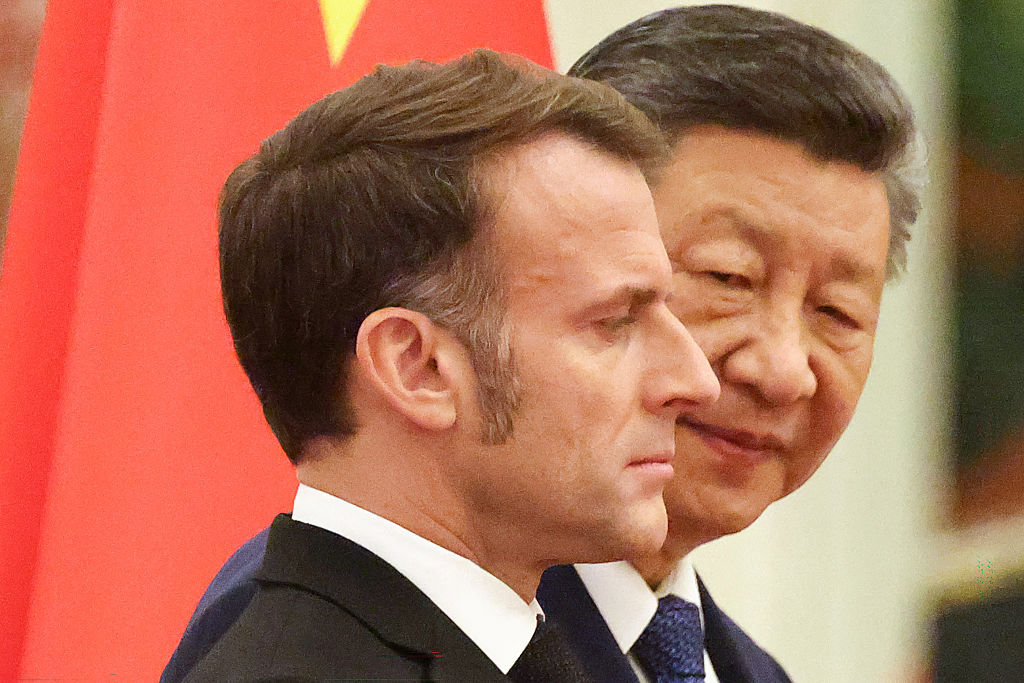
European leaders routinely accuse Chinese industrial policy of distorting competition and interfering with private capital. They could instead consider if China’s record of strategic planning has lessons that the EU could adapt to its own economies. (Ludovic Marin / Pool / AFP via Getty Images)
To the joy of French and German leaders, the European Union has reached an agreement with Beijing to help alleviate the bloc’s €360 billion trade deficit in goods with China. French President Emmanuel Macron celebrated the deal reached in October, which aims to reduce Chinese hybrid car imports and improve market access for some European products, as a way of protecting Europe from “unfair competition.” Further measures to rebalance EU-China trade are being discussed.
To be sure, China’s exports are a challenge for Europe’s struggling industries in more ways than one. Its industrial giants are increasingly struggling to sustain exorbitant profits and dominate in its traditional markets, including China, where consumers are now increasingly turning to cheaper Chinese products.
Volkswagen’s historical restructuring is a case in point. Rather than increasing investment in research and development to produce smaller, cheaper electric cars, Volkswagen continued milking its old business model, distributing €20 billion to shareholders over the past three years. Now, with profit falling by 9.5 percent to €3.5 billion in the second quarter of 2026, the carmaker has abandoned its collective agreements with unions and announced plans for four factory closures in Germany along with one hundred thousand job cuts globally. All the while, Volkswagen aims to increase its operating profit margin from around 4 percent to whopping 8–10 percent by 2030, citing investors’ return expectations.
But fearmongering over China’s trade surplus with the EU and its supposedly “unfair” subsidies tends to obscure Europe’s discomfort with China’s political economy.
Take German Chancellor Friedrich Merz, for example, who says China “deliberately combines its market-driven dynamism with state intervention, overcapacity, aggressive pricing, an undervalued currency, and heavily subsidized exports.” Amid Merz’s accusations of unfair competition lies the real problem: China’s system entails a level of political intervention in the economy that European leaders are unwilling to enforce on capital at home.
State-Owned Enterprises
The first place to look when trying to understand China’s system is the foundational role of state-owned enterprises (SOEs) in its economy. Since opening up its economy to private capital and global markets from 1978 onward, China has maintained a strong network of SOEs. While their share in industrial production decreased over the past decades, they comprise 62 percent of total SOE assets worldwide. Europe follows with a mere 14 percent, after decades of privatization substantially reduced public ownership.
The strength of SOEs lies in their ability to operate beyond profitability as the central objective. That does not mean they are unprofitable, but they can prioritize long-term and capital-intensive investments where returns are low and uncertain.
With leadership appointed by the Communist Party of China (CPC), SOEs are central to China’s industrial strategy and form what is called the “lifeblood of the national economy” in sectors like energy, transportation, and finance. They also support employment stability by maintaining jobs during economic downturns instead of carrying out mass layoffs, which has an anchoring effect on employment in associated industries. In addition, SOEs train a large number of engineers who later move into private manufacturing and technology firms. According to China’s State-owned Assets Supervision and Administration Commission of the State Council (SASAC), SOEs account for more than 70 percent of assets in strategically important sectors.
This makes SOEs a powerful industrial policy tool — especially when they include giants such as China’s State Grid Corporation, the world’s third-largest company by revenue, which delivers an essential economic input: electricity. Thanks to robust public investments into transmission and generation guided by political objectives rather than just profitability, China has achieved the world’s highest electrification rate. In parallel, it has established global leadership in clean technologies, producing renewable energy that increasingly powers its industrial development. After focusing on coal-intensive growth of manufacturing and heavy industry, China now has a major advantage in scaling up electricity-hungry sectors such as AI and robotics, the next realms of global “competitiveness.”
The Asian electrostate stands in a stark contrast to Europe’s reliance on private investment and market profitability to drive the rollout of renewable power. Europe has the capacity to expand its lending to a public renewable electricity system, for example through its European Investment Bank and the European Central Bank. But conservative interpretations of these institutions’ mandates, coupled with fears of “crowding out” private capital, have denied the public sector a more active role in decarbonization. Meanwhile, fossil fuel companies’ interests continue to shape the European energy market.
The problem is that the EU’s green transition plan, the Green Deal, was designed from the outset to make the transition profitable for private capital rather than to plan long-term, strategic investment. When that failed to materialize at the desired scale, green policies have been increasingly rolled back across the bloc. This is evident from the EU’s current deregulation agenda aimed at “cutting red tape” for businesses — which in practice means dismantling workers’ rights and environmental protections.
As a result, European industrial electricity prices are twice as high as those in the United States — and 50 percent higher than in China. Its electrification rate has been rather stagnant over the past decade, matched unsurprisingly by a slow progress in electric mobility and the decarbonization of industries such as steel. Worse, some European industries are even rejecting subsidies for green investments for lack of profitability.
Public-Private Economy
The second major difference is the relationship between the public and private sectors in China and the EU.
In China, public and private companies don’t simply operate in parallel. Deeply connected through industrial clusters, they can share the benefits of SOEs’ political mandates and their access to cheap financing from public banks. Private companies are part and parcel of the country’s socialist market economy. According to figures cited by Xi Jinping in 2018, the private economy accounted for 60 percent of GDP and provided over 80 percent of urban employment.
At the same time, the state maintains a considerable degree of control over private capital. Market access remains restricted in some sectors, such as finance, telecommunications, or health care. Recently, China has also launched a historic tax recovery campaign on its companies. One of its largest agricultural conglomerates, for example, should reportedly repay a sum amounting to 120 percent of its 2025 profits.
Unthinkable in today’s Western economies, many Chinese private companies, especially large ones, have CPC units within their structures that help align business with party priorities and national objectives. They date back to 1994, when company law introduced the ambition to establish the CPC units to serve as a “fighting fortress in the non-public economy.” They appear to be concentrated in sectors where SOEs are more present, ranging from manufacturing and finance to real estate and high tech.
Private companies are linked to SOEs through industrial clusters and special economic zones, created in 1980 as test sites for markets with private and foreign capital. With significant state support, these zones bring together public and private resources to reap the benefits of integrated supply chains, joint research institutions, and skilled workers. SOEs also build supporting infrastructure — electricity networks or high-speed rail interconnections — which increases their chances to grow economies of scale and lower production costs. Today the government continues to embrace this model as a way to develop strategic clusters beyond manufacturing of the 2000s toward high-tech development zones.
One example is the Greater Bay Area, a city cluster that includes Shenzhen, China’s first special economic zone launched in 1980 and now home to companies such as consumer electronics giant Huawei and carmaker BYD. In 2017, national and provincial governments of Guangdong, Macao, and Hong Kong launched a development plan to transform the region from a traditional export-oriented and low-cost manufacturing area into a global innovation and technology hub, including ambitions to provide good living standards and ecological conservation. While still in development, the Greater Bay Area has become a key site for electric vehicles, artificial intelligence, and humanoid robotics. According to Professor Cai Huajie of Fujian Normal University, the area’s total economic output reached 14.79 trillion yuan (around $2.21 trillion) in 2024, placing it close to that of the New York area, the world’s largest metropolitan economy.
State Subsidies With a Plan
When CATL — now one of the world’s leading battery manufacturers — opened in Ningde in 2011, provincial and local authorities helped develop a supply chain of component manufacturers to support its business, which now includes over ninety companies. In turn, CATL helped create one of the world’s leading battery manufacturing hubs that has shaped the city’s economy.
State subsidies and protectionist measures shielding domestic battery production from foreign competition surely played a role in CATL’s rise. But unlike Western governments that are reluctant to use subsidies as a strategic and time-bound tool within a long-term industrial plan, China adjusts them as industries mature. In 2018, China lifted its foreign equity cap on manufacturers of new energy vehicles, and those produced by foreign enterprises gradually became eligible for the same consumer subsidies as domestic models. Subsidies were scaled back, and national purchase subsidies for consumers were phased out at the end of 2022. CATL invested further into research and development to adapt to the less protective environment. When demand for electric vehicles slowed in 2023, CATL cut battery prices to help automakers boost sales and secure its market share.
Naturally, the state has a much bigger stake in this mixed economy. This also means that the private sector’s production and sales are in effect included in a form of public planning that goes beyond “market signals” — particularly in sectors where China competes with foreign companies.
For instance, following the slow rise of companies such as BYD, the government launched the “Ten Cities, Thousand Vehicles” pilot project in 2009 to introduce at least one thousand electric vehicles annually into the public transport system of ten cities. BYD, now the world’s largest electric vehicle manufacturer by sales, was one of the electric bus suppliers for the project. In Shenzhen, this project helped the city achieve 100 percent fleet electrification by 2017.
This approach is now extended to robotics. The Robot+ application plan, developed by sixteen governmental agencies and the Ministry of Industry and Information in 2023, promotes the innovative use of robots in manufacturing, health care, eldercare, and other sectors. China’s 2025 AI+ plan similarly supports adoption of artificial intelligence by SOEs for aviation fatigue detection, health monitoring, operations of the State Grid’s power lines, and other uses.
Financing and Shared Investment Funds
The benefits of China’s public-private ecosystem are also evident when it comes to financing. China’s robust public banking system and its cheap loans are one part of the story. The other is equity: in China, companies in which the public sector holds over a quarter of the shares make up almost half of market capitalization. Across the Organisation for Economic Co-operation and Development (OECD), this level is just 2 percent.
But both public and private capital are actively used for equity investment. China has created thousands of government guidance funds to pool finance from governments, public banks, and public and private companies. These funds provide long-term, patient capital but also an avenue to generate returns while sharing high investment risks. One of the largest such funds is the National Integrated Circuit Industry Investment Fund to help China achieve self-sufficiency in semiconductors.
Compared to Europe’s de-risking model, consisting mostly of loans and guarantees, the scale of public sector equity ownership is striking. According to OECD data, China’s public sector held around $3.5 trillion in listed equities in 2023, 79 percent of which was owned by national and local governments. Europe’s public sector held $1.3 trillion, with around half of it owned by governments. In the United States, the figure was $1.6 trillion, and most of the listed equity belonged to public pension funds and foreign-owned sovereign wealth funds.
Far from increasing joint and strategic public spending, the EU is heading in the opposite direction. As negotiations are underway on its next multiyear budget for 2028–34, several countries, including Germany, demand radical cuts in the spirit of austerity. These could reduce the budget’s real value by 10 percent compared with the current one. Yet as the Green Deal retreats, military spending — not investment in a productive economy — is growing dangerously.
What Does This Mean for Europe?
Learning from the successes of China’s “socialism with market characteristics” doesn’t mean that Europe should imitate China’s industrial policies and try to win the race for global market dominance. The massive scale of production and resource use that such competition would require is bound to have a range of destructive consequences for workers and the planet.
Europe’s current leaders are already showing what this race would look like. After returning from China, Merz advised that, instead of work-life balance, “we simply have to do a little more now.” Workers are increasingly squeezed as working hours are pushed up across Europe, along with austerity cuts to pensions, unemployment, and public services. But as Mariana Mazzucato has demonstrated in her study of Europe’s three hundred largest publicly listed nonfinancial corporations: labor costs aren’t the problem in the European economy. It’s the failure to reinvest corporate profits, an electricity system not fit for decarbonization, and a lack of public ownership.
The wave of mass strikes and protests across Europe over collapsing school systems, housing shortages, and the intolerable cost of living is a predictable consequence of the EU’s misguided approach. Workers, young and old, demand socially necessary investments that the pursuit of “competitiveness” simply can’t deliver.
Instead of sacrificing collective bargaining achievements for which the working class struggled for centuries, Europe should think beyond “Made in Europe” protectionism and start nurturing its industries — above all by reining in big capital and directing it into productive investments. With this strategic approach, it can also tap into opportunities for mutually beneficial cooperation with China on technologies necessary for a low-carbon economy.
Cracks are emerging in the current obsession with competitiveness amid collapsing public investment. The Left can take this moment to campaign for a socialized economy based on public ownership, workers’ decision-making, and people’s real needs — not dividends, export markets, or the production of utterly unnecessary products such as AI-powered kettles or flying cars. Here, China’s political economy can provide some useful lessons, though Europe must create its own path.