Europe Doesn’t Know How to Respond to China
The European Union’s top diplomat Kaja Kallas says Europe needs to take painful steps to overcome the “cancer” of dependency on China. The EU is talking about protectionism, but in reality its firms are addicted to low-wage labor outside the bloc.
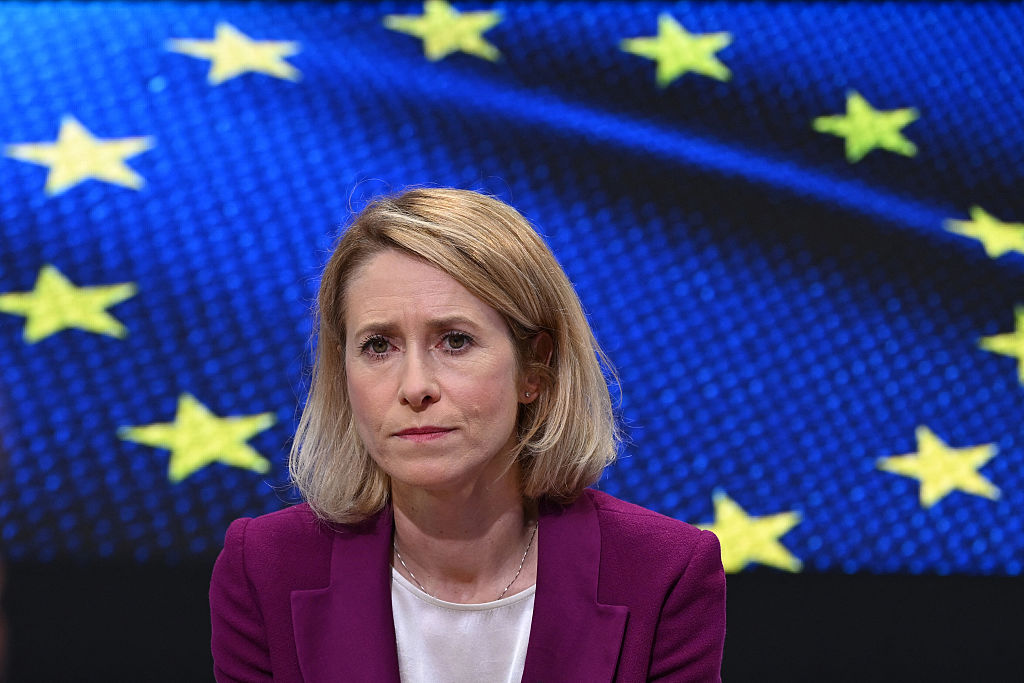
Europe is slowly learning the lessons of China’s interventionist industrial policy. The problem is that it has nothing like the conditions that allowed China to become a tech superpower. (Nicolas Tucat / AFP via Getty Images)
The European Union’s top diplomat, Kaja Kallas, has again gained attention for provocative statements about China. In remarks last month, she compared the EU’s economic relationship with China to a “cancer,” arguing that Europe must endure the painful “chemotherapy” of export controls, investment screening, and supply chain restructuring.
Her attitude highlights a rhetorical turn toward economic independence, recognizing the EU’s inability to manage the consequences of global capitalism. Faced with China’s growing technological and industrial power, officials in Brussels have launched industrial initiatives, discussed new trade restrictions, and sought to strengthen domestic manufacturing. Across the Atlantic, the United States has pursued similar goals through tariffs, industrial subsidies, and efforts to bring production back home.
Over the last few years, the EU has made attempts to reposition itself as an economic powerhouse, in light of member states’ growing dependence on China’s exports and the Chinese market. Official Eurostat numbers tell a stark story. In 2024, EU imports from China reached €517.8 billion, as against €213.3 billion in EU exports to that country, leaving a goods deficit of €304.5 billion. That deficit had climbed to €98 billion in Q1 2026 alone, the highest since Q3 2022. China is now the EU’s largest source of imports, and the gap of export deficits keeps widening.
Even leading capitalists find that the global capitalism developed since the 1980s is now in crisis. For BlackRock’s CEO Larry Fink,
The danger is that we focus so much on the noise that we forget what actually matters. The forces behind today’s headlines have been building for a long time. The old model of global capitalism is fracturing. Countries are spending enormous sums to become self-reliant — in energy, in defense, in technology.
Fink underlines a path the EU and the United States are trying to follow. Yet the European push for independence is easier said than done.
Europe’s Protectionist Turn
The Council of the EU has stated: “Europe’s productivity has been lagging behind other major economies in the last 20 years.” In particular, Andrea Butollo and his colleagues’ research demonstrates that China has become a dominant producer of batteries, electric vehicles, wind turbines, and a range of advanced industrial technologies, with Chinese companies like Huawei, ZTE, Baidu, and Xiaomi emerging as major global competitors. The concern for the Global North is that China increasingly combines technological development with manufacturing capacity. China has become a necessary partner for producing many technologies — most important, anything that uses batteries.
The EU has responded with a wave of industrial initiatives aimed at strengthening its own high-tech production. The Industrial Accelerator Act passed this year prioritizes EU-made products across procurement, offering support schemes for made-in-EU products. Commissioners representing all twenty-seven member states have been asked to map Chinese activity across every portfolio, from trade and agriculture to defense, health, and digital infrastructure. A Guardian report suggests that Brussels is now seriously considering quotas, tariff-rate quotas, and supplier diversification requirements in strategically important sectors.
In addition to limiting Chinese imports, Reuters explains that the European Commission wants to double the EU market share of semiconductors to 20 percent in the next four years to boost the continent’s technological sovereignty. The proposal includes faster approval processes for data centers and aims to force agreements between manufacturers and buyers to “guarantee future purchases.”
Butollo and his colleagues’ research situates these developments within a broader turn toward economic nationalism, arguing that both the EU and the United States have adopted increasingly interventionist industrial policies in an effort to regain leadership in the global technology market. Edward Ashbee has gone further, suggesting that China’s rise may itself become the driver of deglobalization, as Western states conclude they can only develop by gaining advantage over China. Others, like Benjamin Selwyn and Christin Bernhold, maintain that global production networks are continuing to expand despite geopolitical tensions. The EU, now turning toward domestic protectionism, seeks to become an economic powerhouse of its own, much like China. The conditions under which China grew to economic dominance, however, cannot be readily recreated inside Europe.
The European Commission in 2019 termed China “a partner, a competitor, and a systemic rival.” The tension between the EU and China came out into the open with foreign affairs chief Kaja Kallas’s outburst at the annual Lennart Meri Conference in Tallinn. Although out of line with diplomatic practice, her statement was much in line with the EU’s latest shifts.
The problem is that the EU has long had a trade deficit in goods with China. The prominent area of concern is “China’s drive towards import substitution and self-sufficiency.” The commission has stated, “While the EU welcomes efforts by the Chinese authorities to attract foreign direct investment, EU companies continue to face discrimination in the Chinese market, and it remains difficult for European businesses in China to compete due to the lack of a level playing field.” In claiming that the issue is China’s political system, the Europeans show (albeit without admitting to it) that their own market is lagging behind in development.
The commission is critical of China’s economic approach, claiming that “China’s distortive industrial policies and practices — in particular with regard to widespread support for the manufacturing sector — create overcapacity in China, with negative externalities for a wide range of WTO [World Trade Organization] members.” This again confirms that Kallas’s hostile comparison is part of a bigger narrative shift, comparable to Donald Trump’s strong anti-China slogans, already adopted during his first term.
Globalization Isn’t Going Away
In their recent work on capitalist value chains, Selwyn and Bernhold argue that debates about deglobalization routinely overlook a fundamental feature of capitalism: capital’s endless search for opportunities to extract surplus value from labor. Their study revealed that leading US firms are not abandoning globalization; they are reorganizing it while trying to contain China’s technological rise.
Despite years of discussion about reshoring and economic sovereignty, global production remains deeply interconnected as companies continue to rely upon international supply chains. As production becomes more technologically complex and the need to keep costs to a minimum stays fundamental, the requirement for access to specialized suppliers, raw materials, and labor markets increases.
As these same authors cite from studies on the semiconductor industry, front-end production may expand in Europe and the United States, but much of the world’s manufacturing capacity remains concentrated in Asia. Firms are increasingly pursuing a “China + 1” strategy, diversifying production into countries such as Vietnam and Malaysia while maintaining extensive international supply chains.
Importing goods from China was not an issue for decades for the Global North, because the labor and thus products were cheap. But now, China has developed to control more and more of the core technologies, and the EU and United States haven’t been able to adapt, as they are not used to playing catch-up.
Selwyn and Bernhold thus conclude that current developments reflect attempts by capitalist firms and leading states to preserve globalization while restructuring it around new geopolitical realities. But if globalization as a process continues, why are Western governments increasingly embracing protectionist rhetoric?
China Stopped Being the Workshop of the World
Since the late 1970s, China’s role within the global economy seemed relatively clear, serving as a vast — and relatively cheap — reservoir of labor for Western firms seeking lower production costs. Selwyn and Bernhold argue that China’s economic opening changed the United States’ own approach to international deals:
As the US state facilitated a shift in its domestic economy towards high-tech CVC (Corporate Venture Capital) nodes such as research and development “knowledge,” and professional services, it relied increasingly on importing cheap manufactured goods from China which were often produced under the control of, or for, Western firms.
From this, it follows that the United States’ benefit from China was that American firms, controlling the technologies and the market, could use cheap Chinese labor, which helped, in turn, grow the Chinese technology sector.
But in this development, according to Selwyn and Bernhold, the Chinese state successfully pursued a strategy that first integrated the country into labor-intensive global production networks and later facilitated increasingly sophisticated forms of industrial and technological development.
As they claim, China followed a path of “first low-tech labor-intensive industrialization through integration into capitalist value chains, and later increasingly high-tech development.” China has successfully implemented a plan for long-term development of the national economy, comparable to its Western counterparts’ strategies. China had changed position from a workshop to a challenger to US (and EU) firms.
Europe Wants the Benefits of China’s Model
China’s rise has encouraged Western governments to pursue policies designed to restore industrial competitiveness and technological leadership. In the United States, this trend has become associated with reshoring, industrial subsidies, and what policymakers often describe as “friend-shoring.” Both the Biden and Trump administrations have sought to encourage domestic investment while reducing dependence on Chinese supply chains.
This approach has extended to the EU, with both administrations pressuring the European Union to decouple from China. The first notable example of this was back in 2020 already, when the Guardian reported that the United States urged the EU to bar Huawei from 5G networks. Today EU policymakers speak of strategic autonomy, battery independence, technological sovereignty, and industrial resilience. Tariffs and industrial policy are increasingly viewed as necessary tools for defending European competitiveness.
These sentiments stress how significant the shift is in rhetoric and policy, as the whole point of the EU has been to support the free market: as its own website boasts, “The European Union is one of the most outward-oriented economies in the world. It is also the world’s largest single market area. Free trade among its members was one of the EU’s founding principles, and it is committed to opening up world trade as well.” Now as the trade deficit with China is rising, there is a need for a change.
Europe can invest into new technologies. It can subsidize strategic industries. It can support battery production and semiconductor manufacturing. Indeed, as Butollo and his colleagues argue, both the EU and the United States already have implemented more interventionist policies in a bid to regain technological leadership. Yet what the Europeans can’t do is recreate the conditions that initially facilitated China’s competitive edge.
One simple reason for this is that European economies are not built upon vast pools of low-cost industrial labor, at least not inside the EU. European workers enjoy higher wages, protections, and social rights. As a result, Europe’s pursuit of economic sovereignty remains structurally dependent on globalization and cheap products based on low labor costs. This frustration was emphasized by German Chancellor Friedrich Merz, who claimed that “work-life balance and a four-day week will not be enough to maintain our country’s current level of prosperity in the future, which is why we need to work harder.”
Global capitalism has relied on inequality of costs and wealth between trading partners. With China, the inequality is leveling. The EU needs to find new “partners” that have low labor costs, if they want to keep down production costs, stop fueling China’s market, and keep the welfare benefits.
As an example, consider the recently concluded agreement between the European Union and Mercosur (Argentina, Brazil, Paraguay, and Uruguay) with the goal of securing critical raw-material supplies. These materials will have lower tariffs for the EU, which, based on its own press release, will bring more exports from Mercosur and make the EU more competitive thanks to reduced costs: the EU claims that “removing high Mercosur tariffs will enable EU exporters to save over 4 billion euros in customs duties per year.”
Benefits From Global Capitalism Are Decreasing
The EU’s strategy increasingly has two objectives. One is defensive: containing China’s rise through tariffs, restrictions, and industrial policy. The other is expansive: constructing alternative global supply chains through Mercosur, Southeast Asia, and other regions.
The system rewards those capable of combining access to labor with technological development. China succeeded in doing both. Europe now seeks to recover its position within the global economy. To compete, the EU must continue relying on new global production networks as an alternative to both Chinese supply chains and domestic production.
This logic might hold were the world not already so deeply globalized. Kaja Kallas’s chemotherapy metaphor is poorly chosen: chemotherapy targets a foreign body, but China is is structurally embedded in the global market. A conjoined twin is the more apt image: painful separation may be conceivable, but you still share a world with the other afterward. The ambition to decouple from China is risky because the EU lacks both the productive capacity and the raw materials for genuine independence, leaving it reliant on new supply chains that China is equally positioned to penetrate.