The Other Side of China’s Economic Miracle
China has witnessed the greatest stretch of sustained growth and poverty alleviation in human history, made possible by the brutal exploitation of millions workers. A new book recounts the life of one of them offering a glimpse into the dark side of China’s success.
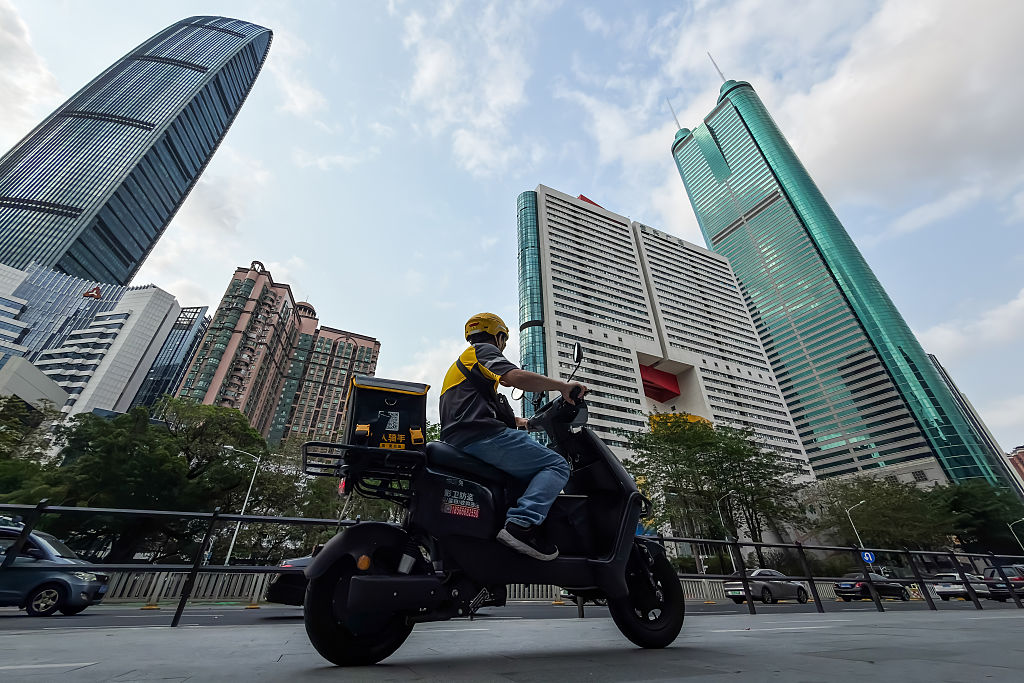
A memoir by the Chinese worker-poet Xiao Hai offers a bracing look into the lives of the millions of workers facing brutal exploitation during the country’s gilded age. (Cheng Xin / Getty Images)
China’s remarkable economic development is the most important event of the last half-century. The People’s Republic has gone from a peasant economy sustaining itself on subsistence agriculture to a global powerhouse that dominates high-tech manufacturing and builds shining megacities.
But behind the broader narrative of marvelous macroeconomic success lie the stories of hundreds of millions of exploited Chinese workers thrust into a new capitalist paradigm. Inseparable from China’s growth was the largest urbanization project in world history. As China developed its manufacturing ecosystem, hundreds of millions of rural peasants flooded into coastal cities, chasing the economic opportunities brought by new factory jobs. In the cities, they searched for an escape from rural poverty but encountered the horrors of industrial capitalism.
The Other Side of Progress
Adrift in the South is the memoir of one of these workers, Xiao Hai, a poet who has spent much of his adolescence and twenties toiling in the harshest jobs available to Chinese workers.
Like many rural Chinese, his parents covertly circumvented the one-child policy, making him an “over-quota child.” This meant that he would have to be given away to another family for five years to avoid harsh government punishment for having multiple children. While his parents managed to avoid being reprimanded, the cost of supporting two children to study past working age was too heavy to bear, so at fifteen, Xiao left school to become a child laborer.
Xiao’s journey began in Shenzhen, a city now known as China’s Silicon Valley, which became ground zero for the country’s move to high-tech manufacturing after the market liberalization initiated by Deng Xiaoping in 1978.
Appropriately, Xiao’s journey through the South begins there. His first job is at a large factory on an assembly line putting together battery boxes with a screwdriver. There he works fifteen hours a day and takes one day off each month. For his long hours, he enjoys a meager monthly salary of ¥400, approximately $48. One day, exhausted at work, he dozes off during an overnight shift and is woken by a blade that slices open his index finger, creating a painful wound that gushes blood. His manager comes over, wraps his finger with gauze, and tells him to finish his shift.
At the end of his day, he notices that a fragment of poisonous plastic from the blade has gone into his bleeding wound and has created an infection. Without access to medical services, Xiao must rely on makeshift treatment from a coworker who disinfects the wound with a lighter and a sewing needle.
Stories like this are often lost in breathless accounts of China’s development that rightly point out how extraordinarily successful Shenzhen and other manufacturing hubs have been. Xiao reminds us that this success was built on the backs of millions of workers who felt the worst of capitalist exploitation.
Xiao recounts drifting across southern China from job to job hoping for a better life. In this endeavor, he finds little success. On his journeys he has a series of grim encounters: at a screen printing factory, Xiao is exposed to toxic chemicals that render a female coworker infertile; communal shoes on the factory floor leave him with a fungal foot infection; and whenever a manager thinks Xiao’s work doesn’t meet standards, he’s forced to pay a fine out of his own wages.
The garment industry doesn’t treat Xiao much better. Most of his coworkers develop spinal injuries from being hunched over sewing machines twelve hours a day. In one dramatic episode, his brother’s hand is impaled four times by a machine, with the needle fracturing inside his bone. After a moment of recovery in a clinic, Xiao’s injured brother marches back to the factory to continue his shift.
At one point, Xiao leaves factory work to try his hand in Shanghai’s gig economy. His time in Shanghai highlights the extreme inequality that persists in China. The country’s white-collar middle class love their cheap fifteen-minute delivery, but these services are underwritten by an underclass of migrant workers. As a gig worker, Xiao zooms around the city and climbs dozens of flights of stairs to deliver over a hundred packages a day. Even after a decade in factories, he says delivery work is the most physically exhausting job he’s had. Losing a package incurs a heavy fine, and a customer complaint is a death sentence. While rushing to the next delivery on his tight schedule, Xiao accidentally runs into a car. Lacking insurance, he is forced to hand over cash to the driver to avoid a call to the police.
Despite his miserable working conditions, Xiao finds solace in writing poetry. In some of his earlier jobs, supervision is lax enough for him to steal brief moments for himself. But when Xiao begins working for Chinese tech giant BOE — a company whose workshops combine intense oversight with a rapid pace-setting conveyor belt — even this small pleasure of writing poetry is taken away from him. Over time, he begins to lose his sense of independence from the machines he works. “Our blood and muscles became integrated into the machines — when we pressed the START buttons we too powered on,” he writes. Instead of being a tool to make Xiao’s work easier, the assembly line snuffs out his only source of pleasure.
This isn’t to say that everything is bad. Workers face exploitative conditions all over the Global South in countries that have not enjoyed China’s miraculous levels of growth. During Xiao’s time in the factory, many in the country felt that the hard work was moving the country toward a more prosperous future. Despite the grueling conditions he faced in Shenzhen, Xiao still feels a sense of pride that he played a role in building the city into a shining metropolis.
Yet seen from a historical perspective, China’s rise, while astronomical, has obvious counterparts. In the nineteenth century, Britain saw historically unprecedented growth. The pace of this change shocked foreign observers who were awed by the country’s proliferation of new railways, canals, and bridges, much like how the West today looks at China’s urban development with astonishment. But Karl Marx was keenly aware of the “misery beneath the miracle” and sought to expose the exploitation undergirding this marvelous abundance.
Capital features the stories of child laborers in Staffordshire’s potteries who work 6 a.m.–9 p.m. shifts, just as young Xiao Hai did. The phosphorus of Manchester’s match factories and the toxins of Shenzhen’s screen printers both poisoned their workers. And modern industry reduced both English and Chinese laborers to appendages of a “monstrous automaton.” Despite being separated by hundreds of years and thousands of miles, working life in late-eighteenth-century industrial Britain and developing industrial China still look quite similar.
Commentators on China often reject comparisons between China and the West by pointing to cultural differences like those between Confucian thought and Protestantism. But Xiao’s autobiography shows that, under capitalism, our cultures are increasingly similar. Xiao’s accounts of factory life tap into something universal within capitalism: the degradation and alienation of work. But alongside universal suffering there is, Xiao insists, also the universal desire for freedom from exploitation. The book ends with these lines: “I have but one humble wish: to live like a human, with dignity. That’s all I can ask for. That’s all.” In a better world beyond capitalism, Xiao’s wish wouldn’t be “humble,” but a basic right guaranteed for everyone.