The Politics of Beef in the 2026 Midterms
Beef has long symbolized the promise of American material abundance. The midterms illustrated the political consequences of failing to deliver it.
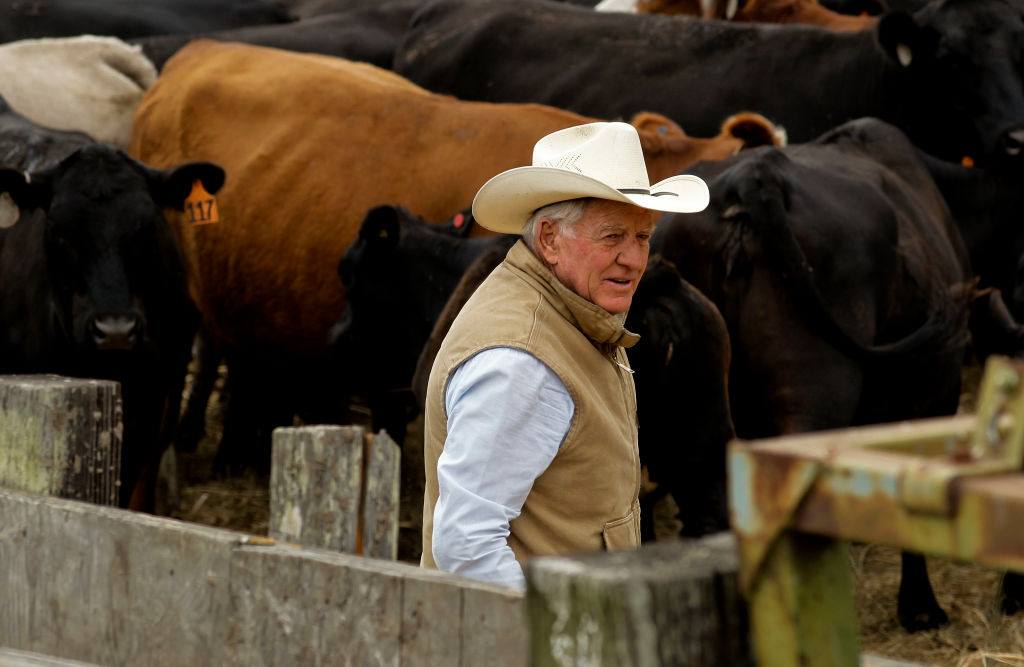
Republicans have learned the political cost of failing to deliver roast beef. The Left now has to figure out how to put it back on the table. (Michael Macor / The San Francisco Chronicle via Getty Images)
In 1840, following the devastating economic contraction of the Panic of 1837, Whig presidential candidate William Henry Harrison defeated incumbent Martin Van Buren by promising “Two dollars a day and roast beef” for every worker. His opponent, meanwhile, was derided for offering workers just “fifty cents a day and French soup.”
Nearly two centuries later, Mississippi Democrat Scott Colom has become the first black person elected to the United States Senate from his state since Reconstruction.
Many pundits have identified the pivotal moment in his campaign: an advertisement mocking Republican incumbent Cindy Hyde-Smith for responding to soaring beef prices by telling Americans, “You have so many proteins to choose from.”
Colom’s punch line: “Pick another protein? I’d rather pick another senator instead.”
Harrison had promised American workers roast beef. Colom made the inability to afford it an indictment of the Republican Party.
Mississippi wasn’t an isolated case. From Texas’s historic Democratic sweep of statewide offices to extraordinary Democratic gains in Kansas, the 2026 midterms revealed the political consequences of the Trump administration’s failure to manage the American beef economy.
Caught between two constituencies with conflicting interests — cattle ranchers struggling to sustain their businesses and consumers increasingly unable to afford beef — the administration failed both. Meanwhile, immigration policies threatened the workers responsible for processing the country’s cattle.
The result was a political nightmare for Republicans and a lesson for progressives and leftists about the difficulty of delivering the material abundance that American workers have long been promised.
The Beef Market Is Broken (for Everyone)
Beef occupies a special place in the American social contract. It has long symbolized material abundance: the promise that an ordinary person ought to be able to afford the occasional steak. Beef, according to a famous industry campaign, is “What’s for dinner.”
Heading into the midterms, Republicans found themselves caught between two constituencies, both struggling, with conflicting interests. On one side were America’s 622,000 cattle ranchers, of whom nearly 90 percent have only twenty cows on average. In 2018, roughly three in four identified as Republican. Many struggled financially with rising input costs, which resulted in the lowest national herd per capita in recorded history. Consumers, meanwhile, faced beef prices up 111 percent since 2019.
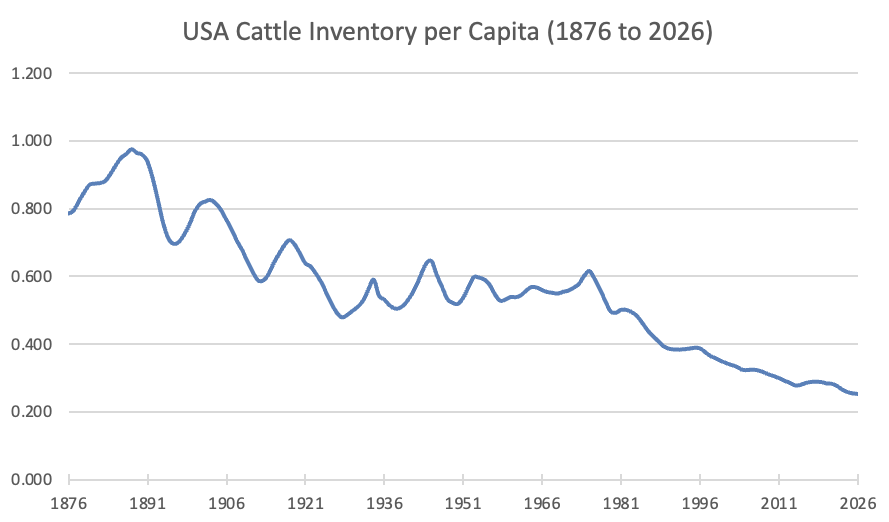
Ranchers need higher cattle prices to sustain their businesses, while consumers need lower beef prices to continue buying it. As Bloomberg reported in late 2025, “The Beef Market Is Broken for Everyone.”
High prices normally induce cattle ranchers to raise more cows. But ranchers have been forced to prepare their heifers for slaughter instead of raising baby calves due to climate-change-induced water shortages and rising primary input costs (namely feed, fertilizer, and fuel — all driven higher by droughts, tariff disputes, and the war in Iran). Last month, Bloomberg reported that more than half of our country’s cattle live in areas suffering from droughts — meaning many of them will have to be sold for slaughter earlier than ranchers would prefer. And even if ranchers want to rebuild their herds, it takes three or four years of financial risk to do so.
The Failure of Republican Beef Policy
Through much of the second Trump administration, Republicans chose a policy of supporting domestic ranchers with high beef prices, implicitly asking consumers to change their eating habits: “Pick another protein.” They were aware, however, that if beef prices rose too much, they’d face a political crisis.
In late 2025, Donald Trump posted on Truth Social that cattle ranchers “would be doing just as they’ve done for the past 20 years — Terrible!” if not for his 50 percent tariff on Brazilian cattle coming into the United States. He noted, though, that “it would be nice” if cattle ranchers also understood that “they also have to get their prices down, because the consumer is a very big factor in my thinking.”
While tariffs supported high beef prices, this ultimately proved politically untenable after beef prices continued to surge.
In August, Trump announced an expansion of the quota for imported lean beef trimmings eligible for reduced tariff rates. The goal was to increase imports of lean beef trimmings used to produce ground beef, bringing down beef prices before the midterm election.
Cattle prices subsequently fell roughly 15 percent from their May levels, exposing producers who had purchased cattle at elevated prices to substantial financial losses. Although other market forces also influence cattle prices, the administration’s decision to expand imports certainly contributed to the reduced value of ranchers’ herds.
Imagine you spent $50,000 to buy cattle in April. Now, their market value has fallen $7,500, or 15 percent. If you borrowed money to make the purchase, that decline would represent an even larger percentage of your own investment. When your cows reach market weight — or when you can no longer afford to feed and water them — you will be forced to sell. And if the prices don’t recover, you will lock in those losses.
At the same time, the policy shift came too late to benefit consumers; retail beef prices continued to surge heading into the midterms.
This is likely because consumers don’t immediately see the benefits of increased supply. The process requires importers to purchase and ship the beef, the imported beef to arrive and receive customs approval, the meatpackers to blend the imported and domestic beef, and the ground beef to move to wholesale distribution. After that, the supermarkets receive the shipment and adjust their prices. Just importing the beef takes two to eight weeks.
While cattle prices crashed, consumers paid even higher prices at the supermarket. The administration had failed struggling cattle ranchers without ensuring the ordinary American could afford to eat a steak.
Texas: When Cattle Country Rebels
The consequences were particularly striking in Texas, where Democrats swept statewide offices in a historic electoral breakthrough.
In August, following the expansion of the in-quota allowance for beef imports, Republican Texas Agriculture Commissioner Sid Miller broke from Trump, warning that some Texas Republicans would lose statewide offices in November due to rural voter outrage. In fact, Democrats ended up winning every statewide Texas office, including his seat after he lost to his Republican challenger in the primaries.
Some of the state’s most remarkable swings toward Democrats occurred in counties with significant cattle-ranching economies. Kleberg County swung approximately 28 points toward Democrats relative to 2024, Brewster County 24 points, and Wilbarger County 16 points. While these shifts were comparable to the roughly 26-point Democratic swing statewide, they were substantial relative to the approximately 7.5-point swing across rural Texas more broadly.
These results do not prove that cattle prices caused ranchers to abandon the Republican Party. The election was a referendum on the Trump administration, and voters had plenty of reasons to reject its candidates.
But the Democratic gains in cattle country suggest that the administration’s agricultural policies may have broken a key part of the Republican coalition.
Kansas: The Workers Behind the Beef
Beyond the consumers in Mississippi and the cattle ranchers in Texas, there was another constituency caught in the administration’s contradictory beef policy: the workers who process American cattle.
The meatpacking industry, which handles the slaughter and processing of livestock, depends heavily on immigrant labor. In September, Immigration and Customs Enforcement (ICE) conducted raids around meatpacking plants in Kansas, the second-largest meat-processing state. Many of these plants were already on the verge of closing because the herds they could buy were too small to continue operating profitably. ICE raids caused further shutdowns and delays, as immigrant workers stayed home out of fear of arrest. Without workers, the supply of beef fell, and beef prices continued to rise.
Kansas’s three largest meatpacking counties — Ford, Seward, and Finney — swung 39, 52, and 37 points toward Democrats, respectively, compared with a roughly 21-point Democratic swing statewide relative to 2024. The Kansas Reflector reported that they were the three counties that helped the Democrats take the Kansas Senate seat, even though less than one in four voters in these counties are registered Democrats.
While the Trump administration increased beef imports in an attempt to lower consumer prices, its immigration policies threatened the workforce responsible for processing this beef. Ranchers faced losses on their cattle; consumers worried about affording steak again; endangered meatpacking workers faced uncertainty about their livelihoods.
Given these widespread grievances, it’s not surprising that a Kansas Senate seat turned blue for the first time since the Great Depression.
The Price of Breaking the Social Contract
Beef prices alone did not determine the 2026 election — high gas prices and the war in Iran drove a lot of political messaging and actual voting. Texas and Mississippi have distinct political histories, and voters had plenty of reasons to reject Republican candidates beyond the cost of hamburgers.
But beef offers a useful lens through which to understand the election. The Republican Party had built a coalition promising to defend rural producers, restore working-class prosperity, and protect traditional American abundance. But its beef market policies broke each of those promises.
When the administration tried to protect domestic producers, it left consumers with unaffordable groceries. When it tried to help consumers, it hurt ranchers. And its immigration policies threatened the workers essential to the entire industry.
Ultimately, the administration asked all three constituencies to accept a lower standard of living.
For centuries, the ability of ordinary Americans to afford beef has been part of the country’s informal social contract. It is a small expression of a larger promise: that even if inequality explodes to unprecedented heights, economic growth should trickle down into tangible improvements in everyday life.
In 1840, William Henry Harrison understood the political power of promising workers roast beef. In 2026, Republicans discovered the political cost of telling them they could live without it.
For progressives and leftists, the lesson is that governing for working-class prosperity requires more than promising lower prices or higher wages. It requires understanding how the goods Americans depend on are actually produced and developing policies capable of expanding supply while protecting the livelihoods of the workers and producers as well as the natural environment that make that abundance possible. Republicans learned the political cost of failing to deliver roast beef. The Left now has to figure out how to put it back on the table.