The British State Is Dodging Accountability for the Troubles
Britain’s Labour government has brought forward a bill that’s supposed to address the legacy of the Troubles in the North of Ireland. But the latest changes to the bill will shield British soldiers from any threat of being prosecuted for their crimes.
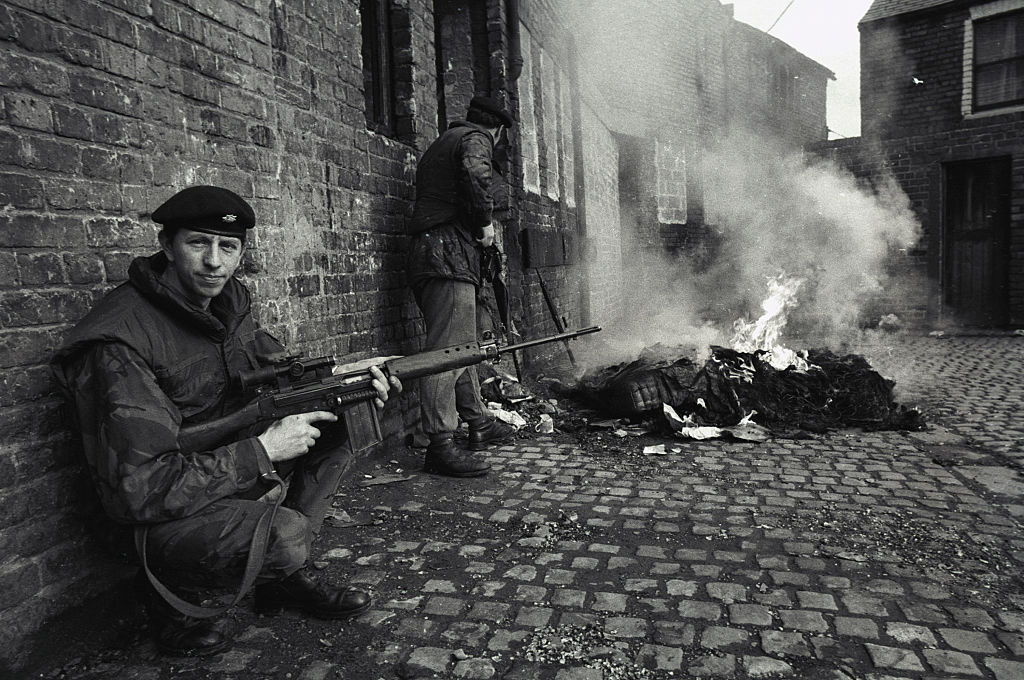
British soldiers have long evaded prosecution for their crimes during the Troubles, even notorious atrocities like the Bloody Sunday massacre. Andy Burnham’s Labour government now plans to codify that impunity by amending its controversial Troubles bill. (Steven Clevenger / Corbis via Getty Images)
Britain’s latest prime minister, Andy Burnham, raised hackles on his first trip to the North of Ireland when he declared a referendum on Irish unity to be “off the table.” Burnham may simply have intended to say that it wasn’t on the short-term agenda, since there is no sign as yet that a majority of people in the North would vote for a united Ireland. But his choice of words implied that it was for the British government to decide whether a referendum should happen, which angered nationalists.
Burnham’s secretary of state for Northern Ireland, Chris Bryant, made another clumsy intervention when the unionist Orange Order tried to march down the nationalist Garvaghy Road in Portadown. The Parades Commission, which regulates all public parades in the North, had denied permission for the march every year since the late 1990s. This time, however, a court found that the commission hadn’t followed the right procedures before rejecting the Orange Order’s application once again.
When the Orange Order filed another application to march down the Garvaghy Road on Sunday, September 29, the commission gave its approval, to the astonishment of nationalists. The Irish taoiseach, Micheál Martin, described the decision as “incomprehensible and wrong.” After not one but two court hearings on September 28, the march was due to go ahead, but residents of the Garvaghy Road assembled overnight to block the road.
They were joined by Michelle O’Neill and Mary Lou McDonald, Sinn Féin’s leadership team from North and South, along with politicians from the Social Democratic and Labour Party (SDLP) and People Before Profit. The size of the counterdemonstration and the involvement of high-profile figures like O’Neill ensured that the march could not go ahead.
Unionist politicians accused O’Neill and the other demonstrators of breaking the law, and Chris Bryant added his voice to the chorus: “Nobody should be attending an unlawful protest.” Bryant waited for two weeks before using his ministerial powers to overturn the Parade Commission’s decision and prevent the Orange Order from marching.
Bryant delivered his first speech to the recent Labour Party conference in the shadow of events in Portadown. While he alluded to the latest crisis, Bryant’s main priority was to make the case for the Northern Ireland Troubles Bill that his government has introduced. The bill has already become a political flash point as part of a long-running dispute over the record of the state security forces during the Troubles.
State Collusion
On February 12, 1989, Belfast solicitor Pat Finucane, who was known for challenging the British government in human rights cases, sat down to dinner with his wife and three children. During the meal, three gunmen entered the family home and shot Finucane fourteen times. His wife, Geraldine, was wounded in the attack. Finucane was thirty-nine when he was killed by a pro-British loyalist paramilitary group.
The killing might have been another entry in the grim catalog of Troubles murders were it not for what happened afterward. One of his killers, Ken Barrett, was eventually convicted. Successive investigations uncovered extensive evidence of collusion between loyalist paramilitaries responsible for killings like this and British state agents.
In 2012, then–Prime Minister David Cameron apologized to the Finucane family for what he described as “shocking levels of state collusion.” A review by Sir Desmond de Silva concluded that there had been a “wilful and abject failure” by successive governments to establish a proper legal framework for the handling of state agents.
In 2019, the UK Supreme Court ruled that previous investigations into Finucane’s murder had failed to meet the state’s obligations under Article 2 of the European Convention on Human Rights. The family had spent decades asking for an independent inquiry into the circumstances of his death. This year, they finally got one. The Patrick Finucane Inquiry held its preliminary hearing in Belfast on June 10.
In Westminster, this has opened up an argument over what should happen to the remaining open cases from the Troubles. The Northern Ireland Troubles Bill is supposed to replace the Conservative government’s deeply controversial 2023 Legacy Act.
The latter bill attempted to draw a line under the past by ending new inquests and civil actions. Many saw this as a way of giving immunity to British soldiers for crimes they committed during the conflict. The immunity provisions were condemned by victims’ organizations and Northern Ireland’s political parties, both nationalist and unionist.
The Labour government that took office in 2024 eventually scrapped the Legacy Act and introduced the new Troubles bill in its place. While it does contain some improvements, it is still seriously flawed.
Last month, the Westminster Joint Committee on Human Rights stated that the bill needs further changes if it is to secure public confidence and address the legacy of the conflict properly. It raised concerns about the independence of the proposed Legacy Commission, the handling of sensitive information, the role of families, and the legal framework surrounding investigations.
“Our Brave Armed Forces”
Over 3,500 people were killed during the Troubles. While British political discourse usually presents the conflict as a sectarian one with the British army stuck in the middle, this distorts the historical record and erases the culpability of the state for its own abuses.
Chris Bryant’s Labour colleague Al Carns was armed forces minister until his resignation in June this year. Carns, who served as an officer in Britain’s Royal Marines, claimed that the Troubles Act would promote unfair harassment of former soldiers: “The [Irish Republican Army] failed to achieve its political ends through the use of terrorist tactics. We must be exceptionally careful that we do not help them achieve those ends through other means.”
Bryant appeared to be very anxious to reassure Carns and his political allies in his party conference speech. He began by expressing his gratitude to every British soldier who had served during the Troubles — “Thank you for your service” — and promised that they would not be “dragged through the courts unnecessarily . . . there is no equivalence between the lawful actions of our brave armed forces and the deliberate acts of terrorists.”
The argument that veterans are being unfairly targeted has a long history but little evidence to back it up. In 2017, the Democratic Unionist Party claimed that 90 percent of cases investigated by the Historical Enquiries Team (HET) involved killings by the British army; the real figure was approximately 30 percent. The HET had completed investigations into 1,615 cases by that point: 1,038 of the cases involved killings attributed to republicans, 536 were attributed to loyalists, and just thirty-two were attributed to the army.
Prosecutions of former soldiers have been rare. According to Bryant’s predecessor as Northern Ireland secretary, Hilary Benn, the authorities considered sixty-eight Troubles-related cases for prosecution between 2012 and 2024 and decided to bring prosecutions in twenty-five of those cases. Only six involved the military, and only one of the six resulted in a conviction (and a suspended sentence).
The Standards Expected
One of the most notorious cases is that of Soldier F, the name given for legal reasons to a former paratrooper who went on trial over the Bloody Sunday killings in January 1972, when the British army’s Parachute Regiment shot dead thirteen unarmed civil rights protesters in Derry. In October 2025, Soldier F was acquitted of murdering James Wray and William McKinney and of attempting to murder five others.
The judge said the evidence against Soldier F was not strong enough to convict him, with the passage of more than half a century since Bloody Sunday making it harder to test witness statements. The British government spent £4.3 million on his defense, a figure that angered victims’ families and politicians, including Foyle MP Colum Eastwood of the SDLP, who called the spending “sick.”
The British state has an obvious interest in bringing the Troubles to an end politically. As time passes since the conflict wound down, more and more people are becoming aware of the sinister role played by the British security forces, including allegations of extrajudicial killings and widespread collusion with loyalist paramilitary groups. The British government has acknowledged that collusion was rife.
The current legacy machinery itself hardly inspires public confidence. The existing Independent Commission for Reconciliation and Information Recovery has been operating under the framework created by the Conservative government’s Legacy Act. In May, a government-commissioned review by Peter May, a former permanent secretary with the Northern Ireland Civil Service, pointed to serious problems in the organization. This prompted Bryant to say that some of the issues the review identified were “unacceptable” and “below the standards expected.”
The government subsequently established an oversight committee and action plan. The Troubles bill proposes transforming that organization into a reformed Legacy Commission. The government’s 2026–27 work plan anticipates substantially increased demand once the new legislation comes into force. It also states that the commission is awaiting further detail from the government about cases that will be referred to it.
On October 13, the British government brought forward more than one hundred amendments to the Troubles bill. One of the most significant changes was a move to give the British attorney general exclusive responsibility for deciding whether prosecutions over Troubles-related offenses should go ahead. Another amendment “makes clear that the Bill does not allow the lawful actions of soldiers in the course of duty to be treated as equivalent to the actions of terrorists.”
Michelle O’Neill branded the amended bill as a “veterans’ charter” and a “wasted opportunity”: “The British Attorney General, who is appointed by the British Government, is going to adjudicate as to whether or not British state forces broke the law here.” Even with the amendments, bodies representing British veterans still complained that it did not offer their members total immunity from any threat of prosecution.
Waiting Too Long
Nearly three decades after the Good Friday Agreement, the institution intended to deal with the past is still waiting for the legislation that is supposed to tell it how to do its job. Meanwhile, the people with direct memories of the Troubles are growing older, from civilians to soldiers and paramilitaries. For many families, this agonizing wait for truth and justice has already consumed most of their lives.
There are also gaps in the bill that have received considerably less attention than the controversy over the status of veterans. This year, the Northern Ireland Assembly backed a motion calling for Troubles-related sexual violence, including rape and child sexual abuse, to be explicitly included within the legacy framework.
The British government’s task should be considerably simpler than the political debate suggests. The process for dealing with the conflict’s legacy needs to be a truly independent one that would investigate and prosecute serious crimes regardless of who the perpetrator was. The danger is that Labour will end up creating another compromise that is designed primarily to make the politics manageable and let British soldiers off the hook.
When the state is accused of wrongdoing, it cannot be allowed to decide for itself when the questions have been answered. Pat Finucane’s wife Geraldine finally saw the first hearing of the inquiry into her husband’s murder in June this year, after waiting thirty-seven years. Further hearings are now beginning as the inquiry works through the evidence surrounding the killing and the role of the state. For the Finucane family and so many others still awaiting answers from the state, the very least the British government can do is to allow such inquiries to finish.