Burying Bloody Sunday
Just one former British soldier will face charges in the 1972 Bloody Sunday Massacre — a travesty of justice that comes amid a disturbing resurgence of nationalist jingoism in Brexit Britain.
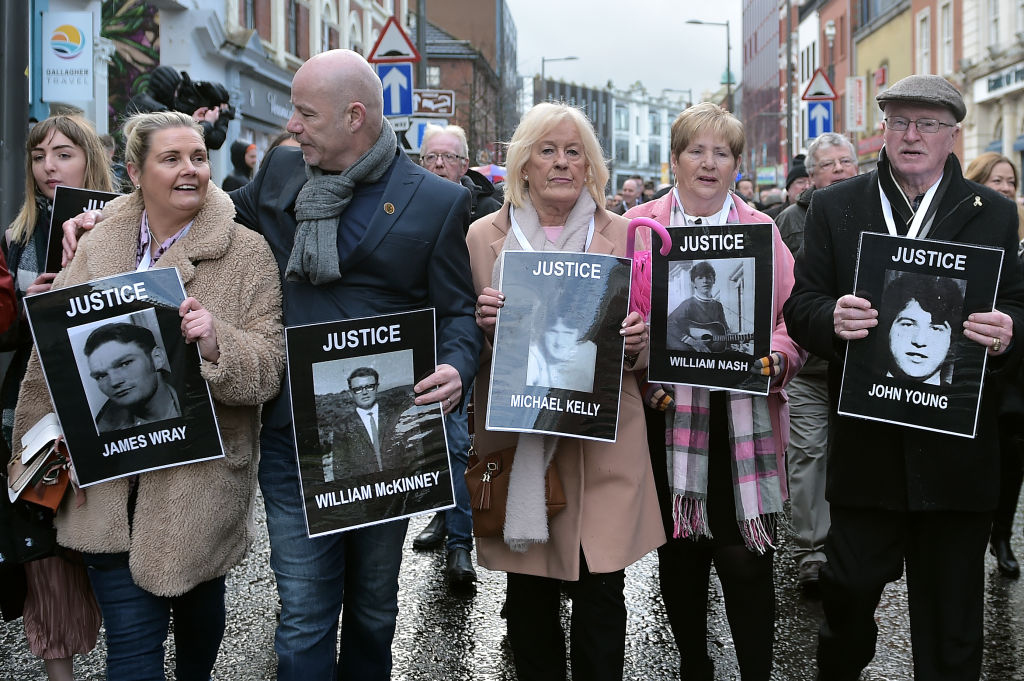
Families of those killed during Bloody Sunday march through Bogside on March 14, 2019, in Derry, Northern Ireland.Charles McQuillan / Getty
Numbers help make sense of some matters. On January 30, 1972 at 2:45 PM, between ten and fifteen thousand supporters of the Northern Ireland Civil Rights Association began a march protesting the British government’s policy of internment without trial. Marching towards the rally point, they were blocked by a British Army barrier. Many were forced down nearby streets, some protestors threw stones at soldiers, and at 3:55 PM soldiers opened fire. From the first to the last shot, a total of one hundred rounds of ammunition were fired. Thirteen people died that day, one more several months later, and fourteen more were injured. An inquiry commissioned in 1998 found that sixteen soldiers had used excessive force. Between that day and the decision on whether to charge the soldiers responsible, forty-seven years elapsed. One soldier was charged.
With a trial now underway, some matters are sub judice, but the Saville Inquiry and the Police Prosecution Service for Northern Ireland have ascertained the facts of the day. The question hangs over whether the one person charged — the semi-anonymous “Soldier F” — merely killed, or instead murdered, the people who died at his hands that day. He will not be charged for at least two of the deaths for which he is responsible. Patrick Doherty was crawling away from the regiment when he was shot in the buttock, the bullet piercing his right flank. Rushing to his aid, Barney McGuigan waved a white handkerchief. Soldier F dropped to one knee and shot him through the head.
Soldier F is not facing trial for murder for these two deaths because he is the only surviving witness. Statements from deceased witnesses are inadmissible to a murder trial. He will face trial for the murder of James Wray and William McKinney, who were both shot in the back, and the attempted murder of Patrick O’Donnell, Joseph Friel, Joe Mahon, and Michael Quinn, all of whom were injured on the day. The delay in justice played a key role in bringing about the fact that only one soldier was charged. Throughout the statement explaining the decision not to bring charges, the fact many witnesses were now dead was often the main impetus for not pursuing a murder charge.