A Midterm Rout Will Hurt the GOP, but Trumpism Will Endure
The Republican Party looks headed for losses in November. But Trumpism will outlast the midterms and even Donald Trump’s own presidency. Defeating it will take a left politics that speaks to working people’s economic pain.
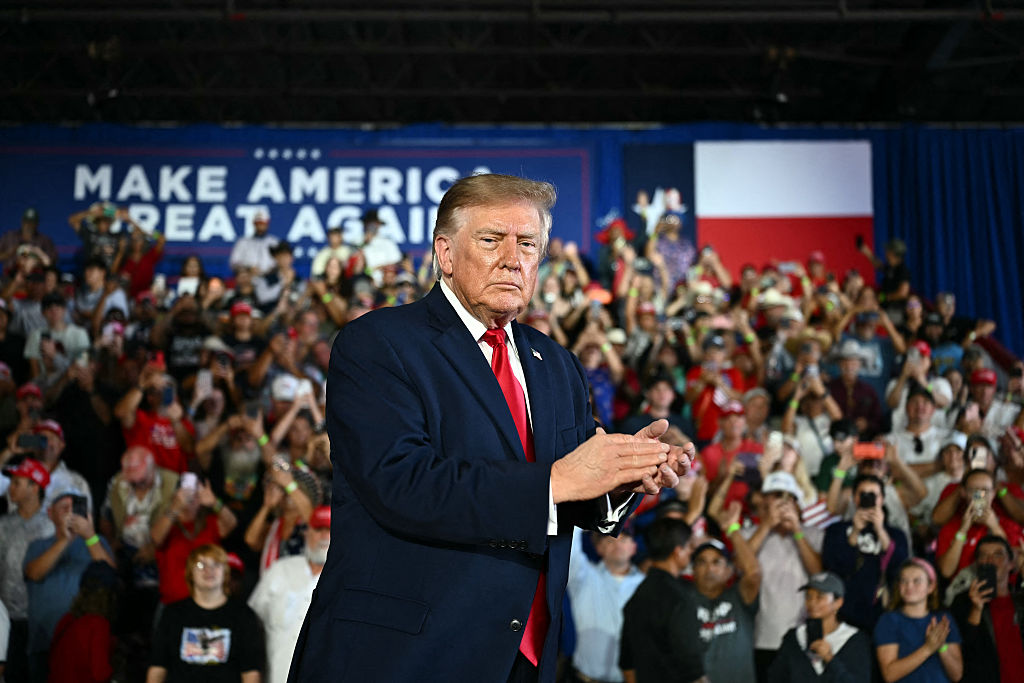
Trumpism fuses pseudo-populism, nationalism, and authoritarianism with predatory capitalism. Its goal is lasting dominance. To undermine that goal, the Left must understand what makes it unique. (Kent Nishimura / AFP via Getty Images)
Observers across the spectrum expect Democrats to make significant gains in the upcoming midterms, in House and Senate races and beyond. There are good reasons to trust in their predictions. Nonpresidential elections in the US are increasingly “nationalized,” meaning that evaluations of presidential and national politics strongly influence down-ballot choices. And President Donald Trump, having behaved cruelly and erratically while presiding over a weak economy and an unpopular war with Iran, has not set Republicans up for success.
With inflation rates high, wages stagnant, and borrowing costs elevated, economic issues are central to the GOP’s current quandary. In a recent Washington Post–ABC News–Ipsos poll, Trump’s economic approval rating stands at just 28 percent. By a three-to-one margin, respondents said the state of the economy was either not so good or poor. Forty-eight percent said they were financially worse off than when Trump returned to office in 2025, the highest percentage saying this about any president in Post-ABC polls since 1986. On other issues, 65 percent said it was a mistake to take military action against Iran, and 68 percent disapproved of the way Trump has dealt with US allies. Tellingly, 56 percent said Trump had gone too far in deporting undocumented immigrants, compared with 48 percent in April 2025.
But whatever happens in November, Trump will hold office for two more years, and the politics he represents won’t evaporate when he exits. Anyone expecting a midterm rout and Trump’s departure in 2029 to restore the old normal — and for the old normal to be sufficient to prevent another far-right resurgence — needs to think again. Instead, we must reckon with the political force that has been unleashed in American life, the aftershocks of which will no doubt be felt for generations to come.
In my new book, Class, Power and the State in the Trump Era: A Critical Analysis (De Gruyter Brill, 2026), I try to sketch an early picture of Trumpism. Below I draw on it to describe what Trumpism is made of, how it changed between Trump’s two terms, and what that means for the Left.
Authoritarian Overreach
One unmistakable aspect of Trumpism is brazen authoritarianism. This dimension is on full display right now, as Trump works diligently to undermine confidence in the electoral system. The Supreme Court checked his attempt to use the US Postal Service to restrict mail-in ballots in September. Since then, the administration has engaged in “systematically laying out unsubstantiated and false claims in an effort to sow doubts about the safety of the country’s decentralized election system,” as a New York Times analysis put it.
For example, as part of Trump’s big-lie campaign about illegal voting, the Justice Department claimed without evidence that twenty thousand people on California’s voter rolls were “likely noncitizens.” The department then charged twenty-eight California residents, all legal immigrants, with violating federal election laws. Despite Trump’s disinformation campaign, most Americans are confident the midterm elections will be conducted fairly, though seven in ten lack confidence that Trump will accept the results if Republicans lose.
Recent weeks have brought stepped-up repression against those Trump regards as enemies. Most notably, Department of Homeland Security officials raided the Washington home of Congresswoman Ilhan Omar, the Somali American representative of Minnesota’s Fifth District, seizing her phone, passport, and other documents. Trump has long displayed a fixation on Omar, whom he has called “garbage,” and on Somali Americans, who reside in large numbers in Minnesota, especially in the Twin Cities area. Several days before the raid, Trump wrote on Truth Social, “The once Great State of Minnesota is being taken over by Somali Immigrants. There is Violence, Murder, and Mayhem all over the State. The people of Minnesota must fight back.” According to several reports, those familiar with the probe believe that its goal is to revoke Omar’s citizenship and eventually deport her.
In my book, I characterize Trumpism as a distinct form of right-wing politics, blending (pseudo-)populism, nationalism, and authoritarianism with uninhibited, even predatory or patrimonial, pro-capitalist economic and social policies. While these political forms have existed in various shapes throughout American political history, they combined in new ways in the Trump era. Trumpism marked a departure from the pre-2016 Republican ideological consensus and signaled the arrival of an alternative form of right-wing politics, one that played out in other countries as well.The goal of the MAGA movement is to weaken rival forces and establish hegemony in American politics based on a reconfigured national-conservative bloc enjoying both popular and elite support. The attack on the election system and the raid on Omar’s home make sense in that light. A movement bent on dominating American politics has every reason to discredit the elections that could check its power and to punish the people it treats as enemies.
The Evolution of Trumpism
If these features were plainly evident in Trump’s first presidency, they only deepened their hold after he left office in 2021 and during his second presidency. From 2021 to 2025, between Trump’s two terms, Trumpism underwent four important shifts. First, Trump’s reactionary political worldview grew more radical, marked by an unremitting commitment to the stolen-2020-election lie, intensifying authoritarianism, vows of retribution, and hysterical rhetoric about the threat of socialism, communism, and the “radical Left.”
Second, the Trump campaign worked with right-wing think tanks to draw up blueprints for a second Trump administration. The purpose was to go beyond such traditional conservative objectives as cutting taxes and reducing spending to a wholesale assault on the administrative state that would give the president complete control over the executive branch. As Russell Vought, now Trump’s budget director, put it in 2023, “The president Day One will be a wrecking ball for the administrative state.” The best-known plan for a second Trump administration was the Heritage Foundation’s Project 2025, released in 2023, of which Vought was a key architect.
Third, Trump and the MAGA movement aligned closely with the preoccupations of right-wing culture and political thought, such as Christian nationalism, anti-wokeness crusading, “pro-natalism,” and concerns about “civilizational erosion” that draw on the far-right great replacement theory. Such thinking is common among Trump 2.0 figures like JD Vance, Pete Hegseth, and Stephen Miller.
Fourth, after leaving office in 2021, Trump almost entirely abandoned the economic pseudo-populism aimed at the working class that was a prominent part of his 2016 campaign. Trump’s 2024 campaign openly courted Wall Street, Silicon Valley, and other parts of corporate America, such as oil and gas, tobacco, and the cryptocurrency industry, which he had previously called a scam.
Trump vowed to cut corporate tax rates, reduce environmental and other regulations, and support fossil fuel drilling. In May 2026, Trump was asked if “Americans’ financial situation” motivated him to make a deal with Iran. “Not even a little bit,” he replied. “I don’t think about Americans’ financial situation. I don’t think about anybody. I think about one thing — we cannot let Iran have a nuclear weapon. That’s all.” He added, “Every American understands.”
An Opening for the Left
But not every American understands. The war with Iran is unpopular, especially in the context of Americans’ domestic economic difficulties. Those difficulties are largely of the president’s own making.
Trump’s signature One Big Beautiful Bill Act, enacted in July 2025, has been called “the most regressive tax and budget legislation in modern American history” by Yale scholars Patrick Sullivan and Jacob Hacker. The inflationary pressures squeezing the working class stem largely from misguided Trump policies, including the war on Iran, which has driven up the price of oil and oil-based products; across-the-board tariffs, which have raised prices of imported goods and inputs used in domestic production; and anti-immigration and deportation measures that have led to labor shortages in construction, agriculture, meatpacking, and other sectors.
So the conditions exist for a large-scale repudiation of Trump and the MAGA movement, which are increasingly authoritarian and even fascistic. As early as 1921, more than a year before the March on Rome, Antonio Gramsci theorized the cross-class, psychologically intense appeal of fascism, noting that fascism “has become an unleashing of elemental forces which cannot be restrained within the bourgeois system of economic and political governance.” The challenge for the Left is to construct a politics that can leash, redirect, and de-energize these “elemental forces” to forestall further drift toward authoritarianism and fascism, something centrist and corporate liberalism has been unable to do.
What does this mean for politics after the midterm elections? First, the Left needs educational efforts to counter McCarthyite attacks from the Right on progressive and socialist ideas so that they can be discussed rationally and without stigma. Second, it should build on the successful electoral work by the Democratic Socialists of America and other groups seen in the Zohran Mamdani campaign in New York and elsewhere. Third, it needs progressive populist economic plans that serve working-class interests and cut through right-wing pseudo-populism. Economist Isabella Weber’s proposals for strategic price controls, which have been discussed in Jacobin, are one starting point worth considering. Gains by the Left in areas such as these will help counter not just the remainder of the Trump 2.0 presidency but Trumpism as an increasingly malignant form of right-wing, antidemocratic capitalist politics.