Serbia’s Students Changed How Serbians Think About Politics
The election win for Serbia’s Student List reflects a deep desire for more democratic ways of doing politics. The test now is to see how the different forces within the movement can collaborate in changing the country’s institutions.
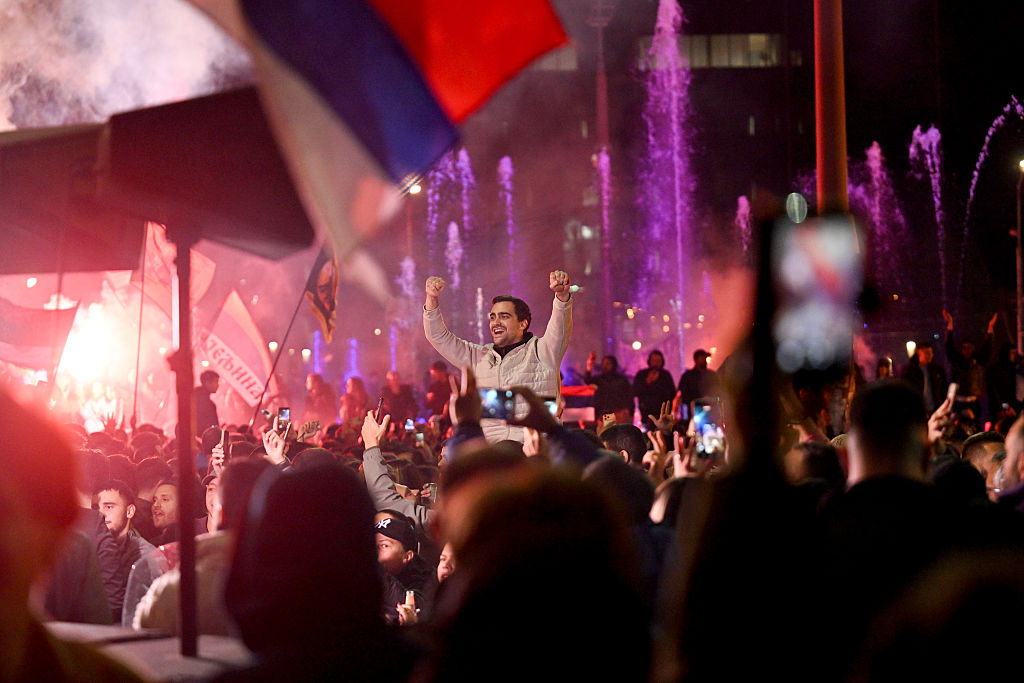
In Serbia’s election, the direct-democratic Student List won a majority of all votes. Its challenge now is to not just replace one ruling faction with another but to free Serbia’s institutions from cliquish control. (Oliver Bunic / Bloomberg via Getty Images)
On Sunday, the largest and most sustained student movement in Europe reached its culmination. After two years of protesting and organizing, this fall Serbia’s students mounted an electoral challenge to former President Aleksandar Vučić, who was this time running to become prime minister. His plans were foiled, as the Student List won with over half of all votes, ending fourteen years of rule by Vučić’s Serbian Progressive Party (SNS).
With the Serbian election process traditionally marked by irregularities, vote buying, pressure on public workers to vote for the ruling party, one-sided media coverage, and other efforts to manipulate the results, the students faced an enormous task. It was far from clear whether Vučić would concede and accept his defeat in case the students won. The tensions were high throughout voting day, and especially toward the evening, when the reports spread that the center of capital Belgrade was becoming filled with police, riot control vehicles, and pro-government thugs.
A deciding factor was the voter turnout, which reached 69 percent, up from 58.7 percent in 2023. Such a high turnout recalled the historic elections of September 2000 when Slobodan Milošević, an ultranationalist dictator responsible for many of the war crimes of the 1990s, was finally defeated. On Sunday, people lined up for hours at polling stations across Serbia and around the world, where the diaspora also participated. Many of the polling stations had people waiting from 5 or 6 a.m., before they opened. The student movement was also successful in mobilizing election observers who covered almost all of the polling stations, making any effort to manipulate the results much harder.