Lula’s Win Is a Defeat for Donald Trump and MAGA
Just as it has throughout Latin America, the Trump administration was openly working to defeat a left-wing government in Brazil and replace it with a far-right one. With Lula’s victory, Trump failed.
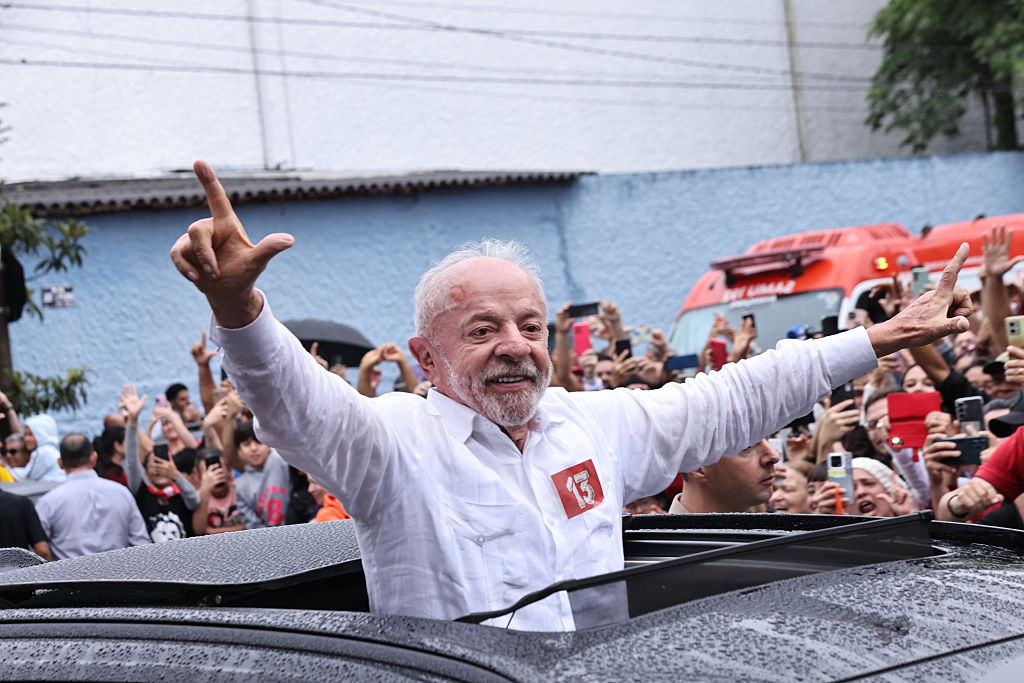
Lula’s win yesterday is not just a big defeat for the Brazilian right. It’s also a defeat for Donald Trump and his MAGA movement in the United States. (Rodrigo Paiva / Getty Images
Luiz Inácio Lula da Silva’s election victory last night in Brazil is being widely celebrated as one of the great political comebacks of our time: the first time any Brazilian presidential candidate has come back from a first-round loss, achieved on the back of a reenergized Brazilian left and a newly launched digital strategy, by a candidate who had been stuck in a prison cell as recently as 2019.
But it’s all the more impressive because it required Lula to overcome not just the powerful forces arrayed against the Left inside Brazil, but also a hostile administration in Washington bent on removing him from power outside of it.
In line with its updated National Security Strategy, the Donald Trump administration has been busy over the past twenty-one months putting its thumb on the scales wherever it can to undermine leftist governments in Latin America and give a leg up to right-wing authoritarians in the region cut from the same cloth. That document had made clear its intent to “reassert and enforce the Monroe Doctrine” and to “reward and encourage the region’s governments, political parties, and movements broadly aligned with our principles and strategy.”
This strategy has been wildly successful. Trump used a combination of threats and a credit line to keep alive Javier Milei’s chaotic and unpopular administration in Argentina. He sanctioned Colombia’s left-wing president, Gustavo Petro, before endorsing the right-wing presidential candidate and detaining one of his high-profile critics. He is backing a right-wing crackdown on Bolivian government officials aimed at insulating the country’s right from corruption charges.
And in Venezuela, he simply kidnapped the sitting president and threatened to do the same to his successor if she didn’t bend the knee.
Brazil was meant to be the next domino to fall. A day before voting in the presidential runoff, Reuters reported that the administration had been working to undermine Lula in the lead-up to the election. According to that report, the two State Department officials responsible for this campaign had explicitly told US diplomats in Brazil that the administration’s eventual goal was to bring Jair Bolsonaro — the former president and father of Lula’s opponent, who is disqualified from running and is now serving a twenty-seven-year prison sentence for plotting a coup — back to power.
The Reuters report was just more or less hard confirmation of something that was already pretty obvious. The elements of the pressure campaign against Lula were no secret, whether the administration’s slapping of 50 percent tariffs on Brazil as punishment for Bolsonaro’s prosecution or its sanctioning of a Brazilian Supreme Court justice. Trump has so far not officially recognized the result, even as the rest of the region, including its right-wing leaders, has publicly congratulated Lula.
To all that, we can probably also add the moves by Meta — the parent company that owns Facebook, Instagram, and WhatsApp — to throttle Lula’s social media presence and that of his allies and to boost his rival. Yesterday Meta workers in the UK put out a statement pinning the blame on the company’s “executives and company leaders,” whose political leanings have, they wrote, “been no secret.” Meta CEO Mark Zuckerberg is one of a number of tech executives who have groveled for the president’s approval since his 2024 reelection, donating $1 million for his inauguration and appearing behind him at the event — so much so that Trump has reportedly mocked Zuckerberg, bragging to people about how he was “kissing my a-s” before showing them his fawning texts.
So, this is not just a big defeat for the Brazilian right but also for its MAGA counterparts in the United States. Brazil is the largest country in South America, its geopolitical importance indicated by the fact that even its neighbors with right-wing governments are choosing not to alienate Lula’s government by going along with Trump’s latest stolen election charade.
Toppling a leftist leader there would have been a major prize for Trump’s “Donroe Doctrine”; instead it has shown the limits of his power to reshape politics even in the United States’ near-“backyard.” All the while, Lula’s government has responded with defiance, formally accusing Washington of interfering in the election and denying visas to two US officials it said were involved in the effort, among other things. As Trump has refused to recognize Lula’s win, one former Lula adviser shrugged it off.
“The whole world has already reacted. The US cannot oppose the election result,” he said, before indicating that Brazil was prepared for a poor relationship with the Trump administration if it came to it.
We shouldn’t overstate this defeat. Lula may have won — a major victory for both the Brazilian left and anyone interested in having a planet habitable for human life — but he will have to govern with a Congress where the Bolsonarist far right holds major sway, a difficult position that could be made even harder by a bitter Washington still bent on inflicting defeat on a prominent left-wing leader.
Still, Lula’s victory gives the Left in Brazil a fighting chance. And if nothing else, the fact that it’s the first time a Latin American state has handed the Trump administration a bloody nose as it tries to meddle in its neighbors’ business is no small milestone.