Lula Must Win. Now It Looks Like He Can.
Victory for Flávio Bolsonaro in Brazil’s election would bring mafiosi to power and reward interference by the White House and Miami reactionaries. In the final stretch of the campaign, Bolsonaro no longer looks invincible.
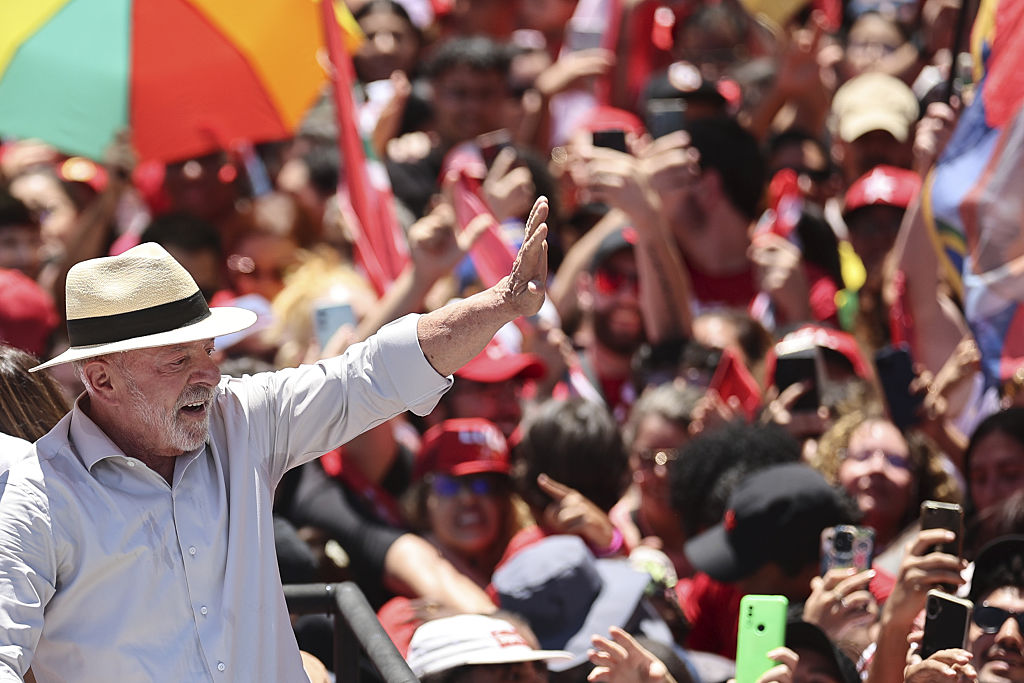
In recent years, Brazil’s right-wingers often dominated the politics of the street. In the final days of the campaign, President Lula’s supporters have occupied public space, hoping that their mobilization can drive up turnout and defy the polls. (Mateus Bonomi / Anadolu via Getty Images)
As Brazil heads to the polls on Sunday, the latest polls show Flávio Bolsonaro’s lead over incumbent president Luiz Inácio Lula da Silva narrowing. One pollster, Qeast, had the eldest of Jair’s brood on 45 percent, just 1 point ahead of Lula.
Flávio’s rejection rates have been steadily climbing since he flopped in last Sunday’s debate. While there is a good chance Brazil may still elect the crooked son of a convicted idiot, three weeks after his first-round victory, it’s also clear that Lula is back in the game thanks to a historic mobilization.
Bolsonaro’s campaign has largely tried to keep him out of the limelight while portraying him as a more moderate version of his father and pushing anti-incumbent messaging through influencers and proxies. After winning the first round by 2 percent, Bolsonaro and his allies started acting as if the election was already in the bag and announcing bizarre potential cabinet appointments, such as a health minister opposed to the idea of health care as a universal right, which is enshrined in Brazil’s constitution. The right-winger’s pick (for now) as finance minister has talked about cutting the Bolsa Família welfare payment and other social programs.
Flávio’s emergence from the shadows during the second round has been accompanied by a constant flood of scandals around him. One story that broke this week in Piaui magazine, Brazil’s equivalent of the New Yorker, encapsulated his brand of moderation. During the height of the COVID-19 pandemic, when a thousand of his countrymen were dying daily, he partied on a boat with a vaccine lobbyist trying to hawk overpriced doses. The lobbyist reportedly gifted him a Rolex and brought along some prostitutes for the ride. In essence, Flávio was pro-vaccination provided he got a cut of the profits, an orgy, and a watch out of it — unlike his more ideological brother Eduardo, who has embraced US-style anti-vax politics.
After running a mostly complacent campaign for the first round this October 4, Lula’s campaign suddenly kicked into gear largely outside of the official structures of the Workers Party (PT). For instance, under the leadership of Minas Gerais lawmaker André Janones, there is a proper digital campaign this time around: a WhatsApp channel named “Lula’s Army” is deploying its now over 8.2 million followers on various missions. Targeted and organic online messaging, along with Flávio actually being forced to show the electorate who he really is, plus a historic wave of street mobilizations, give Lula a real chance of winning. Lula and the Left were also able to pass a historic victory for the labor movement in Brazil, reducing the working week to five days on, two days off on October 16.
It remains to be seen if this will be enough to overcome US intervention, overt manipulation by Big Tech, dirty tricks, constant electoral intervention from the Supreme Electoral Court (TSE) judges, in particular President Kassio Nunes Marques, through rulings favorable to the Bolsonaro clan’s scion, and what has been exposed as a corrupt network in major media firms invested in ensuring Lula’s defeat. News website PL noted: “Bizarre rulings . . . including the censorship of a campaign spot that merely presented Flávio’s criminal ‘track record’ based on reports published by major media outlets.” Another Piauí story suggested that Justice Nunes Marques attended a party with sex workers and high-end meats organized by disgraced banker and “big brother” of Flávio, Daniel Vorcaro, who is best thought of as the tropical Jeffrey Epstein; one of his friends even joked on WhatsApp that Jeff was an amateur compared to Vorcaro.
Post-Civil Society Electoral politics
This is my third election in Brazil, and by far the most difficult to write about, in part because it has been, as Vincent Bevins puts it, “a post-civil society election.” Short-form video curated by individualized algorithms shapes political content in what remains of the public sphere more than traditional media or even the infamous disinformation channels on Telegram and WhatsApp used by the 2018 and 2022 Bolsonaro campaigns. Whereas last time there was a legion of YouTubers and budding podcasters shaping the narrative, this year there are thousands of Instagram and TikTok influencers doing that work; you would only know about them if you were locked into a particular algorithm from fitness to crypto and beauty for evangelical women.
This was evident in the farcical TV debate last Sunday where a heavily coached and stimulated Flávio stalked Lula around the stage and adopted the sordid debate tactics of professional life coach and former São Paulo mayoral candidate Pablo Marçal, who is banned from politics until 2032 for lying about his assets in that campaign. Flávio has even floated the possibility of Marçal serving as his future “minister of prosperity.”
The fact that fitness and beauty influencers, along with aspiring Brazilian streamers, are now pushing far-right narratives is part of what political scientist Miguel Lago describes as a right-wing cultural revolution in Brazil. Philosopher Rodrigo Nunes has discussed it in terms of the technologies of social disintegration. The ideology of entrepreneurship, grounded in the soaring app-based employment and the expanding attention economy, processes a right-wing common sense, in part because the world is increasingly experienced as a Hobbesian competition of all-against-all. For those parts of society locked out of traditional formal employment and top public universities, the world that Bolsonarismo describes seems a lot closer to their reality than the slogans of the Left.
Bolsonarismo’s digital ecosystem is not transparent; we don’t know how the dirty money is circulated, what negotiations take place outside of social media platforms, and how it organizes its internal relations. According to leading political scientist Marcos Nobre, drawing on Paolo Gerbaudo’s work, this has transformed Bolsonarismo into a militant digital mass party that commands around 25 percent of the vote at the same time as it has consumed the traditional rent-seeking parties of the centrão (big center) through a traditional party infrastructure. Bolsonaro’s Liberal Party (PL) is now the dominant force in both Congress and the Senate. This has not come at the expense of the Left, which has actually increased its representation in Congress, but from old-school authoritarian, center-right, and slightly more democratic machine parties.
The Politics of the Street
I described the first round of the election as largely defined by apathetic polarization; the second round has been different. Lula’s Workers’ Party (PT) and its supporters have shown in recent weeks that they can mobilize millions of people in street rallies. In one sense, the final result will provide an indication of whether the politics of the street are enough to counter some of the effects of social disintegration.
From the moment the Right joined the June 2013 protests, which had started as a mobilization organized by radical autonomists against an increase in bus fares in São Paulo, up until the invasion of Brazil’s capital on January 8, 2023, by Bolsonaro supporters rebelling against his electoral defeat, reactionaries became the dominant political force on the streets.
They first did so by contesting the space with the new social movements of the Left, and emerging as the dominant force through the protests against then-President Dilma Rousseff in the wake of the Lava Jato anti-corruption investigation. This culminated in the constitutional coup that toppled Rousseff in 2016, followed by the imprisonment of Lula on spurious charges and Jair Bolsonaro’s presidential victory in 2018.
In office, Flávio’s father continued to mobilize his supporters through anti-democratic demonstrations calling for a return to a government more akin to military dictatorship and targeting Brazil’s democratic institutions — particularly the Supreme Court — as well as motorcycle rallies and anti-COVID-restriction protests throughout his term. After he lost to Lula in the 2022 second-round vote, his supporters again took to the streets, using road blockades in a particularly surreal fashion to contest the election results. In the January 8 protests, Brazil’s “January 6” moment, some quite literally defecated on the official symbols of the republic.
As we know now, this was part of an attempted coup in a country with a long history of violent putsches, planned by a president who made his political career as a defender of a military coup and the worst crimes committed under the dictatorship that ruled the country from 1964 to 1985. The plot involved the planned assassination of Lula, his vice president, Geraldo Alckmin, and Supreme Court Justice Alexandre de Moraes, also known as “Xandão” (“Big Alex”).
After January 8, the Right went back to their homes, and the coup plotters were arrested, with Jair Bolsonaro himself ultimately convicted. Some of his confederates fled the country. Right-wing street protests ceased to be a regular feature of Brazilian politics. However, this did not weaken the far right: Congress was controlled by right-wing blocs, and their common sense continued to spread through the cultural revolution described earlier. The Right no longer needed to mobilize as an insurgent force. Today it has the dominant party in Congress in Bolsonaro’s PL.
The Left, on the other hand, has become the increasingly tired defender of the post-1988 constitution, now personified by Lula. The camp of both the prodemocratic center right and center left has been largely depleted: for the first time since Brazil’s return to democracy, in this year’s first round there was no center-left candidate competing with the PT. Most of the radical left, including factions that were earlier hostile to the PT, is now firmly behind Lula’s candidacy. But this entire prodemocratic camp, including its center-right and centrist elements, is viewed by the Bolsonaristas as “the Left.” For real Bolsonaro supporters, there is no real difference between graying centrists like Geraldo Alckmin, Xandão (appointed to the court by Michel Temer to protect his political interests and block any attempted prosecution) and blue-haired LGBTQ communists. For them, it’s all just “the establishment.”
Who Exactly Is Flávio Bolsonaro?
Flávio is now the candidate of this empowered far-right bloc by virtue of his parentage. If there is any real difference between Flávio and his father — apart from the fact that Flávio is a baptized evangelical Christian and never had a military career — it is that the son operated in the highest, most crooked echelons of Rio de Janeiro politics. There he was widely liked and was invited to get involved in the bigger rackets, unlike his father. Flávio seems to be connected to every major corruption scandal, while his father was able to pose as an anti-corruption politician, because nobody liked him enough to get him involved in the big rackets of the 2000s and 2010s. Jair made do with the petty graft of small-time congressional deputies.
Flávio’s best friend, a crooked lawyer named Willer Tomaz, is involved in laundering over a billion dollars through online betting companies on behalf of various mafia interests. He’s also neck-deep in a scandal involving billions of dollars’ worth of Social Security fraud; Tomaz allegedly had a secret office in a hangar at Brasilia airport to store the dirty money. Tomaz even took Flávio on a hunting trip to South Africa and, according to Tottenham football star Richarlison, stole an island mansion he had bought on behalf of Flávio, among other things.
Flávio and Tomaz represent a new iteration of the fusion of politics and organized crime in Rio de Janeiro, where paramilitary mafias known as Milícias, the Military Police (PM), and evangelical churches work directly with Comando Vermelho (CV), recently designated by Donald Trump as a narco-terrorist organization, in racketeering, money laundering, and ensuring the right candidates get elected. Numerous close allies of Flávio have been apprehended by the Federal Police (PF) over the last few weeks as part of an operation involving laundering over $1.5 billion dollars, including Márcio Canella, the second most-voted state deputy in Rio de Janeiro this election and ex-mayor of Belford Roxo, a satellite city of Rio notorious for organized crime. Flávio’s mother was selected as the substitute candidate for his campaign. Campaign materials for Canella were discovered at the home of the wife of notorious CV capo Márcio dos Santos Nepomuceno, better known as Marcinho VP. The effect was evident in the fact that Flávio won the areas of Rio controlled by organized crime.
Flávio also had close ties to one of the most notorious hitmen in Brazilian history, the late Adriano Magalhães da Nóbrega. A former member of the BOPE, which is Rio’s more elite version of SWAT, before he was kicked out the police for murder, and leader of the Crime Office, an elite death squad working for various Rio mafias, the hitman was introduced to the Bolsonaro clan through a longtime family friend, former military policeman Fabrício Queiroz, who was accused of murdering a “trafficker” in 2003 with Adriano in the famous City of God favela when they were serving together in the PM. Adriano became Flávio’s shooting instructor, while Queiroz was working as a driver for Flávio.
Flávio went on to nominate Adriano for the Tiradentes Medal — the highest honor that the Rio State Assembly hands out for public service — and hired the hitman’s wife and mother as part of his senatorial staff, part of a suspected kickback scheme. Captain Adriano and the Crime Office, and their connections to the Bolsonaro clan, came to public attention following the murder of Marielle Franco, which was carried out by other members of the death squad, leading to his eventual death in a shoot-out with police in Bahia in 2020, in what most people believe was part of an attempt to “close the file on him,” as they say in Brazil.
If Flávio is elected president, it would mean the ascension of Rio’s mafia to the presidency as well as a victory for imperial Miami and the desecration of Brazil’s sovereignty. But the game is now over; Lula has momentum on his side and there is a final debate scheduled for Friday night where Flávio will have to avoid or deflect questions related to the piles of bodies and scandals connected to his political career, and even then this likely will not prove enough to get Lula over the line. But as history has shown, if anyone can pull of a political comeback, it is Lula, the most talented politician to have emerged over the last fifty years.