The Stakes Are High in Brazil’s Upcoming Election
During Jair Bolsonaro’s term as president, he faced a liberal establishment that acted as a bulwark against his worst excesses. If his son Flávio beats Lula in the presidential election, he will lead a government less hostile to the far right.

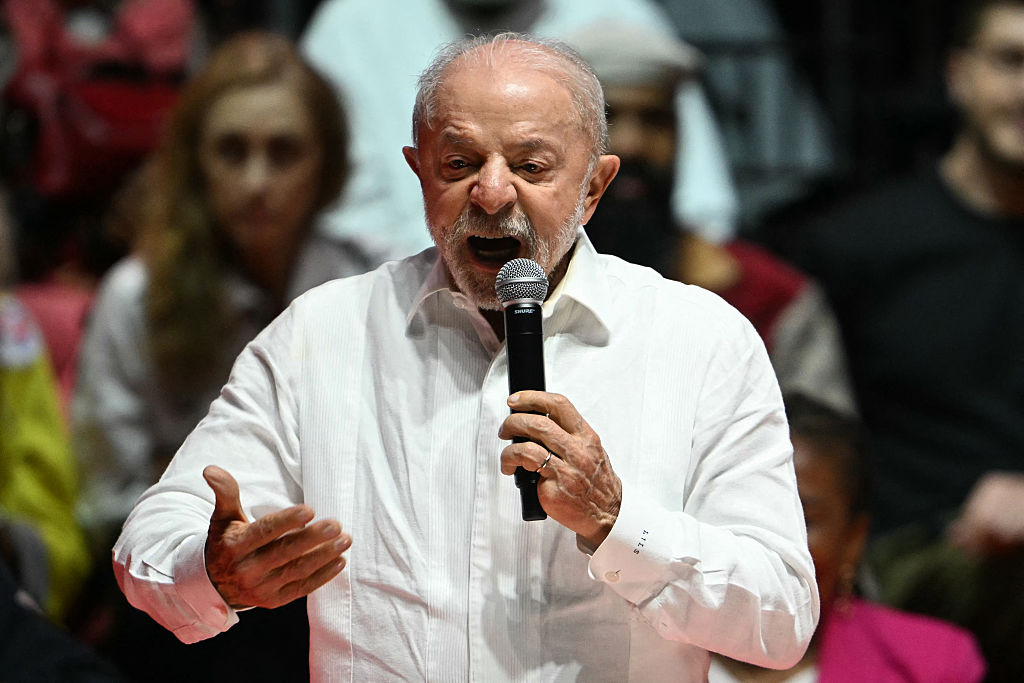
Lula’s third term has seen millions lifted from poverty and unemployment remain steady. But right-wing media, American meddling, and persistent inflation have given Flávio Bolsonaro an opening in the upcoming election. (Mauro Pimentel / AFP via Getty Images)
For a time this summer, Brazil’s presidential election seemed Luiz Inácio Lula da Silva’s to lose, and Latin America’s largest democracy appeared poised to hold its ground while right-wing candidates triumphed in Colombia, Peru, Honduras, Chile, and Panama, and the Left lost its long hold on Bolivia.
Before, the race had been steadily tightening between the eighty-year-old president and his forty-five-year-old challenger, Flávio Bolsonaro, the blandly affable, lacquered version of his father, former President Jair Bolsonaro, who is serving a twenty-seven-year sentence for plotting a coup after his defeat. Even before Flávio’s candidacy was announced, polls had put Lula and Jair neck and neck in a hypothetical runoff, though the elder Bolsonaro was already ankle monitor–bound and barred from candidacy.
Brazil With an S
But Lula’s campaign was jolted back to life in July 2025, when President Donald Trump, following lobbying by Flávio’s brother, Eduardo, intervened on behalf of the embattled former president. Eduardo — a Texas-based, Steve Bannon–linked convicted criminal — urged American pressure in the name of Brazil’s “political prisoners,” and soon Trump announced 50 percent tariffs on Brazilian imports, followed by financial sanctions on Alexandre de Moraes, the supreme court justice overseeing Bolsonaro’s trial.
Lula’s government seized on the affront and made quick work of Trump’s political gift. Within a day of the tariff announcement, it had released an advertisement chiding the gringos for spelling Brasil with a Z; here, the narrator explained, it was spelled with an “S” — for sovereignty. Social media was plastered with images of colossal American flags unfurled at Bolsonaro rallies. And, in a televised address to the nation, Lula declared, “Brazil has only one owner — the Brazilian people.” His message was forceful and unabashedly nationalist, while the Bolsonaro family’s appeals to Washington made its own professions of national pride look pathetically conditional.
The strategy seemed to have worked, at least temporarily. By August 2025, a Quaest poll put Lula 12 points ahead of Bolsonaro in a hypothetical runoff. Then, the following May, Flávio’s death knell seemed to sound when The Intercept revealed that he had solicited $24 million from Daniel Vorcaro, the disgraced Banco Master owner jailed on suspicion of multibillion-dollar fraud. In a turn almost too obliging to be true, it was revealed that the massive sum was solicited to fund Dark Horse, a lavish, soapy propaganda film about Flávio’s father’s rise and survival of an assassination attempt starring Jim Caviezel, who played Jesus in Mel Gibson’s The Passion of the Christ.
Flávio had publicly denied having personal contact with the banker. Yet the day before Vorcaro was arrested while preparing to board a private jet bound for Malta, Flávio had sent the banker a WhatsApp message reading, “Brother, I am and always will be with you.”
In a country particularly sensitive to political corruption scandals, and with voters uninspired by either candidate, the morass seemed close to the worst thing that could have happened to Flávio. In Datafolha’s next survey, Lula broke once more from tied runoff projections, gaining a 4-point advantage.
But the political blaze soon spread toward Lula. On September 1, newly disclosed messages recovered by federal police showed Vorcaro seeking advice and intervention from Justice Alexandre de Moraes, even asking whether he should leave the country. Moraes’s replies were not recovered, and he denied acting on the banker’s behalf, but file metadata also indicated that a draft of his wife’s firm’s whopping R$131 million contract with Banco Master had been edited under a user profile bearing the justice’s name.
Though the Banco Master scandal implicates Flávio and not Lula, it has become particularly damaging for the latter because Lula is seen as a key ally of Moraes. The jurist has attracted controversy for his role in overseeing Bolsonaro’s prosecution and helping annul the ginned-up charges that led to Lula’s imprisonment until 2019. The most recent polls once again show Lula and Flávio at a stalemate, leaving observers of Brazilian politics waiting either for another sordid revelation, or the very likely possibility of another bumbling intervention from Washington.
Lula’s campaign has already had to contend with a right-dominated media at home and interference from abroad. Most recently, Meta inexplicably blocked his campaign social media account for a period less than two weeks before the election, then lifted the ban. This past week, intelligence officials in Brasilia have briefed French and German officials on possible American and Russian attempts to influence the elections.
But the preoccupation with scandal that has defined coverage of the election also obscures a more stubborn problem for the incumbent. He has a substantial record to defend, and yet considerable difficulty persuading Brazilians that his leadership made their lives better.
Brazil’s economy has fared anomalously well by regional standards. Unemployment stood at just 5.3 percent in the quarter through August, and between 2023 and 2024, 8.6 million people were lifted out of poverty. Lula restored increases in the minimum wage above inflation, expanded payments to families with young children, and secured a significant tax exemption for low-income people. He has continued the tangible improvements that made him the most popular president in Brazilian history during his second term.
Yet slowing inflation has not undone years of rising prices, while expensive credit eats into what savings families have. By June, debt repayments excluding mortgages absorbed more than a quarter of aggregate household income. Meanwhile, the war with Iran has put renewed pressure on prices.
Lula has not been able to satisfy his constituents in part because he is caught representing the interests of two distinct groups. To the cautious financiers and industry leaders that help decide Brazil’s elections, he must be a solidly establishment figure — the levelheaded custodian of an economy whose debts must be paid. To the workers that fueled his political rise and are fed up with the stasis and complacency of a power-mongering, wealth-hoarding few, he must offer clear material support and evidence that things will change. And though the Economist, following much of the anglophone press, has described him as a “doddering leftie” trying to best a “vengeful nepo-baby,” much of the Brazilian left has found Lula altogether too accommodating to the institutions that have failed them As early as 2010, early leaders on the left wing of Lula’s Workers Party (PT) began lamenting that, in the words of Plínio de Arruda Sampaio, “The leadership abandoned the PT’s project and embraced the pursuit of power.” The metalworker who lost a finger on the job and forged his political reputation rousing crowds of union workers in the late 1970s is now having difficulty convincing voters that he hasn’t grown too comfortable with the establishment he once promised to challenge.
Nonetheless, Flávio’s stubborn buoyancy in the race should be cause for alarm well beyond the Left. For all his air of managerial sobriety, the dutiful heir could prove far more destructive to Brazilian democracy than his father.
During his presidency, Jair Bolsonaro threatened to disobey judicial rulings, defamed the country’s voting system, and promoted military officials who were later convicted alongside him for a coup conspiracy that included plans to assassinate Lula. But when he entered office in 2019, his authoritarian ambitions were constrained by solid institutions built to withstand attempts to erode democracy. Principally, he was checked by an unusually powerful supreme court, armed with sweeping constitutional and criminal jurisdiction under the 1988 Constitution that was adopted after decades of military dictatorship.
But much has changed since 2019, and those restraints can no longer be taken for granted. Nor can the survival of the democracy they helped preserve.
To begin with, regardless of the presidential outcome, the Chamber of Deputies is expected to remain dominated by the center and Right, while the Right could substantially strengthen its position in the Senate. There, Flávio has explicitly campaigned to build a Bolsonarista coalition willing to impeach Moraes and other supreme court justices. Even without an impeachment majority, a victorious Flávio could gut the court. Two of its eleven justices were appointed by his father, three reach compulsory retirement age by the end of 2030, and one seat remains vacant. If that vacancy survives Lula’s term, Flávio could appoint four justices — with Senate approval — bringing the number chosen by the family to six, a majority.
For a court that has ordered a sitting congressman’s arrest, blocked social media accounts, and suspended X throughout the country, and that has the power to do much else, such capture would give Flávio the power to govern with impunity. With control of the courts and congress, “democratic backsliding” is about the best outcome one could hope for.
Freedom of speech and of dissent would be eroded. Jair routinely smeared and discredited journalists, even weaponizing dictatorship-era censorship laws. Alongside the building of five El Salvador–style megaprisons, Flávio has proposed barring parts of school curricula that conflict with parents’ religious or moral beliefs. He has also sought to replace racial quotas in public-service recruitment with income-based preferences and, in a 2011 interview, called the sight of two men kissing “disgusting.”
Abroad, Flávio’s flimsy nationalism would likely give way to vassalage to Washington. In June, he wrote to Marco Rubio offering to place his prospective transition team “immediately at your disposal” to negotiate a trade and investment agreement. But following Washington into confrontation with Beijing could prove expensive for Brazil. China has eclipsed the United States as a more reliable market for Brazilian exports, buying nearly 29 percent in 2025 against America’s 11 percent, and Chinese companies invested another $6.1 billion into Brazilian infrastructure that year.
The most lasting and globally reaching damage, however, would be environmental. Flávio has dismissed human-caused global warming and mocked the idea that forests generate rainfall, even though reduced rainfall is already harming Brazilian soybean yields. He has coauthored a bill to open mandatory vegetation reserves on rural properties to clearing and backed proposals restricting indigenous claims to ancestral land, alongside expanding oil and gas infrastructure and legalizing fracking.
If his father’s presidency offers anything like a preview, the consequences will be disastrous. Jair hobbled environmental enforcement, making illegal clearing easier and punishment less likely. As a result, annual deforestation in the Brazilian Amazon surged by 54 percent between 2018 and 2022, reaching a fifteen-year high in 2021. Further destruction could help push the forest beyond recovery. A study published in Nature this May found that warming of 1.5–1.9°C above preindustrial levels, combined with the clearing of roughly a quarter of the Amazon — which stores carbon equivalent to roughly fifteen to twenty years of global emissions — could trigger widespread ecological collapse. No subsequent government can simply replace vanished rainforest or recapture lost carbon.
Yet a Bolsonaro restoration is by no means assured. The coalition that returned Lula to office — organized labor, the rural and urban poor, and progressive sections of the middle class — has frayed but retains considerable strength. Its roots run especially deep in the northeast, where Lula’s Bolsa Família program has long supplemented the meager incomes of working families. It remains to be seen, however, whether right-leaning women will see through Flávio’s shallow attempts to win their votes by mentioning his mother, in an attempt to erase the caustically sexist — and eminently unpopular — legacy of his father from their minds. Nor is it clear that the next Vorcaro WhatsApp screenshot will matter more to voters than the price of groceries or the prospect of getting home safely.
At the height of the dictatorship, as military police tortured and jailed dissidents, Chico Buarque released “Apesar de Você,” a somber but resolute samba. To slide the track past state censors, it clothed a resonant challenge to the regime in a quarrel between lovers. “Despite you,” he sang, “tomorrow will be another day.” The censors eventually caught on and banned it. But by then, a hundred thousand copies had sold.