Dockworkers Worldwide Are About to Strike for Palestine
The second International Day of Action of Dockworkers, in solidarity with Palestine and against militarism, begins this Friday — and could be the largest worker action against war in history.
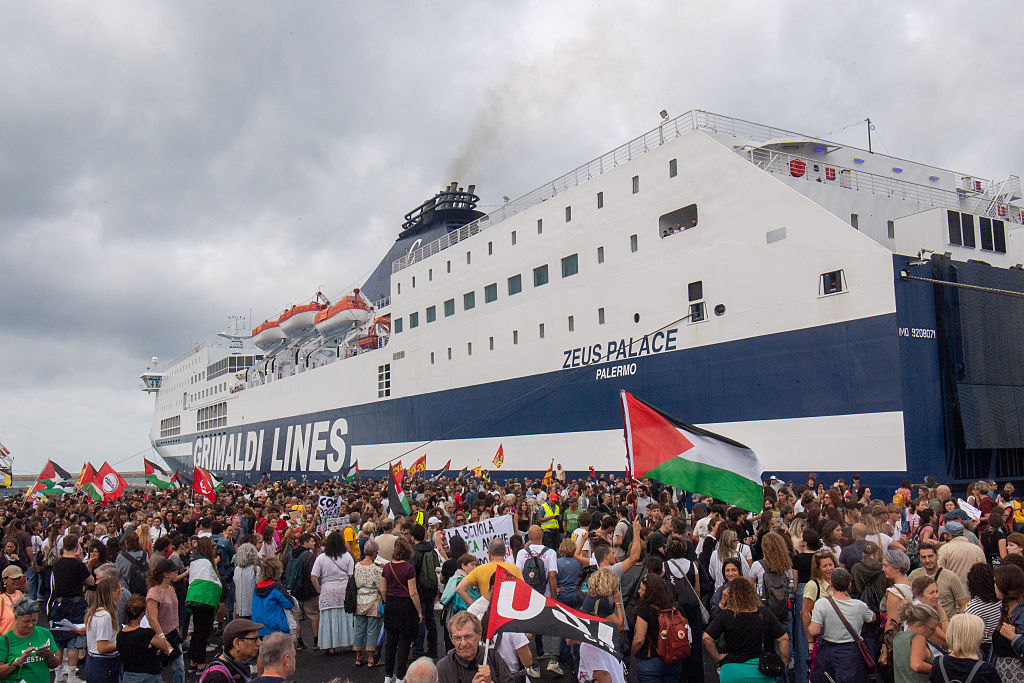
A procession of Italian dockworkers, workers, and students forced their way through the Varco Valessini gate and entered the port of Livorno during a protest for Gaza and Palestine, on September 22, 2025, in Livorno. (Laura Lezza / Getty Images)
In 1984, while the global struggle against apartheid burned hot, union dockworkers in San Francisco refused to unload South African cargo to demonstrate their hostility to a white supremacist, fascist regime. In so doing they reaffirmed what Harry Bridges, the first president of the International Longshore and Warehouse Union (ILWU), asserted when asked about what role organized workers should play in world affairs: “Interfere with the foreign policy of the country? Sure as hell! That’s our job, that’s our privilege, that’s our right, that’s our duty.”
Few workers believe that they have sufficient power to express political opinions at work, let alone insert themselves into global affairs by downing their tools. And yet, as revolutionary unionist “Big” Bill Haywood reminded, “If the workers are organized, all they have to do is to put their hands in their pockets and they have got the capitalist class whipped.”
Starting in 2023, the Palestinian General Federation of Trade Unions (PGFTU) called on workers and unions to “Stop Arming Israel.” In 2025, the PGFTU asked international workers to “organize days of rage and global solidarity in factories and workshops, in ports and airports, in the streets and public squares, in support of Palestine and its brave people.”
The Palestinian Boycott, Divestment, and Sanctions movement clearly builds upon the struggle against apartheid South Africa, arguably the most effective global social justice movement of the late twentieth century. As early as 1959, African National Congress President Chief Albert Luthuli, later awarded the Nobel Peace Prize, stated: “Economic boycott is one way in which the world at large can bring home to the South African authorities that they must either mend their ways or suffer for them.”
This Friday, October 30, dockworkers in around one hundred ports in nearly twenty countries will engage in perhaps the largest coordinated work stoppage in world history. The epicenter is the Mediterranean — where dockworkers in dozens of ports in Italy, Greece, France, Cyprus, the Basque Country, and Morocco — will refuse to work for either part of the day or the entire day. They will be joined by dockworkers and other workers who will rally in Spain, Turkey, Germany, Ireland, Portugal, Denmark, Sweden, Australia, Veracruz, Mexico, and Oakland, California as well as many ports in India.
They’re not demanding higher wages or shorter hours. In the words of two of the many posters circulating, “Dockworkers do not work for war” and “No Harbour for Genocide.” Dockworkers are saying they refuse to be complicit in waging war, let alone genocide.
The Ship Must Sail on Time
The history of strikes is inextricably linked to shipping. Tellingly, the English term for workers’ most powerful weapon, “strike,” has nautical origins. In their book Many-Headed Hydra, Peter Linebaugh and Marcus Rediker described how, in 1768, sailors in London “struck [took down] the sails of their vessels, crippling the commerce of the empire’s leading city and adding the strike to the armory of resistance.” Since then, the term for work stoppage has been strike. Shipping is central to capitalism: even today, upward of 90 percent of all goods consumed (either raw materials or finished products) are moved by ships.
For at least a century, dockworkers, seafarers, and other maritime workers have occasionally refused to load or unload cargo to protest imperialism, fascism, and war.
In 1935–36, dockworkers in the southern African ports of Durban, Cape Town, and Lüderitz Bay, as well as in San Francisco, refused to load cargo aboard Italian ships to protest that fascist empire’s invasion of Ethiopia.
In the late 1930s, dockworkers in Local 10, the ILWU’s San Francisco Bay Area branch, partnered with the Chinese community to refuse to load cargo for imperial Japan to protest its invasion of China.
The most widespread example of global dockworker activism was against apartheid South Africa. In San Francisco, Brooklyn, Sydney, Port of Spain (Trinidad), Gothenburg (Sweden), Copenhagen, and many other ports, union workers refused to handle cargo.
Anti-apartheid activism among workers was not limited to shipping. Irish supermarket workers led a multiyear campaign by refusing to check out customers who bought South African products, as dramatically described by Irish author Sally Rooney.
Perhaps the most relevant example was ILWU Local 10’s campaign against fascist Chile. In 1978, San Francisco dockworkers and clerks of ILWU Local 34 discovered the US military was secretly shipping weapons to Chile. The ILWU had staunchly supported the previous regime, led by socialist Salvador Allende, overthrown in 1973 in a military coup led by Augusto Pinochet, with the active support of the United States.
Local 10 activists including Herb Mills, who later wrote a fictionalized account called Presente, partnered with Chilean exiles, Bay Area Latinos, the Catholic Church, and others to press the US government to stop any sending of military supplies. In tandem with sympathetic congressional members, the ILWU helped convince the Carter administration to reverse US policy and stop sending military equipment to Chile.
Dockworker Solidarity With Palestine
The PGFTU’s 2025 “Cry Before Death” stated: “Our union comrades, we await your role in delivering the cry of the children and workers of Gaza to decision-makers and to the streets.”
In solidarity with the Palestinian labor movement, the second International Day of Action of Dockworkers seeks to disrupt the global supply chain first and foremost in Mediterranean ports, which is the “front line” in the struggle against Israel’s war on Palestine — as well as its wars on Lebanon, Turkey, Syria, and Iran — all supplied by US and European military equipment and ammunition.
Since 2019, when they refused to load weapons for Saudi Arabia’s war in Yemen, dockworkers in Genoa — Italy’s busiest port — have emerged as a leading force. Last year, in solidarity with the Global Sumud Flotilla that sought to break Israel’s illegal blockade of Gaza, one Genovese dockworker promised, “If we lose contact with our boats, with our comrades, even for just twenty minutes, we will block all of Europe.” Last fall, among the flotilla participants was the Genovese docker activist José Nivoi and the Amazon union activist Chris Smalls.
The Genovese dockers have strong support from a well-organized civil society, student groups, and supportive local government. This fall, Genoa also is hosting a sound installation by Canadian artist Hajra Waheed, Hum III: From Port to Port, A Sonic Convening. Waheed’s exhibition explores the historical tradition of radical labor organizing, antifascism, and internationalism in Casablanca, Chattogram, Durban, Genoa, Sydney, Jaffa, and other ports. Waheed intentionally connects histories of direct action to dockworkers engaged in opposing apartheid Israel, including on October 30.
The World Federation of Trade Unions (WFTU), an Athens-based organization with affiliated unions representing 105 million workers, is cosponsoring this action:
The mobilization is taking place at a critical time, as military conflicts are spreading and war fronts are dangerously expanding and becoming interconnected, from Ukraine to the Middle East. The murderous state of Israel, with the support of the USA, the European Union and NATO, continues its crime against the Palestinian people and escalates its military aggression against Iran and Lebanon, increasing the danger of an even broader conflict.
The WFTU highlights that workers “in the metal industry and shipyards, railways, energy, telecommunications, transport and logistics. . . . ports, industrial zones and military infrastructure. . . . [also] can play a decisive role in the common struggle against imperialist war and exploitation.”
Charmaine Chua, a scholar of supply chain disruptions and an organizer with Workers in Palestine, provides more specifics about
strategic nodes sustaining Israel’s genocide: from Turkey supplying crude oil through the port of Ceyhan, to coal exports from South Africa, to shipments of components to Elbit Systems from Genoa, Ravenna, Livorno, and more, to Oakland’s role in supplying US military operations across the world. To trace the role of these ports in genocide is to see the tentacles of fuel, weapons systems, and renewable energy feeding the Israeli and US war machines. But if ports have become an astonishing crystallization of our states’ callous complicity in the war machine, the immense solidarity of dockworkers and civil society reveals the mass opposition forming in response to these ongoing catastrophes.
One must also understand that, since the supply chain — which makes “modern” war possible — is global, shutting down one port, or even the ports in one country, is insufficient. That is why Katy Fox-Hodess wrote that no strategic choke point is a “magic bullet” and why she, along with coauthor Rafeef Ziadah, began studying “Labour Internationalism in a Time of Genocide.”
Chua goes further: “Meaningful labor solidarity with Palestine will require all of us to find where we have other points of leverage in our own workplaces, to sustain organizing on our own shop floors, and to build a unionism committed to organizing everywhere, rather than only at strategic sites.”
While dockworkers soon will take the stage, some could not wait. Last week in Livorno, dockworkers disrupted the movement of US military cargo from the joint Italian Air Base and US Naval Air Station Sigonella, nicknamed the “Hub of the Med.”
This Friday, dockworkers across much of the Mediterranean and beyond will stop work and rally against war and genocide. In today’s world, workers seeking to shape global politics must organize across industries and nations. While this Friday’s action should be huge, how workers respond next week and those to come will be even more important.