All Aboard Eugene Debs’s Red Special
In 1908, on one of his five presidential runs, legendary socialist organizer Eugene Debs embarked on a whirlwind tour across the country on his own train, the Red Special. His mission: spread the socialist gospel to any American who would hear him out.
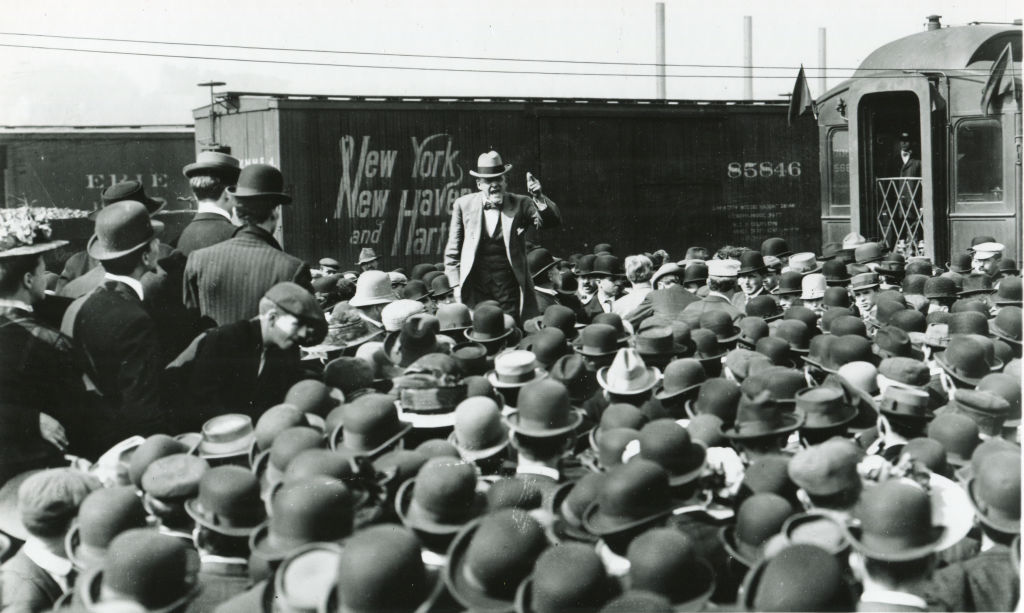
Eugene Debs’s 1908 socialist presidential campaign saw him crisscross the nation twice and travel over 20,000 miles in one of the most aggressive speaking campaigns a US presidential candidate has ever undertaken. (Archive Photos / Getty Images)
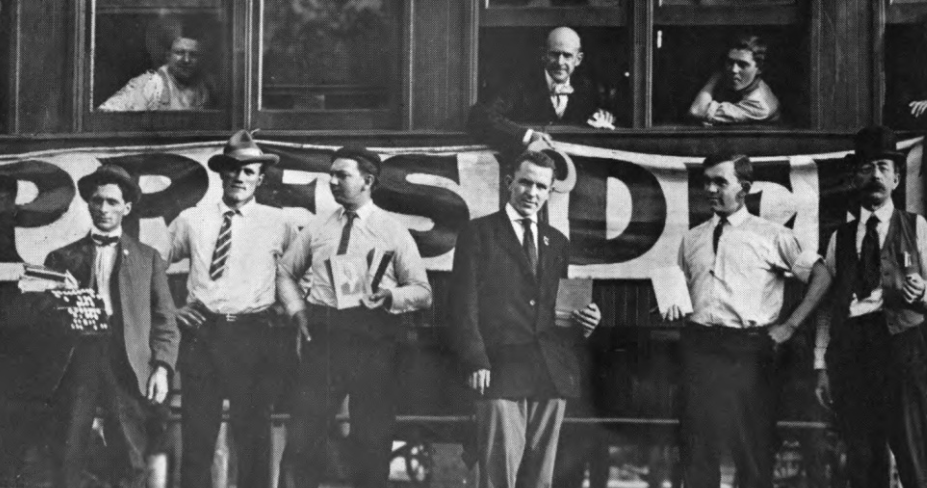
The specially chartered locomotive pulled out of Chicago on a late August day in 1908, heading west, a sleeper car, dining car, and baggage car loaded with socialist pamphlets in tow. Red flags poked out, bunting and streamers festooning the sides.
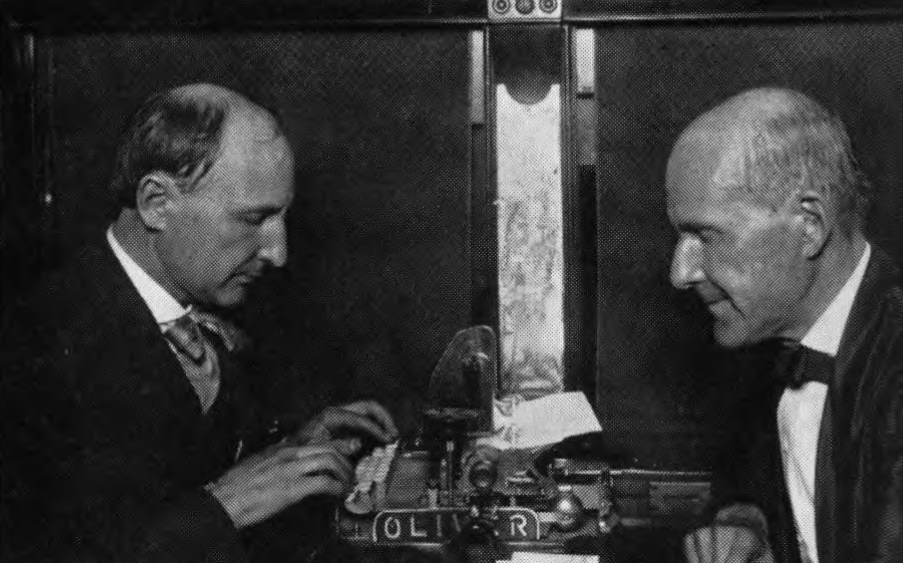
The passengers were in high spirits. Socialist Party presidential candidate Eugene V. Debs joked that he and his balding brother, Theo, were the resident “long hairs”: “We have three long hairs between us.” Neighbor Stephen Marion Reynolds, whose new biography of Debs was serving as campaign literature, pinned a red flag to his pajamas and explained, “Something might happen in the night, and they would find me dead or unconscious. How would they know I wasn’t a Republican?” As the train raced across the fields of Iowa — flat, flat, flat — a newspaper reporter asked Debs what he’d enjoyed most on the trip so far. “Oh, associating with this brace of despots, I suppose,” Gene quipped.
Debs’s speaking trip was a cavalcade of railroad depots and opera halls, scheduled speeches and impromptu whistle-stops. His September 2 itinerary read like this:
Des Moines, Iowa: Depart at 6 a.m.
Creston, 9:40–10:10
Corning, 10:50 to 11:20
Clarinda, 12:20 to 1 p.m.
Burlington Junction, Missouri, 1:45 to 2:15 p.m.
Kansas City, MO: 3:30 p.m. (speech that evening)
He spoke at each stop, plus at least six other unscheduled ones.
Sometimes he mounted a platform outside the Red Special — as Debs’s campaign train was known — speaking as Theo and others distributed campaign literature in the crowd. Other times, he simply rained down words from the caboose. He attracted converts, critics, and the merely curious. At the Corning, Iowa, stop, a woman, sneering, asked a man clad in overalls whether he’d accepted a socialist book. The man — half-sheepish, half-unapologetic — showed he had.
Briefly, Debs considered cutting south to speak in the minefields of Birmingham, Alabama, where members of the United Mine Workers were engaged in a daring interracial strike. He ultimately judged the detour cost-prohibitive given the cramped budget. The Red Special continued speeding west. (The landmark strike was soon crushed by the government, wiping out the local union and, with it, the rare organization able to challenge Jim Crow.)
It was Debs’s third presidential bid in a row. His Socialists would again try to beat the vast structural odds by reaching the toiling masses rally by rally, pamphlet by pamphlet. By sheer exertion. By relying on the “Jimmie and Jennie Higginses,” as the selfless rank-and-file members of the Socialist Party were known. People like Sarah Cluff of Provo, Utah, and E. Z. Ernst of Olathe, Kansas.
Cluff was in her early fifties, an English immigrant who had toiled at a lace factory as a young girl and raised three children in poverty. Opinionated and resolute (she’d successfully divorce her husband a few years later on grounds of cruelty), Cluff was part of the volunteer army that sold Appeal to Reason, the massive socialist paper out of small-town Kansas that was proving a linchpin of Debs’s campaign.
As a younger woman, Cluff had been mystified about “why it was so hard to get enough to subsist on.” Then she’d studied socialism. It was “the only light,” she told the Appeal, “that can dispel the darkness for working people.”
Ernst, also in his fifties, was a farmer and artisan in northeast Kansas who’d once led a sixty-acre socialist commune. An 1896 illustration in the paper Ernst edited at the time showed him with short hair and a long tangle of muttonchops and a beard, as if while clearing farmland the underbrush had leapt onto his face and taken up residence. By the 1908 election, he’d been a radical agitator for decades, passing out literature, selling subscriptions, and knitting together town and countryside, so crucial to Socialist success in the rural Midwest.
Sarah Cluff and E. Z. Ernst weren’t outliers. Socialist Party membership had doubled since the last presidential election to 40,000, and a staggering four thousand volunteer speakers were available to work the soapbox. In Milwaukee, party members would venture out every Sunday morning, arms chock-full of literature and buttons, brains swimming with answers to questions they’d receive at the doorstep.
They could take heart that the headline-grabbing Red Special was barreling across the country at that very moment.
The Red Special experienced some hiccups once it reached the Pacific Coast. The campaign was already running low on money, threatening an embarrassingly early end to the trip. Debs turned to average party members, whose nickels and dimes filled up the campaign coffers. The show would go on.
Supporters contributed more than just money. They would pile onto the iron caravan at each stop, their enthusiasm infectious, sometimes bearing gifts. One day in Oregon, Theo described the bounty to his daughter: “The baggage car is half full of the finest fruit I have ever seen. At every station our supply is increased: pears, plums, seedless raisin grapes, and such bunches, strawberries, watermelons, and today a comrade handed in a magnificent string of fresh mountain trout.” They wolfed it down for dinner that evening, joined by Socialist rank-and-filers, who could pay two cents a mile (and fifty cents a meal) to ride for several stops.
Along the road, Debs saw the unmistakable sign of recession: workers on the “tramp.” One day, shortly after leaving San Bernardino, California, the train stopped when a tramp was found on board attempting to snag a ride. Normally, the man would have been tossed off the train. But this was the Red Special. He was instead ushered up “to ride with a presidential candidate on the plush,” Debs recounted with a laugh.
“Of all the workers who are tramping,” Debs told a reporter, “we have not seen one of the type usually used for caricatures in the comic sections of the Sunday newspaper editions. All we have encountered since leaving Chicago on this campaign train have been fine young fellows, the same kind that have helped make this country what it is today, but have been thrown out of work by the trend of the times.”
And what use was an economic system that regularly made millions beg for a job?
As Debs crucified capitalism, its leading champions mounted a defense. Earlier that summer, President Theodore Roosevelt had used a memorial ceremony near his twenty-three-room summer home in Long Island to charge Debs and his compatriots with promoting “equality of reward” rather than “equality of opportunity.” Socialists would sweep away a system that valued “energy, foresight, intelligence, thrift, courage” in favor of one that allowed the undeserving to “rob his neighbor of what that neighbor has earned.” (The dedication ceremony was for a monument to an early English settler named John Underhill, the famed leader of a colonial militia that massacred American Indians.)
Debs couldn’t conceal his scorn, unloading on this “well-groomed president of the ruling parasites” in an Appeal article. What “equal opportunity” was there for the unemployed workers teeming the breadlines? What “equal opportunity” was there for the child laborers “fed alive to Mammon”? It was capitalism, not socialism, Debs growled, that had a skewed system of rewards — bequeathing “colossal private fortunes” for owning rather than toiling.
Debs was more gracious with Lincoln Steffens, the Progressive journalist, who interviewed Debs in Milwaukee shortly after Roosevelt’s address. Sympathetic but skeptical, Steffens pushed Debs on the nuts and bolts of his socialist vision. Debs explained that in the “cooperative commonwealth,” as he called it, everyone able to work would have a job. No one would be terrorized by the “fear of starvation.” Workers would be “paid according to their social use” rather than the profit-minded calculations of the free market. “Skill and ability would count” in determining remuneration, but workers performing undesirable jobs (say, sanitation) would also get better pay or shorter hours. Labor-saving technology would be used to reduce drudgery. Pay wouldn’t be equal, but nobody would pile up money like a Rockefeller (or a Roosevelt).
Wasn’t Debs worried, Steffens asked, that people would lack an incentive to work? He wasn’t. Human beings had an innate need to be active, he explained, and they were motivated by a range of concerns other than making the most money possible. And “a society that produced for use and not for profits would have plenty of work to have done.” Plus, with much shorter hours, all workers would have ample leisure time, when they could “enjoy healthily all the good things of the earth.”
What about individuality? Wouldn’t socialism “level men down”? Here, Milwaukee Socialist Victor Berger, who joined Debs for the interview, jumped in with characteristic gusto: “The capitalist system — doesn’t it level most men down now? Yes, it takes all the individuality, all the courage, self-respect, liberty, and beauty out of the great mass of men to produce a few” economic titans. Debs agreed.
He slapped down the stereotype that socialists fomented class hatred (“There are classes now and we say so. Why not? It’s true”) and that they wanted to seize personal property. “Socialism does not abolish private property,” he explained, as he’d surely explained so many times before, “except in the means of production. We want all men to have all they produce, all; we are for [personal] property; it is Capitalism that is against it.”
Nor was Debs worried about running a socialist economy. He cited capitalism’s recurring depressions and panics as “proof that capitalists cannot handle industry, business, nor even money.” He noted one of the contradictions at the heart of capitalism, what economists call the “overproduction problem”: employers want to keep labor costs as low as possible, but this means that workers don’t make enough money to buy the goods they produce. And so, Debs explained, “The surplus grows, a load on the market, till the crash comes, production halts, men are discharged, prices fall, and — there’s your panic.”
Debs thought the solution was simple: socialize the economy, remove the profit incentive, distribute the economic pie more equally, all fixed. Even in the Steffens interview, he never laid out precisely what a democratic socialist economy would look like. Yes, the railroads and steel mills and banks and other large industries would be publicly owned, managed in some capacity by a democratically accountable government. But what role would their workers play in directing these enterprises? How would socialists ensure that an expansive state didn’t become another haughty boss? And what of smaller firms? Would they be run as worker cooperatives? What role might markets play?
Like many socialists of the era, Debs seemed to think it was preemptive, even undemocratic, to sketch out a postcapitalist blueprint. That was for the people themselves to decide (and the socialist intellectuals to agonize over).
He certainly underestimated the difficulty of managing a modern economy. And yet this fuzziness about the nitty-gritty turned off fewer people than we might imagine. Catholic priests fulminating against “ungodly” socialism and major-party newspapers smearing “violent” socialists probably dissuaded more workers from voting for Debs than the charge that he lacked a fully fleshed-out alternative.
Many Americans had lived through a Civil War that had extinguished an entire economic system in the South. Many remembered a time before industrial capitalism. The Socialists’ claim that they would harness the economic trends and technologies of the day and simply transfer them to democratic, public hands seemed less far-fetched to early twentieth-century ears than twenty-first-century ones.
Or as Debs ended the interview, soaring back into the heavens:
We know that economic conditions determine man’s conduct toward man, and that so long as he must fight him for a job or a fortune, he cannot love his neighbor. Christianity is impossible under capitalism. . . . When things are rearranged so that I can help my fellow man best by helping myself, by developing all my skill and strength and character to the full, why, then, I shall love him more than ever; and if we compete it will be as artists do, and all good men, in skill, productiveness, and good works.
By the end of September, Debs had traveled nine thousand miles and delivered 187 speeches over twenty-five days in every western state and territory, to an estimated 275,000 people. Exhausting. So exhausting, in fact, that occasionally, when it was an especially small town and Gene’s throat felt especially aflame, Theo would fill in for his brother unannounced, the doppelganger convincing the crowd that this balding man gesticulating wildly before them was the famed Eugene V. Debs.
And still the East Coast lay ahead.
There were some highlights out east: Gene’s wife, Kate, joined him for this leg of the journey, and in Trenton, Ohio, a scrum of children dashed through the rain after school to greet the Red Special — “one of the most beautiful compliments paid us on the entire trip,” Debs told the kids, choking up. “This train,” he explained, “represents an effort to make it possible for all children everywhere to have time for play, and time to go to school, and the opportunity to grow up.” The band struck up a tune, and they were off.
Debs’s train rumbled through nearly every state in the Upper Midwest and Northeast, clattering textile towns and cacophonous manufacturing cities. He marched in front of a parade stretching ten full blocks to Boston’s Faneuil Hall. He sold out New York City’s Hippodrome Theatre, with 7,500 paying admission and 2,500 more turned away. After working himself into a sweat — a photograph from the event shows Debs in a three-piece suit speaking from the wooden floor of the hall, his sea-blue eyes flaring like a tropical storm, his hands in a flurry so fierce the shutter could only register a blur — Debs climbed into an open-roof car and headed down to the Lower East Side.
By that point in the journey, Debs admitted, “I was little more than a portable corpse.” The newspapers reported that he was so fatigued it “was painful to witness,” and Debs told those assembled at Hamilton Fish Park he wouldn’t be giving a speech because “I am not able to do so.”
Kate was watching from a box at the Hippodrome — accompanying New York Socialist Morris Hillquit and his wife, Vera — with what must have been a mix of pride and dismay. What would be left of her Gene after the cause had gotten through with him?
Her husband pushed on. Turning back west, continuing to fill speaking engagements along the way, the Red Special made an impromptu stop at Harpers Ferry, West Virginia, the site of John Brown’s doomed antislavery rebellion. Standing at a monument marking the spot where Brown was captured, Debs delivered brief remarks: Brown “dared the whole world and gave up his life for freedom. What more can a man do? . . . [Ralph Waldo] Emerson has said: ‘The time will come when John Brown will have made the gallows as glorious as Jesus Christ made the cross.’”
Cheers and tears. William Lowery, a former slave who owned the scuffed-up tin candlestick that lit John Brown’s fort, gifted Debs the timeworn object. Theo found it the “most thrilling and dramatic” moment “of the entire trip.”
The Socialist Party was making an explicit appeal to black voters that year despite their minor electoral heft. (Ninety percent of African Americans still lived in the Jim Crow South.) A party pamphlet cast Debs, rather hyperbolically, as “the John Brown and William Lloyd Garrison and Frederick Douglass and Abraham Lincoln of the new emancipation all rolled into one.” Jobs and political rights for all — Debs’s “new emancipation” would rip out the roots of racial oppression (although the pamphlet omitted mention of any immediate civil rights measures). The party dispatched several black speakers, including the Reverend George Washington Woodbey, who traversed the Upper Midwest and the East Coast, culminating in a two-hour, eve-of-the-election address on a cold night in the increasingly black New York City neighborhood of Harlem.
Other slices of the working class also received targeted appeals. Denmark’s A. C. Meyer, a Socialist member of parliament, crossed the Atlantic to campaign for Debs, often making his overtures in his native tongue at Scandinavian venues like the soaring five-story brick of Minneapolis’s Dania Hall.
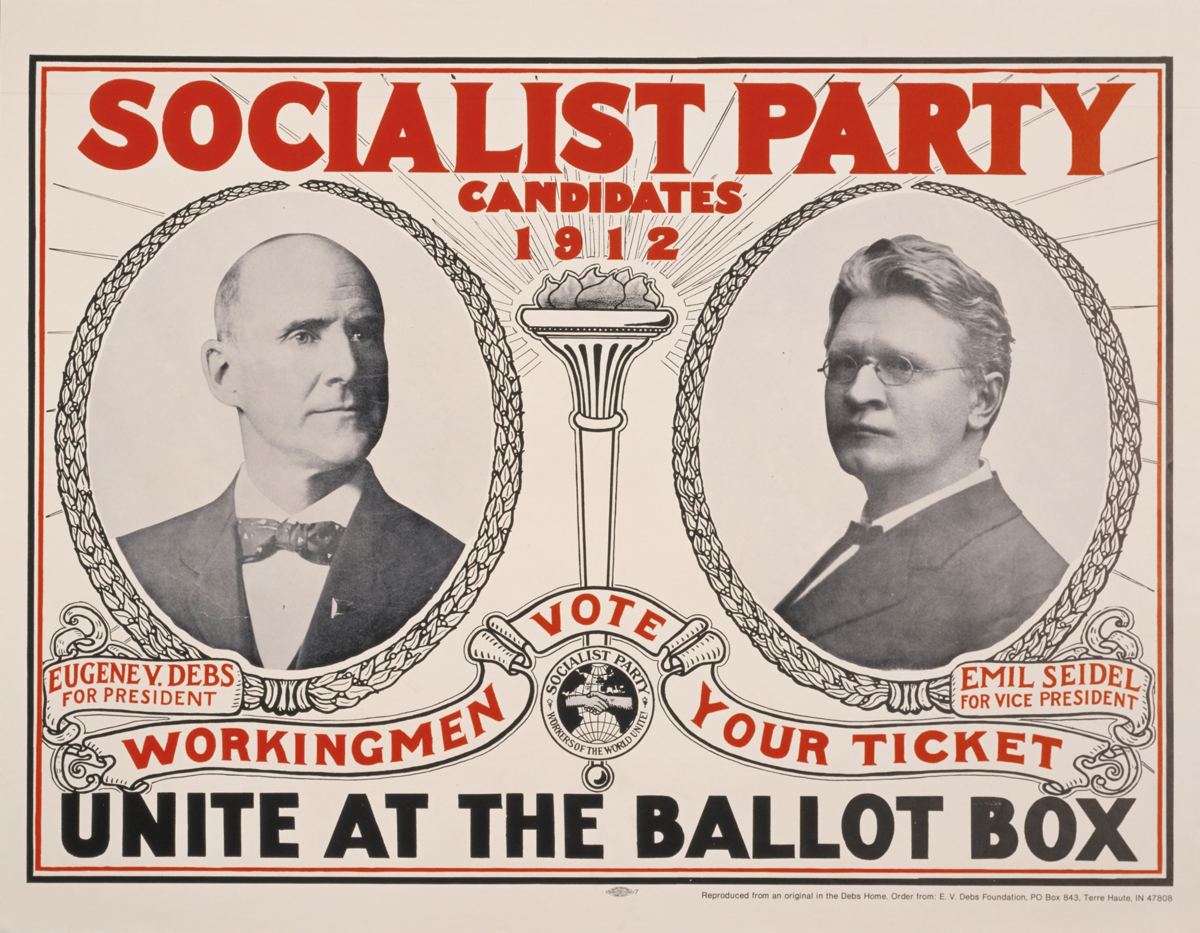
It had been an inspired campaign. Debs had crisscrossed the nation twice, traveled over 20,000 miles of tracks, forced his raspy voice to deliver addresses sixty-five days straight in “one of the most aggressive speaking campaigns ever undertaken by a presidential candidate,” according to one biographer. He had heard passing train drivers sound their whistles in solidarity, seen buggies queue for miles along the tracks and throngs so eager to hear his words they’d block the rails to make the Red Special stop. At his final campaign address, the Chicago crowd cheered him for twenty-seven minutes straight.
The results of Debs’s 1908 Red Special campaign were disappointing: a mere 20,000 votes more than in 1904. Good for just 3 percent of the national vote, despite higher shares in strongholds like the Mountain West, the industrial Midwest, and the Great Plains. His Red Special, the campaign’s great expenditure at $35,000, had been funded by 15,000 contributions and $14,000 in ticket sales. J. P. Morgan and Andrew Carnegie alone had donated millions to the GOP.
But all was not lost. Far from it. By Debs’s next presidential bid four years later, party membership had tripled to roughly 120,000; some 1,200 Socialists held elected office, including eighty mayors in thirty-six states; and strikes were cascading through the country, many led by Socialists.
Maybe, just maybe, Eugene Debs’s “cooperative commonwealth” was still on the horizon.