Fernando Haddad on Brazil’s Place in Global Capitalism
Positioned between major power blocs, Brazil sits at the center of debates on geopolitics, development, and the green transition. In an interview, left-wing finance minister Fernando Haddad assesses domestic political trends and Brazil’s place in the global economy.
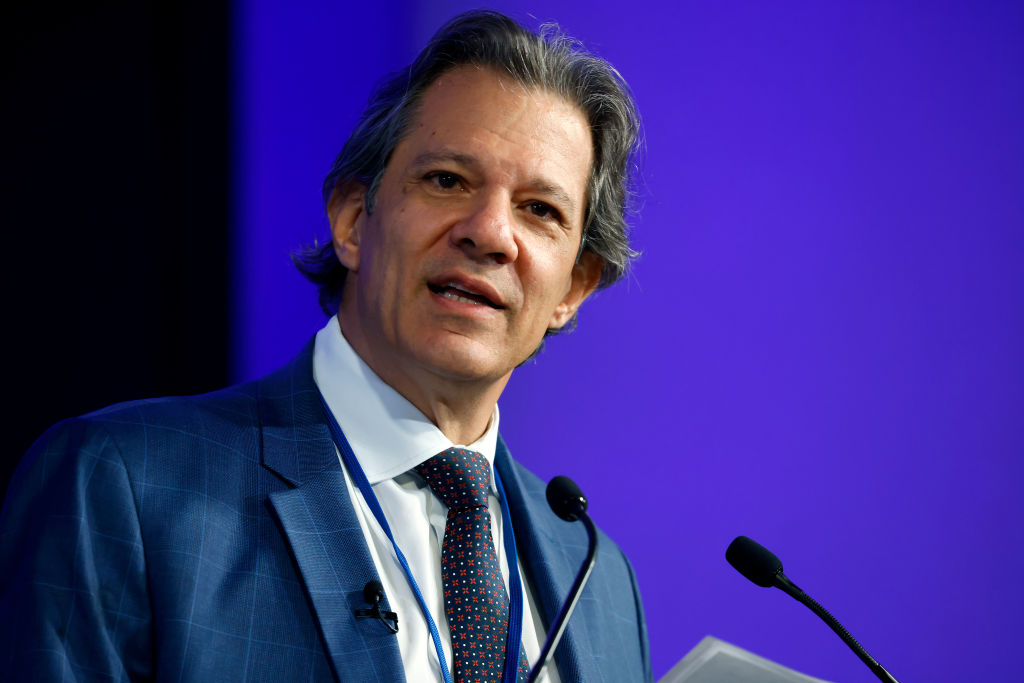
Finance Minister Fernando Haddad moves between theory and practice, combining his academic background in philosophy with his experience in government. (Samuel Corum / Bloomberg via Getty Images)
- Interview by
- Daniel Denvir
As the world’s seventh largest economy, poised between Western and Eastern power blocs, Brazil is at the forefront of contemporary debates on geopolitics, development, and the green transition. Its political landscape remains dominated by the clash between the left-pragmatism of the ruling Workers’ Party (PT) and the right-populism of bolsonarismo: the former attempting to establish a more equitable growth model under constrained conditions, the latter reactivating some of the darkest elements of the country’s authoritarian past.
Among the partisans of the PT who are grappling with this fraught situation, Fernando Haddad has a unique ability to move between theory and practice, combining his academic background in philosophy with his experience in government — having served as minister of education from 2005 to 2012 and mayor of São Paulo from 2013 to 2017.
When Luiz Inácio Lula da Silva was prevented from running for president in 2018, Haddad stood in his place, winning forty-seven million votes yet losing to Jair Bolsonaro by a significant margin. Upon Lula’s return to office three years ago, he was appointed minister of finance, and he has since tried to balance the party’s progressive program with the demand to shrink the deficit in the wake of the pandemic.
Here, Haddad talks to Daniel Denvir about the rise of the far right, the implications of Great Power rivalry, the necessity of multilateralism, and the prospects for a country like Brazil in the current global conjuncture, as well as his latest book, The Excluded Third (2024). This is an edited transcript of an interview that first appeared on the Jacobin Radio podcast The Dig.
What is it about the crisis of neoliberalism — and the broader crises of the US-led liberal international order — that has fueled an explosion of far-right populism in so many countries throughout the Americas and Europe? And within this panorama, what makes the rise of bolsonarismo distinctive?
The rise of the far right is a global phenomenon because the crisis of neoliberalism is a global phenomenon. When the structures of the twentieth century that mitigated the effects of capitalism or promoted some form of emancipation — the Soviet system, national developmentalism, social democracy, the welfare state — began to come apart, neoliberalism imposed itself as the final alternative.
Witnessing the collapse of these structures, the global left offered nothing new. And now, as neoliberalism has fallen into crisis, the Left has again failed to reposition itself or advance its program. That’s because, in a way, we are still mourning the past rather than building the future. Instead of imagining new structures, we are stuck at the funeral of the old ones. In this political vacuum, the far right has seen an extraordinary opportunity to ascend. It thrives in these conditions because it finds straw men to blame — which is the most cunning way to win hearts and minds for a project that is fundamentally destructive.
How exactly this played out was contingent upon local circumstances. In Brazil, it took the form of a deeply unqualified ex-army captain who had emerged from the shadows of the military dictatorship and had spent his entire career advocating a return to authoritarianism. It was Bolsonaro who, because of certain unique factors — including the assassination attempt during his election campaign — was able to rise to power with the help of far-right populist discourse. On a global scale, I believe such victories are a result of this crisis of neoliberalism and the failure of the Left to respond.
Let’s look at some of the Left’s responses in recent years. In Europe, we’ve seen populist methods used by parties like La France Insoumise and Podemos with varying levels of success; in the US, we had a similar experience with Bernie [Sanders], although we have never had our own party vehicle for reasons that are particular to this national context. In Brazil, the PT was the mass party of the late-twentieth-century left, which led the struggle against the dictatorship and is now leading the resistance against the far right.
At this dangerous political moment, during what is generally thought to be a post-mass-party era, how should the Left think through the strategic problems of party organization and form?
Before Lula was elected in 2022, we spent seven years out of power, which was a consequence of two factors. The first was a parliamentary coup against President Rousseff Dilma in 2016. Up to then, Latin America had a long history of violent military assaults on democratic institutions; but this coup was of a completely different order, since it took place entirely within democratic institutions, and its only objective was to remove the PT from power.
The second factor was the decision to bar Lula from running in the 2018 presidential election, which he certainly would have won, because of the “Operation Car Wash” allegations. This is a well-known story. Operation Car Wash began as an anti-corruption investigation but soon became a political weapon used to stop Lula from winning the presidency. So I ended up running as the presidential candidate instead. It was crucial for the PT to put up a fight in that election to show that we were still able to compete in the political arena. Even in defeat, we made it to the second round and won about 45 percent of the vote.
The Bolsonaro government was an utter disaster, and once Lula was exonerated he was finally allowed to run again in 2022. Yet it was very difficult to compete against the far right when they held state power and were willing to use every possible means to retain it. So we were compelled to form an alliance with Brazil’s democratic center right. Before Bolsonaro came onto the scene, our main electoral opponents were the PSDB (Brazilian Social Democracy Party), the center-right party that was central to the country’s democratization process.
Unlike Bolsonaro, the former PSDB president Fernando Henrique Cardoso was a very civil and cultured person with a basic commitment to democratic values. So we built an alliance with such forces that allowed us to defeat the far right and return to government.
As a result of forging that coalition, our present program has some elements that could be described as centrist, but at the same time its aim is to recover the social rights that had been suppressed by bolsonarismo: increasing the minimum wage, fighting hunger, protecting the autonomy of universities, guaranteeing freedom of expression, and so on. The current PT government is moving toward social demands that were not on the agenda of our previous ones, such as taxing the superrich to redistribute income.
How does left populism in the US and Europe compare to the example of the PT? The PT is obviously the dominant force on the Brazilian left, but there are also other parties like PSOL (Socialism and Freedom Party), with whom the PT has had both a cooperative and a conflictual relationship.
I believe that the Left must return to the discussion of social classes, and in this regard the PT has a very important characteristic: it is not a dogmatic party. The PT is a pragmatic party that seeks to interpret our historical reality and act in accordance with it. Its roots are in the trade union movement in the ABC region of the state of São Paulo, which is the most industrialized part of Brazil. But more recently it has opened up to other social groups.
Today we have many people who, to use the traditional jargon, simply cannot sell their labor power to capital, and must find other ways to survive since capitalism no longer provides them with such opportunities. The PT has tried to establish a bond with this new “precariat.” They are not the same as blue-collar workers; in many cases they are people who want to get blue-collar jobs but are prevented from doing so by these historical constraints. We have also tried to build links with another emerging group, namely the creative class. There is a vast literature on this category that Italian theorists call the “cognitariat,” whose labor power is more of a creative force than a productive one. In my view we should not give up on a class analysis of such actors, who are as significant as the industrial proletariat even though their character is distinct.
I often read writers like [Michael] Hardt and [Antonio] Negri who refer to “the multitude.” But when you speak of the multitude you tend to lose sight of the specificities of these groups who have a particular class perspective, even if it is not a homogeneous one. The emancipatory struggle today depends on developing this understanding that the non-property classes are far from homogeneous. They have different political, aesthetic, and cultural standpoints — and the role of politics is to give them a common project. This won’t emerge mechanically from economic conditions; it will only come about through the activities of a party like the PT.
So, in other words, a particular party form is the expression of a particular composition of the working class at a particular conjuncture. That’s where you would start your analysis of the different political forces on the Brazilian left?
Yes. I think we must escape the dogmatism of traditional class theory. The idea that there is one unified class that represents the interests of humanity cannot withstand historical scrutiny. Under capitalism, only the property classes are homogeneous. They can coordinate with one another almost through telepathy. They spontaneously know which interests to defend. It is as if they could do without politics.
For us it is different. Non-property classes must face up to various dilemmas that cannot be resolved by the intervention of any single, universal class subject. To advance the shared interests of humanity we need more politics, not less: more ingenuity, more inventiveness, more socialist imagination than we had a century ago.
How did your experience over the past decade, first seeing Lula sent to prison and then losing the presidential race to a far-right extremist, lead you to write The Excluded Third: Contribution to a Dialectical Anthropology? The book explores the basis of social and cultural antagonisms and how they might be overcome through emancipatory struggle. You’re a minister of finance, of course, but you’re also a trained philosopher. What sort of philosophical inquiry did you feel was required at this particular moment?
My political experience allowed me to think through the issue of sociability, which I brought together with my academic research to produce The Excluded Third. Its basic argument is that the reason anthropology seems to be a conservative discipline is that most anthropologists do not accept contradiction as a central element in thinking about human sociability, whereas we can arrive at a different view if we use the Hegelian categories of identity, difference, and contradiction.
Applying these terms to the natural or biological sciences is a big mistake. But if you view them as dimensions of human intersubjectivity, you realize that they capture the way people choose to live with each other. Were it not for the concepts of identity and difference, for example, injustices like slavery would be a logical impossibility. If human beings saw themselves as equals, they would simply dominate nature without dominating each other.
This problem of human sociability is one of the issues that separates liberals from socialists. For socialists, economic inequality is a fact of contradiction rather than simply a mark of difference. When you conceive of an emancipatory project, you have to recognize that there is a contradiction in capitalism between owners and nonowners, while at the same time accepting that among nonowners there are differences that can only be overcome by politics — that there won’t be any natural alignment between nonowners due to the simple fact that they are the dominated rather than the dominating class.
An emancipated society would also involve a different kind of relationship to nature, one that places more emphasis on the ecological and less on the economic. It would require forms of organization, forms of production, which respect both the differences between people and between humanity and the environment. This new society can only be forged when politics creates the conditions for overcoming our present set of contradictions.
So the starting point is to return to social classes, to go back to discussing what produces contradiction and what produces difference. This is an invitation to put dialectics back on the agenda. To think dialectically is to think that human sociability is founded on these premises, which are not the premises of reflective thought but of intersubjective relations.
José Dirceu, one of the founders of the PT, recently referred to the current Lula administration as a “center-right government.” What do you make of that assessment and the broader contradiction to which it speaks? On the one hand, it seems clear that a broad front is needed to resist the far right, especially given that Congress is controlled by your political adversaries, which in various ways reflects the deeper balance of power within Brazilian society. On the other hand, there is still an urgent need for a left-wing program to fundamentally transform Brazil and, in doing so, address the root causes of far-right reaction.
I disagree with Dirceu’s statement. Of our five governments, I would say that this is the most left-wing. I have absolutely no doubt about this. We have set in motion a profound shift in this country’s economic agenda.
Let me cite some examples. This is the first time that, in making a fiscal adjustment, the government has demanded that the rich contribute. On every previous occasion, those who paid for these adjustments were people earning the minimum wage, people reliant on social welfare. Now, while we have accepted the need to deal with the budget deficit after the pandemic, we have insisted that it should be financed by the rich. Never before have we put so much stress on the issue of inequality. The PT has always been a champion in the struggle against poverty, and our previous administrations have been praised for this. But on the issue of inequality we have evolved, so that it is now at the center of our political agenda.
From an environmental point of view, this is also the most progressive Brazilian government to date. We are leading the global debate on financing the preservation of tropical rainforests, on creating a coalition around a fair carbon market, on taxing the superrich during our presidency of the G20 — proposals that were never on the table until now.
We have also fought hard on the question of multilateralism and the need for regional integration, to prevent the world from returning to a bipolar situation. So, in my view, President Lula’s third term will be recognized as his most progressive, and I hope the fourth one will be even more so.
How do you see the geopolitical and geo-economic power that the BRICS wield, or might potentially wield in the future? Do you think the BRICS could create alignment among countries of the Global South on the need for an alternative global political and economic order that would confront the deeply entrenched inequalities of the US-dominated world system?
I’m thinking back seventy years to the Bandung Conference in Indonesia, the inauguration of a third worldist politics that was able to transcend differences between monarchies, democracies, and socialist states. Then as now, neocolonial power imposed unequal relations of exchange and dependency upon formerly colonized nations. So could the BRICS echo or learn from that experiment? Could we see a new, coherent project emerging between Brazil, Russia, India, China, and South Africa?
I think we need to be realistic about what the BRICS can accomplish, although I also understand that we have to explore all the bloc’s possibilities. First of all, the BRICS have the primary function of strengthening the G20. Were it not for them, the G7 would dominate all the geopolitical debates of our time.
So the BRICS are able to prevent the G7 from pretending to speak for all of humanity, as if there were no other relevant players. Their mission in that respect is to demonstrate that the world has changed and that there are new political actors who need to be respected. If there is any hope of reforming international organizations into ones that reflect these changes which have taken place over the past forty years, the BRICS will be a vital part of that task.
Another dimension is the BRICS’ relationship to the third world. Here it remains unclear what role China will play. It is a country in transition, and there are two paths that it could take. The more optimistic one would be a kind of socialism for the twenty-first century, while the less optimistic view, in the progressive camp at least, is that China has already become a traditional capitalist country.
It may be the case that China represents merely another ordinary national project, like that of so many other countries which have risen to become the global hegemon, from Spain to the Netherlands to England to the United States. If China simply intends to take the place of the current hegemonic power, I think the third world will be undercut, and we will have a situation where the traditional international division of labor continues to dictate the rules.
But if China embarks on a more ambitious, more generous project, involving technology transfers and a new approach to the global industrial geography which offers greater opportunities for developing countries — a more democratized alternative to the current division of labor — then there could be a different outcome. So whether China is a proto-capitalist or proto-socialist country is a question that history has not yet answered, and the answer will depend not only on the Chinese Communist Party but also on the emerging classes in China and the kind of relations they want their country to cultivate with other states. There is a lot of speculation about this, but I would say that the future of China is central to most of the significant political issues that remain unresolved today.
In terms of China’s relationship with the rest of the world, and whether it takes up the crisis-ridden role of the US as global hegemon, you mentioned the importance of technology transfers. I was looking at some reporting in Phenomenal World which showed how Chinese firms have committed over $227 billion across 461 green manufacturing projects in fifty-four countries since 2011, with 88 percent of investment occurring just since 2022. In inflation-adjusted dollars, this sum is larger than the $200 billion Marshall Plan.
So is there a real possibility here that China could relate to other countries in a way that the West never has, allowing them to create their own development models by making green tech transfers and opening factories — EV factories, for instance — overseas?
Again, this is a question that history will have to answer. The possibility exists for countries to be integrated in totally unprecedented ways. But the export of capital from a rich country to a developing or even an underdeveloped one is not an original feature of our time. It has been happening since the end of the nineteenth century.
The industrial revolution — especially the second industrial revolution, with the arrival of the steam engine and the railways — involved an enormous export of capital that drew even very backward regions into the orbit of capitalism. Brazil underwent significant industrialization as a result, funded by the income from exporting coffee to Europe and the United States. It was one of the countries with the most economic growth between 1930 and 1980. So there is nothing novel about foreign investment starting these cycles of development in semi-peripheral or peripheral countries.
Today we could start to see something qualitatively new, not just a reproduction of the growth cycles of the past, but this will depend on how China intends to engage with its economic partners: whether there is a more egalitarian development process across the planet or whether national prerogatives win out. This, in turn, will hinge on the geopolitical developments that take place as China’s economy continues its ascent on the global stage.
We don’t yet know where China’s green development model is heading and what that will mean for the future of the world system, but we do know that Brazil’s economic relationship with China has played a fundamental role in remaking its economy since the turn of the millennium.
Lula took office in 2003 amid an unprecedented global commodities boom: a super cycle driven by rapid Chinese development that demanded vast quantities of raw materials from countries like Brazil. That commodities boom gave the PT government the fiscal space to redistribute wealth to poor Brazilians while registering impressive levels of GDP growth, which was a historic achievement. But at the same time, this process contributed to Brazil’s deindustrialization and reprimarization, meaning that primary-goods exports and agribusiness, rather than manufacturing exports, came to dominate the economy.
What is your assessment of that contradictory trajectory and how to deal with the dominance of agribusiness in Brazil today? Economically, the present order seems to militate against a more sustainable and equitable development model, while politically it seems to provide the material basis for some of the most reactionary and antidemocratic forces in Brazilian politics. None of this is easy to change, however, because the government is highly constrained and the economy needs export revenue in foreign currency.
At the center of your question is the international division of labor. In this division, the higher order activities with greater value added are based in a few regions of the world — the core of capitalism — where you have a concentration of the creative forces I mentioned earlier. In these places, in addition to regular profits, capital can earn a super profit — whose character is similar to rent — which is extracted from activities that add knowledge to production. This dynamic generates a permanent flow of profits from less developed regions to more developed ones. Just as wealth is concentrated among a few social classes, it is also concentrated in a few countries.
I think the issue that needs to be debated here is whether the Chinese project of development is compatible with this historical pattern. The nature of the Chinese economic system, its social character, not only bears on domestic relations between Chinese workers and elites, whether there is a relationship of domination between them; it also has implications for China’s relations with the rest of the world. It is possible that China will simply reproduce the asymmetry between core and periphery, and the world economy will remain stratified.
In this context, Brazil needs to advance a national development plan — one that prevents this process of reprimarization of our economy and tries to assert our competitive advantages, especially around clean energy and critical minerals, so that we can think again about reindustrializing the country. But in my view, this is not possible without partnerships in areas such as technology, which can allow us to reindustrialize while fulfilling our goals of adding greater value to what we produce domestically.
Your ministry has been developing a new green industrialization plan. Here in the United States, [Joe] Biden’s Democratic Party rolled out a green industrial policy of its own, which was in many ways an important break with neoliberal orthodoxy, but it was also woefully insufficient.
It was excessively indirect in terms of financing, relying on tax credits rather than direct expenditures, let alone public ownership, and it was fundamentally bound up with the new Cold War with China. Under [Donald] Trump, significant parts of this program are being dismantled. What can we learn from this experience? How do Brazil’s current efforts compare to those of Biden in the US?
Right now Brazil is thinking in terms of global finance. We are hoping to create global instruments for financing the ecological transition which could enable new forms of development that are not restricted to specific regions. When Brazil talks about taxing the superrich, we do not simply mean that each nation-state should place additional taxes on its wealthiest citizens, for today their fortunes are no longer national but global. We have 3,000 families who have accumulated wealth of R$15 trillion, or around US$3 trillion. So we must find financial mechanisms to place even a fraction of this wealth in the service of a global project of ecological transformation, to fight back against deprivation, against misery, against a lack of opportunities.
If we don’t take this step, if we don’t start building some kind of architecture of international governance, with a budget of its own as well as a vision of the future, I think we will make the mistake of believing that interstate and inter-capitalist competition are capable of meeting today’s vast humanitarian challenges.
Tech companies are the most powerful on earth, and their CEOs are the richest people who have ever lived. In the United States, it’s become frighteningly clear that the tech oligarchy finds its political expression an authoritarian fascism.
The role of AI in the US economy is particularly astounding. AI investments, according to the Financial Times, account for 40 percent of US GDP growth this year and 80 percent of US stock gains. What do you make of the role of US tech in the global economy? What sort of challenges does it pose for a left political project like that of the PT in Brazil?
And lastly, to zoom out a little, some Marxists make the argument that the tech companies have ended capitalism as we know it and replaced it with a new domain of “technofeudalism,” driven by rents rather than profits. Others like Evgeny Morozov reject this view. I’m curious what your position is.
Nation-states must have the courage to regulate the tech sector in their own territories, which is what Brazil has done by sending a bill to the National Congress to regulate digital competition. It would introduce minimum levels of competition to ensure that Brazilian companies and capital do not become easy prey for these multinationals.
What’s most intriguing about the tech giants is that they insist on rules that are absolutely incompatible with the principles they claim to uphold. They praise liberalism and free competition while at the same time challenging the type of bill we’ve drafted and demanding preferential treatment, as if their enormous power weren’t enough of a privilege in itself.
Since knowledge has become a factor of production — a development of the postwar period, which intensified from the 1980s onward — we have seen new enclosures to protect the monopolies of the digital economy. This allows the tech companies to attain super profits in the form of rent, yet it bears no resemblance to the feudal world, none at all. It is rather the quintessence of capitalism: its most advanced stage.
Capitalism has commodified land, labor, and money — [Karl] Polanyi’s three “fictitious commodities” — and has now entered a phase where it is commodifying knowledge itself. In my academic work I describe this phase as “super industrial.” This is not a feudal world but one of total commodification, where capitalism has been raised to the level of paroxysm. While I understand the rhetorical appeal of the “technofeudalism” thesis, I think this term confuses more than it illuminates the present situation.
Let’s turn back to geopolitics and geo-economics. If the US and China can’t work together to rebalance the global economy, foster geopolitical stability and disarmament, and support a just energy transition — if the US instead continues to wage a new Cold War — then we’re obviously heading in the wrong direction.
Amid the broader crisis of the liberal international order, the genocide in Gaza, Trump’s tariff wars, the US attacks on boats off Latin America’s coastline, the proxy war between the West and Russia, and so on, what is your vision for a new global order? How might we begin to build it?
In the Cold War era, the Soviet Union posed a military threat to the United States but not an economic one; it was never a global player in the struggle for control of markets. Then, when an economic rival finally emerged, it was the unarmed nation of Japan, which could threaten American hegemony economically but not militarily. China, by contrast, is a much bigger challenge for the US because it combines military power with economic might. A repolarization of the world around these two powers could have even more disastrous effects for humanity than previous conflicts, which were ultimately solved without resorting to hot war.
The conflict that the Trump administration seems to want to ignite would be a clash without historical precedent. This is why the civilizing forces of the world are betting so much on multilateralism as a possible antidote. In Brazil, the government has fought hard for an agreement between the European Union and Mercosur to create alternative trade routes. I believe it is essential to create such alternative poles which can prevent repolarization from taking place.
We’ve seen how the United States has dealt with the rise of China’s economic and military power, but how China itself responds will also have implications for the entire planet. If there is merely a struggle for hegemony, a struggle for power, I think many difficulties will lie ahead; but if China is open to a different approach — a geopolitical rebalancing that implies concessions even for those who have no power, a spirit of compromise that involves international solidarity and generosity — then perhaps we can face some of the problems presented by national borders, problems that are impossible to solve as long as borders are seen as insurmountable barriers. There is clearly a role here, both political and pedagogical, for global progressive forces.
I want to conclude with a big-picture question. How do you navigate all the inevitable contradictions and compromises of being finance minister of a BRICS country that must pursue a reformist program hemmed in by structural constraints at both the domestic and global levels, while also remaining a Marxist and a socialist, with a vision of a postcapitalist horizon that can sometimes feel very, very far away?
If you dream of a better world, if you imagine that humanity will not stop at its current stage, that it will seek alternative forms of social organization that allow people to develop as global citizens, then you cannot prevent yourself from confronting the practicalities of the present. I always keep in mind that as well as being accountable to others, I have to be accountable to myself when I leave the offices I hold.
In none of my previous positions, whether as minister of education, as mayor of São Paulo, or now as minister of finance, have I found myself in a situation where twenty years later I’ll look back and feel ashamed of the decisions I made in light of the principles and values that I defend. So I’ll continue to push the wagon where I think it should go. It may go faster or slower, but I know I’m pushing in the right direction.