Alberta’s Post-Referendum Hangover
Alberta’s sovereignty push has failed, but the province’s Conservative infighting continues, and working people are paying the price. The government has spent its energy pursuing partisan advantage while neglecting Albertans’ everyday concerns.
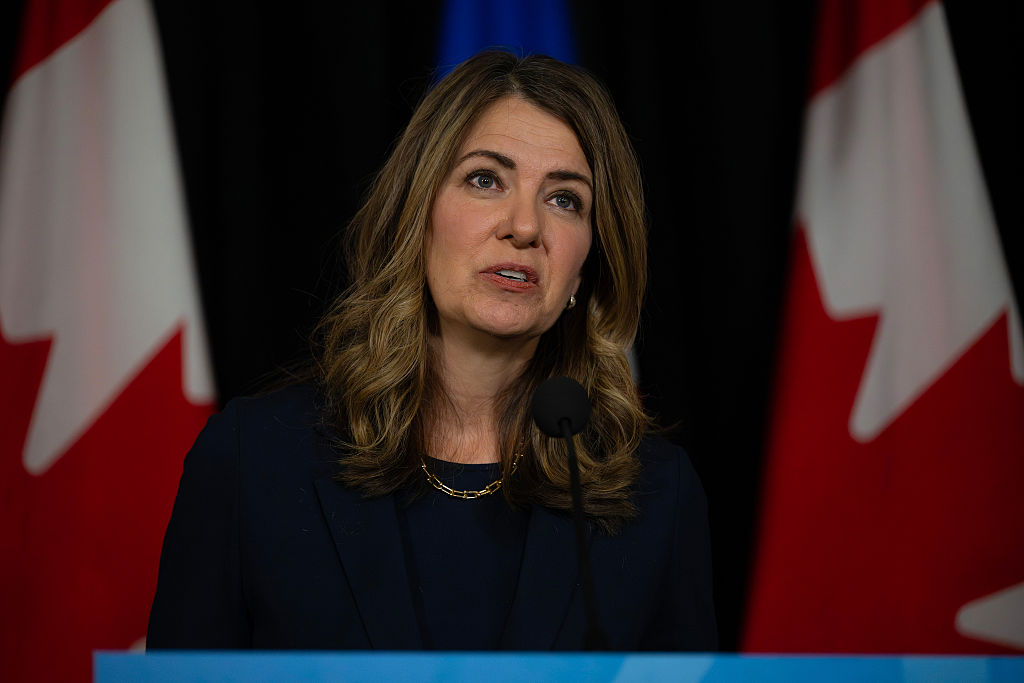
Thwarted separatists are turning on Alberta’s conservative leaders, deepening political turmoil in the province while health care, affordability, and education remain neglected. (Gavin John / Bloomberg via Getty Images)
Alberta is one of the unhappiest provinces in Canada, a reminder of the old adage that money can’t buy happiness. The province fails to responsibly manage the riches from its oil and gas sector, leaving little of the spoils to Alberta workers, while billions in profits flow to foreign shareholders, many of them American.
Perhaps the unhappiest of all Albertans are the separatists. This right-wing populist fringe helped push the province into a deeply divisive referendum, which failed in its aim to garner support for independence from Canada. The October 19 referendum’s very existence suggests that Premier Danielle Smith is governing with an almost exclusive focus on managing pressures within her party to protect her own leadership.
Polling shows that support for independence has rarely exceeded 30 percent. And yet getting Alberta out of Canada has robust support within the premier’s own United Conservative Party (UCP). One of the most reputable pollsters in the province, Janet Brown, found earlier this fall that a majority of UCP voters, 53 percent, backed beginning the process toward a separation vote in the October referendum.
In winning the UCP leadership in 2022, Danielle Smith was able to recruit new members with “little to no history of party politics,” drawn to her promise to push for more sovereignty for the province. She emerged as the anti-Ottawa candidate during Justin Trudeau’s increasingly unpopular tenure as prime minister. She also benefited from the strong pandemic-era anti-vaccine sentiment that helped bring down her predecessor, Jason Kenney. Smith promised that, under her leadership, Alberta would reject federal laws or court decisions that were deemed to be against the province’s interests.
Go-Go Mandate Overreach
Having secured the party’s leadership, Smith tacked toward safer political territory to successfully beat the center-left New Democratic Party (NDP) in the province’s 2023 election. Aware of the political sensitivity of universal public health care, she committed to a guarantee as the campaign approached: “Under no circumstances will any Albertan ever have to pay out of pocket for access to their family doctor or to get the medical treatment that they need.”
Perhaps even more important than what Smith said was what she left unsaid. She did not campaign to suppress Alberta’s vibrant wind and solar energy industry, but after her election victory she announced a moratorium on new renewable electricity projects, in a move that appeared to come from nowhere. Nor did she campaign on invoking the unpopular notwithstanding clause four times in order to shield legislation from Charter challenges. Of those four invocations, the clearest violation of Charter rights was the law ordering striking teachers back to work — running roughshod over their Charter-protected right to strike. Finally, Smith most certainly did not campaign on holding a referendum on whether to begin the process toward a future vote on independence for Alberta. Arguably, Smith came to power by promising one thing to separatists and something quite different to the general voting public.
In the spring of 2025, Albertan’s top priorities were health care, the cost of living, education, and affordable housing, according to a Nanos survey. These same broad concerns remained the leading issues in a Leger’s October 2025 poll. Yet in the post-referendum hangover, the concerns of working Albertans are again being ignored, and Albertans are likely to spend most of the rest of 2026 having to witness pointless bickering on the Right. This bickering started within hours of the “Remain” side having bested the separatists by 75 percent to 25 percent.
Jeffrey Rath, one of the most prominent separatist organizers, characterized Smith’s federalist stance during the referendum campaign as a betrayal of the UCP party members who had supported her. He confirmed that he would push to remove her, “in the same way that we worked to get rid of Kenney.” He also alleged that Smith’s 2022 leadership campaign purchased the voter list of Wexit Canada, now the Maverick Party, and used it to pitch her as a “secret separatist.” A group of UCP constituency associations is pushing for an early review of Smith’s leadership. And in another sign of the turbulence that is the new daily reality for the governing party, a rural UCP representative, Shane Getson, abruptly announced his resignation on October 26.
The referendum has exposed a deep divide within the UCP between separatists and federalists. There is no knowing how the battle for the party’s future will play out. Working families are hapless bystanders in what amounts to a political hostage situation.
Tyranny of the Minority
Professor Jared Wesley suggests that Albertans are not as divided nor as beholden to right-wing ideology as the mainstream media narrative asserts. He argues that the UCP presents itself as the “authentic voice of ‘ordinary people.’” The Alberta referendum, meanwhile, demonstrated how much influence the extremist fringe that helped elect Premier Smith had within the party: Smith called a vote on starting a process toward separation in spite of the fact that roughly two-thirds of voters rejected the option.
As Wesley’s research has shown, a huge number of Albertans call themselves moderate. Add up the number of self-identified moderates, liberals, centrists, progressives, and socialists, and the resulting group would outnumber conservatives.
These people are not well served by Premier Smith.
Take the campaign promise that no Albertan would have to pay out of pocket to see a family doctor or receive needed medical treatment. This promise was quickly broken. In December 2025, Alberta passed the Health Statutes Amendment Act, which helped to establish what has been called by Friends of Medicare a two-tier health care system, allowing physicians to work in both the public and private system concurrently. This is a dangerous erosion of the principles of universality and a violation of the Canada Health Act.
During a cost-of-living crisis, why should anyone pay for health care services that should be available through the public system?
Or consider the unprecedented interference by the UCP in the renewable-energy industry. The Pembina Institute, an energy think tank, says that nearly eleven gigawatts of proposed wind, solar, and storage projects have been withdrawn from the province’s development waiting list, warning that the greater reliance on natural gas generation is likely to drive up electricity prices. Again and again, the UCP has opted to shore up support among separatist zealots and pro-fossil-fuel constituencies against the interests of ordinary working Albertans.
Working-Class Politics for the Win
What, then, is to be done? Despite the upheaval of Premier Smith’s tenure, recent polling still puts the UCP at a virtual dead heat with the NDP. Meanwhile, the government has set up a new electoral-boundaries review process overseen by a UCP-majority committee. Critics, including the NDP, have accused the UCP of attempting to gerrymander Alberta’s electoral map in its favor.
The NDP should confront the UCP’s populism with a politics that puts working people ahead of elites and separatist hard-liners. This will involve making some bold policy choices. It might mean, for example, calling for a windfall profits tax on oil and gas revenues, and full public auto insurance. The party should take a serious look at the “Worker Agenda” proposed by the Alberta Federation of Labour and borrow the policy proposals that would be most viable in an election.
Three-quarters of voters rejected starting a process toward separation. The citizenship and immigration questions won only narrow majorities; all four constitutional proposals failed. Now Alberta needs a revived NDP with a platform that unabashedly champions working-class people — and offers a genuine alternative to an out-of-touch UCP.