The Outsize Political Power of Canada’s Western Separatists

Only about a quarter of Albertans support independence. But the threat of rupture nevertheless has pushed Canada’s political class toward accommodation with petro-state grievance politics.
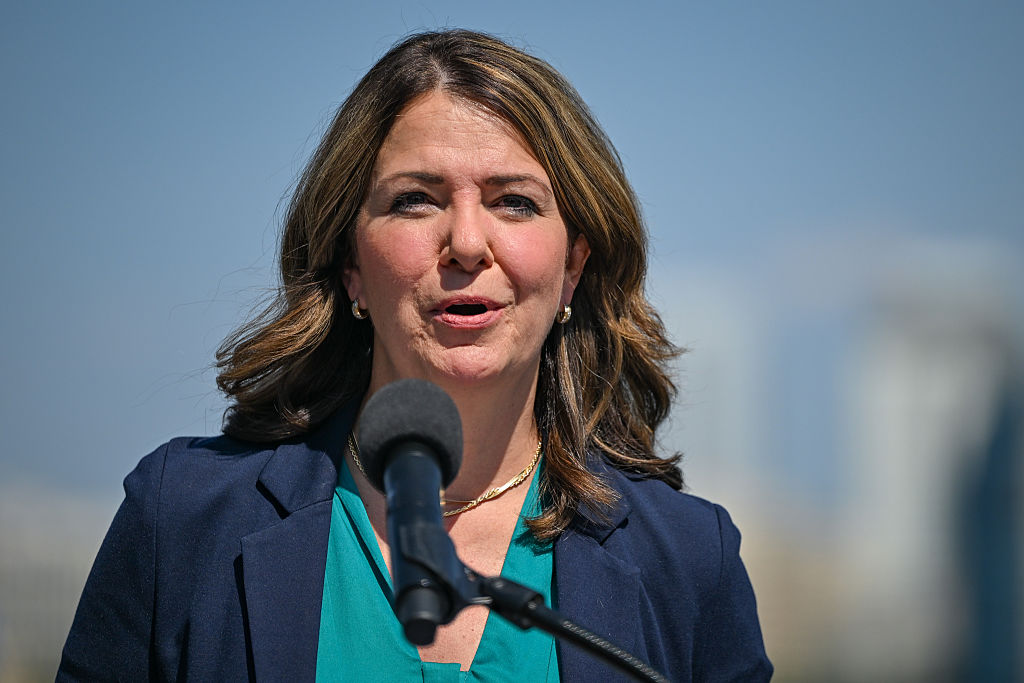
Alberta Premier Danielle Smith addresses the media in Edmonton on July 18, 2025.

Alberta Premier Danielle Smith’s challenge is to keep separatists within the United Conservative Party fold while reassuring moderate voters that she’s not a threat. This is why she’s opened the door to an independence referendum without bringing one forward, let alone endorsing it herself. (Artur Widak / NurPhoto via Getty Images)


Alberta Premier Danielle Smith, a conspiracy theorist radio host before entering politics, has scheduled a referendum for October on whether the oil-rich Canadian province should hold . . . a future referendum on independence.

Smith, who owes her remarkable comeback from political obscurity to both the pandemic and Alberta’s uniquely oil-fueled grievance politics in equal measure, announced her referendum-within-a-referendum in a May 21 address posted to her YouTube channel.

The announcement came after a year in which her government lowered barriers to a citizen-initiated independence vote, as well as two court decisions that ruled the government must consult with First Nations before engaging in a process that would, by necessity, abrogate their treaties with the federal government if successful.

On May 13, Justice Shaina Leonard of the Court of King’s Bench ruled in favor of Athabasca Chipewyan First Nation (ACFN) and the Blackfoot Confederacy’s efforts to nix the separatist organization Stay Free Alberta’s petition to place a question on the referendum ballot about Alberta becoming an “independent state.” Echoing Stay Free Alberta’s response to Leonard’s ruling, Smith called the decision “incorrect in law and anti-democratic,” and pledged to join the separatist group’s appeal of the ruling to higher courts.

In addition to nine previously announced referendum questions on Canadian constitutional matters Alberta cannot unilaterally decide, as well as immigration restrictions, Albertans will now also be asked on October 19:

Should Alberta remain a province of Canada or should the Government of Alberta commence the legal process required under the Canadian Constitution to hold a binding provincial referendum on whether or not Alberta should separate from Canada?

In true right-wing populist fashion, Smith was quite transparent that the question is an effort to circumvent inconvenient court rulings that she has characterized as stymieing the will of the people, even as she emphasized that she would vote in favor of remaining in Canada.

“Because this proposed referendum question does not directly trigger separation, but if successful would ask Alberta’s government to commence the legal process necessary to hold a binding referendum on the matter, the recent court ruling would not be applicable,” Smith said in her address. She also made clear that the measure would buy time while her government and Stay Free Alberta appeal the Court of King’s Bench decision, providing ongoing grist for the separatist mill for the foreseeable future.

Beholden to Separatists

There’s immense overlap between the Alberta separatist movement and the anti–pandemic restrictions crowd that coalesced around Smith’s United Conservative Party (UCP) leadership campaign in 2022. That campaign was set in motion after former premier Jason Kenney was removed by the party membership for what they viewed both as an insufficiently hands-off approach to Covid restrictions and insufficiently confrontational approach toward the federal Liberal government.

Smith’s leadership campaign manager Rob Anderson, now her chief of staff, coauthored the Free Alberta Strategy with University of Calgary political theorist and avowed separatist Barry Cooper and anti-lockdown lawyer Derek From. The strategy calls on the province to take steps to insulate itself from what its authors regard as an intrusive federal government. Its centerpiece is the Alberta Sovereignty Act, which empowers the provincial government to refuse to implement federal laws and regulations it opposes, specifically naming “attempts by federal agencies to regulate our Province’s energy sector in any manner.”

Smith’s first piece of legislation in October 2022 was the rebranded “Alberta Sovereignty within a United Canada Act,” which has functioned as her mantra for navigating tensions between separatists and federalists. Invoking the act has become something of an annual tradition for Smith. It has been used to express opposition to a proposed 2035 net-zero electrical grid target, a proposed oil and gas emissions cap, and a federal gun buyback program.

Credible polling suggests that support for independence has remained stagnant over the past year at roughly a quarter of Albertans, though a majority of UCP voters are in favor. However, Alberta’s ruling party has deep ties to separatists. Stay Free Alberta leader Mitch Sylvestre is the president of a UCP electoral district association in rural northern Alberta. He was honored at last year’s party convention in Edmonton for his fundraising prowess.

Jeevan Mangat, the former leader of the separatist Wildrose Independence Party, is the president of a UCP district association in Calgary and hopes to run for the party in the next election. Jason Stephan, Red Deer member of the legislative assembly — roughly equivalent to a state representative — wrote an op-ed for the right-wing news site the Western Standard urging readers to sign Sylvestre’s referendum petition and vote in favor of independence.

Smith’s challenge is to keep separatists within the party fold while reassuring moderate voters that she’s not a threat. This is why she’s opened the door to an independence referendum without bringing one forward, let alone endorsing it herself. A criminal investigation into the leaking of three million Albertans’ voter registration information by separatist voter-ID initiative the Centurion Project has heightened Smith’s need to put some additional arms-length distance between herself and the separatist movement.

What Separatists Want

In 2001, an open letter to then-Premier Ralph Klein was published in the right-wing National Post, calling on him to build “firewalls” around Alberta, including a provincial police force, pension plan, and tax collection agency, to insulate the province from the federal government.

Signatories Stephen Harper and Ted Morton eventually became prime minister and Alberta’s finance minister, respectively, but did far less to advance the letter’s proposals than Premier Smith, who has already appointed a chief for a provincial police force. Calgary oilman Patrick Beauchamp founded the Alberta Residents League in 2002 to promote the ideas contained in the Firewall letter. Beauchamp’s desired end goal was Alberta becoming a US state. But given the unpopularity of US annexation, Beauchamp decided to change his messaging to Alberta independence.

A delegation of separatists with the Alberta Prosperity Project (APP), of which Mitch Sylvestre is also the CEO, traveled to the United States three times last year to meet with State Department officials. On the eve of their first trip in March 2025, separatist lawyer Jeffrey Rath told YouTuber Rachel Parker that his preference was for Alberta to become a US territory like Puerto Rico or Guam, though he would settle for statehood.

By January 2026, Rath changed his tune, telling the Canadian Broadcasting Corporation that the notion of US annexation was “out of left field” and “off the table.” But having the blessing of the far more powerful neighbor of the country you are trying to leave would certainly be an asset for any separatist movement.

A look at the APP’s draft fiscal plan, The Value of Freedom, provides a sense of the sort of society separatists want to build, with or without US assistance. It calls for Alberta to increase oil production to 9.5 million barrels a day by 2045, up from 3.8 million, and gas production to 21 billion cubic feet a day from 11 billion — goals that roughly dovetail with the premier’s pledge to “double” oil and gas production.

But while Smith sometimes pays lip service to “transitioning away from emissions” by shilling for costly, speculative carbon capture and storage technology, the APP speaks of abandoning “external climate agendas” altogether and eliminating “all externally imposed limits on CO2 provision.” The presumed increase in resource royalties leads the APP to muse about whether to eliminate federal or provincial income taxes, alongside the hated federal sales tax.

The plan also envisions an independent Alberta conducting 75,000 to 130,000 deportations within its first three years of independence. The parallels with the Trump administration’s agenda are hard to miss.

Reorienting the Canadian State

Smith’s strategic accommodation of the separatist movement on which she depends enables her to use the prospect of Alberta independence as leverage to pressure Prime Minister Mark Carney to reorient the Canadian state along the lines envisioned by the fossil fuel industry. So far, she’s been remarkably successful.

In November 2025, Smith and Carney signed a memorandum of understanding in Calgary, in which Carney took a wrecking ball to the edifice of Canadian climate policy while receiving little in return. Carney backtracked on the country’s planned oil and gas emissions cap and 2035 clean electricity mandate, both targets of the Alberta Sovereignty Act. He further committed to a new tar sands pipeline to the West Coast as well as the Pathways carbon capture and storage hub for northern Alberta proposed by the largest tar sands companies. This was framed by Smith as a “grand bargain,” but it looks much more like capitulation.

All Smith had to do in exchange for these concessions to the industry, for which she worked as a lobbyist before her return to politics in 2022, was negotiate with the federal government on a path to align the province’s industrial carbon price with the federal benchmark. While the federal carbon price had been scheduled to reach CAD $170 by 2030, Carney and Smith reached an agreement last week to lower it to CAD $130 by 2040. The latest deal also greatly reduces the emissions reduction targets of the Pathways project to sixteen megatonnes by 2045 from sixty-two megatonnes by 2050.

Given the track record of actually existing carbon capture, this almost 75 percent decrease in Pathways’ emissions reduction target is more realistic, but it also further illustrates how Carney and Smith are partners on fossil fuel expansion. Chief Allan Adam of ACFN, a longtime critic of the tar sands, warned attendees at an April 2026 rally in support of treaty rights and against separatism not to “be tricked” by the provincial government’s saber-rattling against the federal government. “Canada is with them. They don’t say it, but they go hand in hand,” said Adam.

With Carney using annexationist threats from the Trump administration to gut environmental regulations and ram through major infrastructure projects, it is difficult not to agree with Chief Adam. But whether or not Alberta ever seriously approaches independence may ultimately be beside the point. The movement’s real significance lies in how it effectively pushes the center of Canadian politics toward the demands of the fossil fuel industry while simultaneously allowing Smith to present herself as a reasonable alternative to rupture.

Carney’s appeasement of Smith’s extractive populism fails on two levels. It does nothing to prepare Canada for a future beyond hydrocarbon dependency, while also failing to address the deeper politics of grievance that also drives Alberta separatism.

Canada does not need further accommodation to either petro-state corporate authoritarianism or the managerial complacency that helped produce the current impasse. It needs a politics capable of acknowledging the bitterness of the present moment — at a time when 60 percent of Albertans report difficulty meeting basic monthly expenses — while firmly rejecting the Fraggle-eyed utopian promises of separatist resentment. What Canada lacks is not more constitutional brinksmanship, but a left populism capable of turning economic frustration toward collective development instead of permanent regional grievance.