Saudi Arabia’s Yemen Strategy Has Fallen to Pieces
Saudi Arabia has spent years trying to build up its Yemeni allies against its main opponent, Ansar Allah. Ansar Allah’s sudden military offensive over the last few weeks shows that this project has been a failure, despite all the money spent on it.
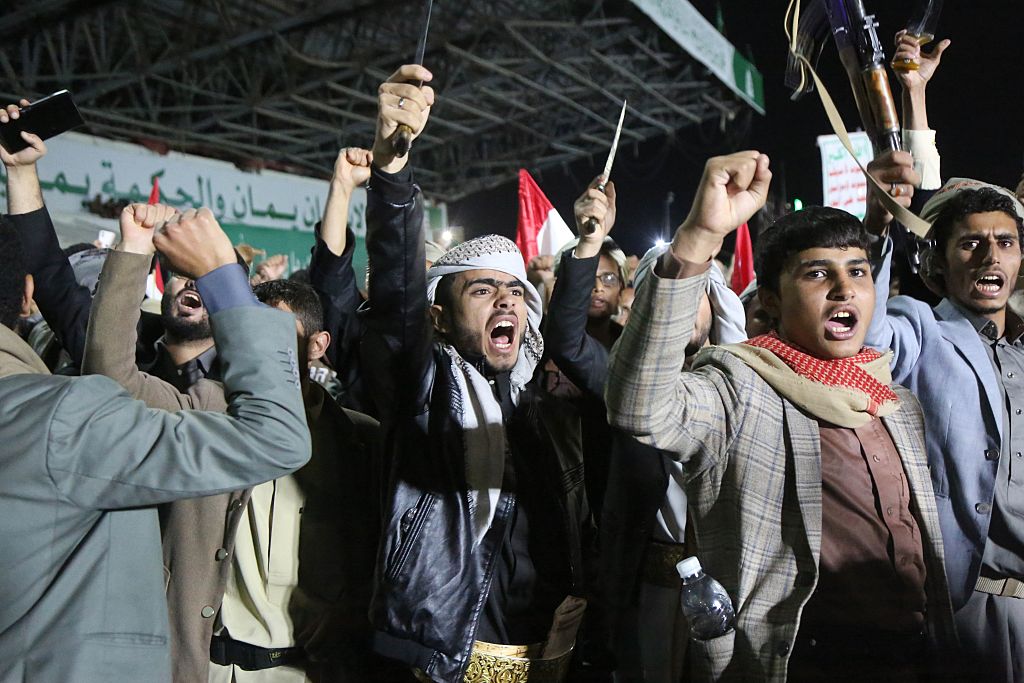
When Saudi Arabia began intervening in Yemen’s civil war, its leaders expected to be able to impose their will on a much poorer neighbor. More than a decade later, blowback from their Yemeni opponents is causing major disruption to the Saudi economy. (Mohammed Mohammed / Xinhua via Getty Images)
- Interview by
- Daniel Finn
Over the past few weeks, Yemen’s Ansar Allah movement, also known as the Huthis, has launched an offensive and made big territorial gains. The latest turn in the Yemeni civil war could have major implications for the world economy, as it involves one of its most important trade routes through the Red Sea. It certainly poses a big challenge for Yemen’s neighbor Saudi Arabia.
Helen Lackner is a leading expert on the politics of Yemen and the author of several books about the country. She spoke to Jacobin about the background to the latest developments and what is likely to happen next. This is an edited transcript from Jacobin’s Long Reads podcast. You can listen to the interview here.
Daniel Finn
What was the impact of the military campaign against Ansar Allah by the United States and Israel, along with the other steps taken by the Trump administration to impose new sanctions on Yemen?
Helen Lackner
The US bombing of Yemen was concentrated in the period between March and early May 2025. There was a fifty-two-day bombing campaign targeting the Huthi-ruled areas. Its main impact was to degrade, at least to some extent, the Huthi capacity to launch missiles. But it did not by any means destroy that capacity, as has been demonstrated since then.
One important element to talk about in relation to the Trump policy, which has had a much more lasting effect than the bombings, is the designation of Ansar Allah as a “Foreign Terrorist Organization” in March 2025. That kind of move doesn’t have instant results, but it has gradually worsened the living conditions in Huthi-controlled territory and even come close to paralyzing economic activity.
Most banks that were previously based in Sanaa, the capital, have now moved their headquarters to the interim capital of Aden. International transactions, which were already very difficult, have become much harder to conduct. That’s relevant first of all in relation to the import of basic goods. Ninety percent of basic staples in Yemen are imported: wheat, rice, tea, etc.
The second major impact has been on remittances, which have been the biggest source of income for many Yemenis for a long time. Making the transfer of remittances more difficult is something that affects ordinary Yemenis. The Yemenis living under Huthi control already accounted for two-thirds of the population before the latest offensive. We’re talking about twenty to twenty-five million people.
Coming to the Israelis, they launched a number of air strikes in 2025. The most notable one was in August that year, when they managed to kill the prime minister and nine other ministers, plus a number of other senior officials at a meeting. This demonstrated that they now had access to intelligence, something that they previously lacked because Yemen hadn’t been a priority for them.
But it also demonstrated that the formal government under the Huthis is not the decision-making entity. The bombing happened last August, more than thirteen months ago now, but the Huthis haven’t yet appointed a new prime minister or any replacements for the ministers and the other officials who were killed.
Daniel Finn
During the period when Ansar Allah was at war with Israel and the United States, how did that affect the protracted efforts that had been going on to negotiate a formal end to the internal conflict in Yemen, which obviously involves outside actors (notably Saudi Arabia) as well?
Helen Lackner
There are two elements that need to be looked at. The first is the UN track. We’ve had a UN special envoy since 2011, with the current envoy having been in the role for more than five years now. But the last meeting between the Huthis and the internationally recognized government (IRG) was in 2018, and the UN process has come to a complete standstill.
The second element is the direct negotiations between the Saudis and the Huthis that were taking place, to some extent with Omani mediation. If they had been finalized, there would have been an agreement whereby the Huthis would no longer attack Saudi Arabia in any shape or form, while on the other hand, the Huthis would receive compensation for a lot of the war damage between 2015 and 2022 as well as salaries for their staff. The siege on the ports and airports would be lifted, and the Huthis would get a good share of the oil revenues.
The deal would not have been a signed and sealed agreement between the Saudis and the Huthis. It would have formally been a deal between the IRG and the Huthis, endorsed by the Saudis. This process was widely believed to have more or less been settled and agreed when the Gaza genocide started. But the Huthis then became involved in supporting the Palestinians and the deal was put on hold.
Daniel Finn
At the end of last year, there was a short-lived attempt to form a breakaway statelet in southern Yemen. What was the background to that attempt, and why did it unravel so quickly? Was it primarily driven by internal factors or by the Saudi–Emirati rivalry?
Helen Lackner
It was a bit of both. The anti-Huthi front is officially the IRG, which itself has been badly divided since the war started in 2015. One of the major divisions arises from the southern separatists, who want to return to the situation before 1990, when there were two separate states, the Yemen Arab Republic (in the northwest) and the People’s Democratic Republic of Yemen (in the south and east).
The southern separatists themselves come in a multiplicity of forms. But the strongest force among them is a group called the Southern Transitional Council (STC), which the Emiratis had been supporting very heavily since its foundation in 2017. It has been the most active element in undermining the IRG.
The Emiratis certainly colluded with, and possibly encouraged, the STC in its bid to take over Hadhramaut and al-Mahra, the far eastern governorates of Yemen. Those governorates had been primarily under the control of the IRG — at least its anti-STC elements — except for the coastal area in Hadhramaut. The STC then mounted a blitzkrieg that in a way resembled what the Huthis have done more recently, and its forces took over the whole of those two governorates within a matter of days in December 2025
The IRG and the Saudis called for them to “withdraw to your previous positions.” Instead they continued their offensive, moving closer and closer to the Saudi border. At that point, the Saudis intervened, bombing a couple of Emirati ships that were bringing in military supplies for the STC in Mukalla, the regional capital, and the port of Hadhramaut. At the same time, the IRG broke its official support agreement with the UAE and demanded that it immediately withdraw its forces, which it did.
This was followed by an offensive by the non-STC elements, supported by the Saudis, who pushed back the STC and effectively closed it down throughout the country. The STC itself split into factions. The bigger one joined the IRG and went to Riyadh to prepare for a South–South dialogue that the IRG had announced. They officially dissolved the STC — some say they were forced the make the decision.
But another branch of the STC, supported by the Emiratis, continues to exist today. Its leader is believed by everyone to be in the UAE, although he hasn’t made any public appearances. The Emiratis have continued to support this faction in an underhand way.
There are also still elements of the STC who remain active and who are objectively now allies with the Huthis, as they have said they won’t fight them. There are widespread reports that they have been selling weapons to the Huthis, and the Huthis have also said that they will not attack them.
Basically, you have a situation where this particular group of southern separatists has now split into two. One group is now with the IRG and the other one is more or less underground but claims to be involved in civilian demonstrations and the like.
When it comes to Saudi Arabia and the UAE, there has been a tendency to assume that they are great allies, but if you look at history, this is simply not the case. Most of the time they have been rivals. There was a brief moment when they were very close to each other after King Salman came to power in Saudi Arabia with his son, Mohammed bin Salman (MBS), as minister of defense.
MBS wanted to become crown prince, and his father also wanted this. He has since achieved this ambition, with a lot of help from the Emiratis. The United States favored his cousin Muhammad bin Nayef, who had long been cooperating with their intelligence agencies, for the role of crown prince. But he was supplanted by MBS, and the UAE’s ambassador to Washington, Yousef Al Otaiba, played a very important role in that outcome.
But even back in 2017, there were divisions opening up between Saudi Arabia and the UAE over Yemen. They had started the war in Yemen together in 2015, but by 2017, there were already significant differences between them. Those differences are now apparent in several other countries, including Sudan, Somalia, and Libya, without even mentioning the economic competition between the two states, which is also very important.
The situation with the STC and what happened in December last year reflected a combination of internal and external factors, and it would be difficult to determine which aspect was more important than the other. But the Saudi–Emirati divisions will remain an important problem, and Yemen will remain one of the main sites where you can observe the extent of those divisions.
Daniel Finn
Western politicians and diplomats generally refer to the IRG as if it were the legitimate authority in the country and the Huthis were simply a rebel movement. But what power does that government actually exercise inside Yemen?
Helen Lackner
This is a very important question that has become all the more important in the light of recent events. The IRG officially controlled about two-thirds of Yemen’s territory before the Huthi advances. But if you look at the map of the country, you will see that much of the area it controlled was desert. The share of the Yemeni population under the IRG’s control was estimated to be about one-third — a maximum of ten million people.
Until the war started in 2015, the IRG was simply known as the Yemeni government. Then it was forced out of Sanaa and officially moved to Aden; since then, there have been all kinds of internal conflicts and divisions inside the IRG. It isn’t a cohesive entity.
There are different military units, many of which were previously supported by the Emiratis and are under different commanders. For example, the main force on the west coast that has recently been defeated was under the command of Tareq Saleh, the nephew of former President Ali Abdullah Saleh. He has worked with the IRG, but he has never considered himself to be a member of it, although he is a member of the Presidential Leadership Council.
The presidency of the IRG is currently an eight-man body with one president and seven vice presidents. The majority of the seven vice presidents are men who control large military units. I hesitate to use the word “warlord,” but it is close to being accurate for some of them.
At the civilian level, you have a set of ministers and administrations in the different governorates, but their fundamental problem is finance and the quality of governance. Since November 2022, when the Huthis bombed the ports exporting Yemeni oil on the southern coast, the IRG’s income has more or less disappeared, and it has become almost totally dependent on Saudi financing, international aid, and a very small amount of money raised from taxes. The majority of civil servants have not been paid regularly in any part of Yemen for many years.
Although the majority of ministers are actually in Aden, the president has only been there occasionally. He is in Saudi Arabia most of the time. The IRG’s degree of control is minimal and varies from one area to the next. It is more effective in governorates where the local administration has some oil and gas and has been able to keep some of the income and use it to finance services.
Even after the collapse of the STC, the IRG remained badly divided. There have been efforts to reorganize the military forces and create some kind of centralized command structure. But what has happened over the last few weeks demonstrated that they were nowhere close to achieving this. The IRG forces disbanded very rapidly and suffered heavy losses.
Daniel Finn
What impact has the ongoing US war on Iran had on Yemen? To what extent do the Huthis coordinate their actions with Iran and its other allies in the region?
Helen Lackner
Initially, it had much less impact than anybody expected. Outside observers were expecting the Huthis to take action in support of Iran right from the start, but they did nothing. Although they issued many statements supporting Iran, there was no action. At the end of March, they launched a number of missiles at Israel, but apart from that, they just stated that they could close the Bab al-Mandab Strait if they chose to do so, which would obviously have had a major impact on the world oil market.
In a way, this demonstrates that the US bombing campaign of 2025 was probably more effective than many thought at the time, because the Huthis clearly saw it as a priority to discourage Donald Trump from renewing the air strikes. Today, when the Saudis are desperately asking for US support, the Huthis have been talking to US officials, asking them not to start again. Having spent years calling the United States the first and greatest enemy, they have also said that all ships can pass through the Bab el-Mandab except Saudi ones.
Another element that’s always worth remembering is the fact that the Huthis are not Iranian proxies. They have their own plans and objectives. Right now, their objective is to strike a blow against Saudi Arabia. Stopping Saudi oil being exported via the Bab al-Mandab and via the East–West pipeline is part of that.
It’s convenient for them that this move also supports Iranian efforts to put pressure on the United States by reducing supplies for the world oil market. The Saudis had been exporting about four to five million barrels a day, but that has now been interrupted. Iran and the Huthis are allies; they work together when it suits both sides; but neither is taking orders from the other.
There has also been military coordination, even though less military equipment for the Huthis has been arriving, because efforts to stop smuggling on land and by sea have become more effective. The Huthis manufacture most of their equipment themselves, but they do need to import some very sophisticated technical elements. They’re now buying a lot of that material directly on the world market instead of receiving it from Iran.
There is plenty of evidence that Iranian and Lebanese military advisers have been helping the Huthis, but they could easily survive without them. They might be slightly less sophisticated, but they could survive without the equipment and the advice. The Huthis have been involved in military activities for more than twenty years now. If they had limited capacities at the beginning, they’ve clearly developed those capacities much further over the years, including some advanced forms of technology.
Daniel Finn
What was the state of play when the Huthis launched their most recent offensive? Was the offensive something that was widely anticipated in advance?
Helen Lackner
It was anticipated by some, I would say, but not widely. If you look at what happened in the last three or four months, it seemed to me that the Huthis were likely to launch an offensive within the current period, for several reasons.
For one thing, the impact of the terrorist designation had begun having a major effect on daily life in Huthi-controlled areas. The economic situation has greatly worsened and is continuously deteriorating. The World Food Programme, which is the main source of food aid, reduced its contribution dramatically over the last two years, then stopped it altogether last September.
This was partly because the Huthis had arrested UN and NGO staff members who were involved in aid distribution but also for political reasons. Of course, the fact that United States Agency for International Development funding completely stopped for Yemen after the early months of 2025 has also had a big impact. You have increased popular dissatisfaction throughout the region, and not just dissatisfaction — people are starving.
A second element of concern for the Huthis was what appeared to be a distinct strengthening of the IRG after February this year. As I mentioned, the IRG leaders were reorganizing the military and shifting people between areas. They claimed a few months ago that they had restructured up to 80 percent of their forces and that they were battle-ready. Events clearly proved that this assessment was premature.
The third element, of course, is that the Saudis are the main supporters of the IRG after the UAE’s political exit. For the Huthis, the question was, “are the Saudis going to come and make the deal with us, or are they going to go with the IRG and fight us?” The way things were going, with the Iran war and other aspects of the situation, they were concerned that the Saudis would no longer seek to negotiate with them.
To attack Saudi Arabia makes a lot of sense from their perspective because there is a baseline of popular support, whereas acting directly in support of Iran is something that has no resonance among Yemenis. Yemenis generally have no sympathy for Iran.
The pretext for taking action was the Saudi bombing of the runway at Sanaa airport, when a Huthi delegation was returning on an Iranian flight from Ali Khamenei’s funeral. But this was more of an inconvenience than anything else, since they did not bomb the runway of Hodeidah airport and the delegation was able to land. It was a pretext rather than the main reason.
Daniel Finn
How significant are the gains that the Huthis have made over the past few weeks? Does it represent a decisive shift in the balance of forces, and what implications might it have for the Saudis?
Helen Lackner
The big question is whether the gains are reversible or not. If they prove to be irreversible, then they’re very significant.
There has been a lot of talk about Huthi control of the Bab al-Mandab. In fact, they already controlled the Red Sea. The big difference now is that if they sit at the bottom of the peninsula, or on Perim Island, they can shoot at anything that comes by with fairly unsophisticated weaponry.
Obviously, the fact that they are preventing Saudi ships from going through, exporting oil and bringing back imports, is important. For imports, the Suez Canal is a reasonable substitute. For exports, the Iraqi drone attack on the pipeline last week is more significant, because it is preventing oil from reaching Yanbu, the Saudi port on the Red Sea coast.
The Saudis can still export up to two million barrels a day. But by going through the Bab al-Mandab, they had been exporting between four and five million barrels a day over the last few months. Going through the Suez Canal is much less convenient because the large oil carriers, known as VLCCs, cannot go through the canal fully loaded.
The oil has to be taken to the bottom of the canal and either transferred to smaller ships or through a small pipeline and then reloaded when it reaches the Mediterranean Sea. Eighty percent of Saudi exports go to East Asia, so after arriving in the Mediterranean, they have to go all the way past Gibraltar, around Africa, and back up to Asia. This route is much less convenient and much more expensive.
The balance of forces between the Huthis and the anti-Huthi elements will depend on what happens next and whether the latter can reorganize themselves and receive the air support and other forms of support they need from the Saudis or other players. But air strikes do not win wars without land forces, so unless the Yemeni land forces are reorganized so they can be more effective, there will not be any reversal.
I wouldn’t like to say that the change in the balance of forces will prove decisive in the long term. My perception when this fighting started in August was that we were back more or less where we were in 2015, at the beginning of a long and nasty war. At the moment, unfortunately, I see no reason to change my mind on that, although I hope that I’m wrong.
Daniel Finn
What are the social and humanitarian conditions facing the people of Yemen after the latest turn of the war, and how are they likely to develop in the coming months?
Helen Lackner
It’s very important to remember that the humanitarian situation is disastrous, regardless of what happens for the country’s leaders. Yemen was the world’s worst humanitarian crisis for a number of years. It lost that title, not because anything improved in Yemen but because things got so much worse in Sudan and other places.
Starvation is becoming a major issue throughout the country. As I mentioned earlier, the situation is even worse in the Huthi-controlled area, for two-thirds or more of the population, than it is in the IRG area. But in both areas, it is very bad.
The UN’s humanitarian aid appeal for this year, which is smaller than last year’s, has only been financed at 23 percent by the end of September. This is very low, even compared to last year, which was already very bad. People were suffering enormously even before the latest turn of events.
Now, with the developments in the southwest of the country and the military activity, about 150,000 people have been displaced at the latest count, on top of the four to five million people displaced over the last ten years. Given the shortage of aid, it’s even more difficult for them to find places to stay, whether temporarily or permanently.
So many people have been interviewed saying that they’ve just run with the clothes on their backs and bullets flying overhead, and the number of displaced people is likely to increase. Those who are still in their villages but have been caught up in the fighting are going to try and escape if they possibly can, so long as you have these active military fronts.