Under Israeli Settler Attacks, I Feel I Am Not Alive
Ruqayya Rabe’i was three months pregnant when a mob of Israelis invaded the village where she lives. She spoke with Jacobin about her lost pregnancy and how settler violence seeks to destroy the basis of Palestinian life.
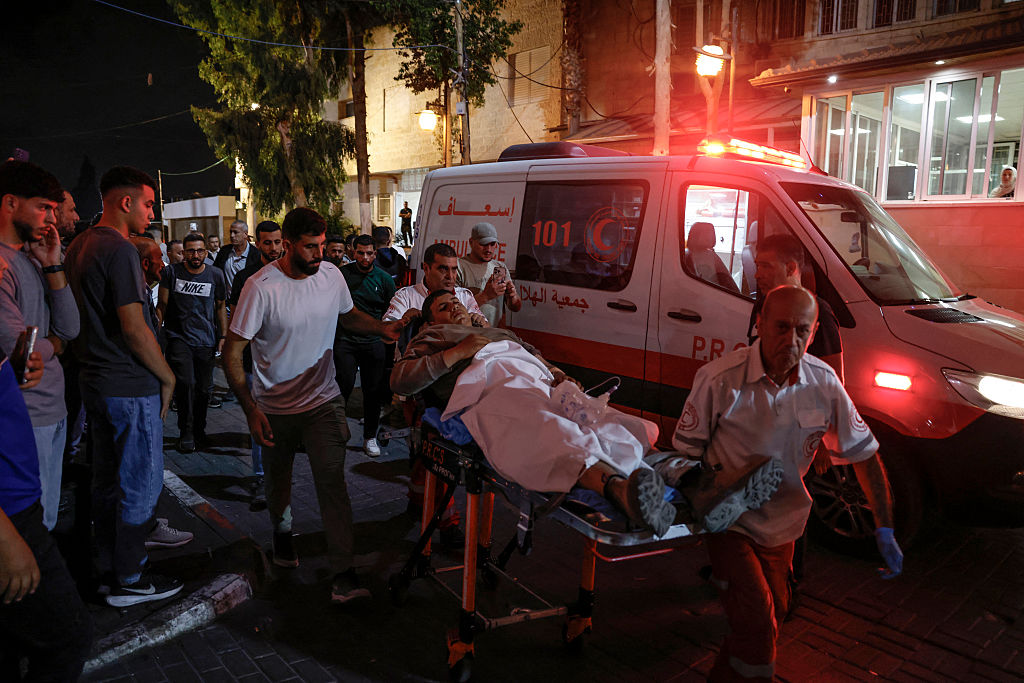
A paramedic transports an injured Palestinian into the Ramallah Governmental Hospital after arriving from the village of Al-Mughayyir, northeast of Ramallah in the Israeli-occupied West Bank, following an attack allegedly carried out by Israeli settlers on August 30, 2026. (Zain Jaafar / AFP via Getty Images)
In the West Bank village of At-Tuwani this July 19, Ruqayya Rabe’i, three months pregnant, lay in her room beside her four sleeping daughters. At 12:30 a.m., the first stones hit her home. She rushed to check the front door. There in the living room, she found her fifteen-year-old son, Usayd, sleeping directly below a window where, according to Ruqayya, several settlers were armed with guns and knives and trying to force their way in.
She tried to shake her son awake, but he didn’t stir. When the settlers noticed her, she fled, certain that if they saw him, they would shoot.
The window was shattered, a chemical compound poured through it, and the frame went up in flames, Ruqayya said. She called her husband, who was working in the nearby city of Yatta, frantic, believing at that moment that her son had been killed.
Her son, meanwhile, woke up to the flames and ran to find his mother. At the sight of him alive, Ruqayya collapsed from shock, unconscious. By the time an ambulance arrived, she could hardly crawl to the street — one hand on the ground, the other on her belly.
The attack was over in ten minutes. The perpetrators abruptly left the scene, leaving behind burned vehicles, vandalized homes with the Hebrew words for “revenge” and “house arrest,” and a destroyed mosque. But the effects on this family will be felt for a lifetime.
Numbering near forty according to residents, the mob of settlers had descended from an illegal outpost, Havat Ma’on, located just southeast of the Palestinian village. The settlers there have been terrorizing the Palestinians of At-Tuwani since the outpost’s establishment over two decades ago.
Impunity by Design
Havat Ma’on is one of over five hundred settlements and outposts across the West Bank, more than 165 of which have been established since October 2023 and all of which are illegal under international law. Settlers like those who attacked At-Tuwani are not acting in isolation but instead are instruments in a broader Israeli strategy of land-grabbing by force, backed by a state that encourages them every step of the way. Outposts such as Havat Ma’on are established illegally even under Israeli law yet are routinely legalized after their formation, rewarding settlers for occupying Palestinian land instead of punishing them for stealing it.
Settlers then face little to no legal accountability for their crimes against Palestinians and are further encouraged through extreme armament campaigns. Of the eighteen Palestinians killed by Israeli settlers and forces in the West Bank during the first half of 2026, no murderers have been convicted. According to a study by Israeli rights group Yesh Din, 93.6 percent of police investigations into settler crimes in the West Bank are closed without charge, and only 3 percent of cases lead to any actual conviction. Hundreds of thousands of Israeli settlers have received state-issued guns, in large part thanks to Israeli National Security Minister Itamar Ben-Gvir’s massive armament campaign since October 2023, relaxing already loose permit laws for Israeli citizens. Critics argue this “green-lights” the intensification of violence against Palestinians, using settlers as “private militias” to advance state land-grabbing goals under the pretext of civilian self-defense.
More than just a byproduct of Israeli policy in the West Bank, this violence is a weapon of the broader Zionist colonial project aimed at displacing Palestinians and consolidating de facto annexation.
An Accelerating Crisis
Amid unchecked impunity, accelerating settlement expansion and armament, and mounting crackdowns on Palestinians since October 2023, settler violence has reached an all-time high. A June 2026 United Nations Commission of Inquiry found that settler attacks had risen by 130 percent since 2023. The UN Office for the Coordination of Humanitarian Affairs (OCHA) recorded more than 1,330 attacks causing casualties or property damage across roughly 250 Palestinian communities in the first seven months of 2026, with attacks now occurring at a rate of around six per day. Around 880 Palestinians have been injured in the context of settler attacks this year, while eighteen have been killed — already surpassing the seventeen fatalities recorded throughout the full year of 2025.
Yet these figures capture only documented incidents. Much of the everyday violence shaping Palestinian life in the West Bank never enters official statistics. A 2026 report by Israeli settlement-monitoring groups Kerem Navot and Peace Now found that the vast majority of incidents, ranging from harassment and threats to physical violence, are never documented or counted by any authority. For communities living alongside expanding outposts, this intimidation and constant threats of attack have become part of daily life, and the recorded figures offer only a limited reflection of the reality they face.
“They do these attacks on the pretext of land defense,” Mohammad Hurani, an At-Tuwani resident and neighbor of Ruqayya, told us. “Every twenty-four hours something happens, and if something doesn’t happen, the people remain on edge.” During the July 19 attack on At-Tuwani, settlers attempted to set Mohammad’s house on fire and spray-painted the Hebrew word for “revenge” on an exterior wall. “We tried to defend ourselves, but they outnumbered us ten to one, so we couldn’t do much.”
Hurani explains that there has been a severe increase not only in the frequency of attacks but also in their intensity. Prior to October 2023, “settlers used to come in groups of three or four but now come in mobs of several dozen.” In documented cases, the Israeli military has protected settlers during attacks, joined them in raiding villages, or arrived at the scene only after the settlers have fled, as documented by various Israeli and international human rights groups. In At-Tuwani, Israeli military forces arrived approximately forty minutes after the settlers left, according to Mohammad. “[The military] began yelling, ‘You don’t belong here,’” he recalls. “Without taking any statements from us, they proceeded to Havat Ma’on to collect statements from the Israelis.”
OCHA estimates that 56 percent of total Palestinian injuries in the West Bank this year occurred in the context of settler attacks. Over 1,100 Palestinians have been killed in the West Bank by settlers and Israeli forces since 2023, according to the UN Relief and Works Agency for Palestinian Refugees in the Near East (UNRWA). Almost all perpetrators walk free. But the true cost of these attacks cannot be measured in numbers.
Following the attack in At-Tuwani, Ruqayya was transferred to Yatta Public Hospital, where despite doctors finding that the fetus had a weak heartbeat, she was discharged after an hour without treatment. Public hospitals across the West Bank have been operating under severe strain as the Israeli government continues to withhold over $5 billion worth of tax revenues from the Palestinian Authority, which would otherwise pay public sector employees and keep hospitals running, according to Deutsche Welle.
Suffering from emotional trauma and painful cramping through the following day, Ruqayya was brought to a private hospital in Yatta for testing.
At 5 p.m. on July 20, the fetus was pronounced dead.
“I feel I am not alive,” says Ruqayya. “He left before he could see the good things in this world, before we could even see him. Now he is gone.”
The attacks leave communities in a permanent state of vigilance. Ruqayya’s daughters still sleep in a room with no protective barriers, leaving her constantly worried about future attacks. “The sound of broken glass is still ringing in my ears. I’m afraid for my daughters — I can’t sleep.”
Yet in At-Tuwani, as across Masafer Yatta, fear has not erased resistance. Residents continue to rebuild damaged homes, accompany shepherds and farmers to their land, document attacks, and support families targeted by settlers. In communities where violence and intimidation aim not only to injure individuals but to drive Palestinians from their homes, remaining on the land has become an act of resistance.
An Election Without a Clear Break
The months ahead may bring even greater pressure. Israel’s upcoming election is not the cause of the surge in settler violence, but it may intensify the forces already driving it. With Prime Minister Benjamin Netanyahu’s bloc facing the possibility of losing power, settler leaders and their political allies have incentives to consolidate territorial gains before any political transition.
Meanwhile, neither of Netanyahu’s leading opposition rivals are currently positioned to meaningfully challenge the structures enabling settler violence. While their policies differ in intensity, neither offers a clear break with the broader trajectory of settlement expansion and the displacement of Palestinians.
Although Gadi Eisenkot, a former Israel Defense Forces chief of staff who has surged in recent polling, has publicly condemned the “violent lawbreaking by an extremist minority” of settlers in the West Bank, he has centered his campaign on security and governance rather than settlement and settler policy.
Naftali Bennett, a former Israeli prime minister running in alliance with centrist leader Yair Lapid under the Together (Beyachad) party, has traded the lead with Eisenkot throughout the campaign. As a former head of the settler movement’s main umbrella organization, Bennett opposes a Palestinian state outright and has publicly advocated that Area C, which comprises more than 60 percent of the West Bank, should “ultimately be part of the State of Israel.”
Electoral competition may therefore accelerate settlers’ efforts to establish further “facts on the ground,” with little indication of meaningful policy shift.
Beyond Condemnation
Ultimately, protecting Palestinian communities requires moving beyond condemnation and imposing material costs on those enabling their displacement. The targeted sanctions already imposed by the European Union and several Western governments are an important step, but they remain largely insufficient given the scale of ongoing settlement expansion and state-enabled violence. Governments should expand sanctions beyond individual violent settlers to the organizations financing illegal outposts and the government officials implicated in facilitating settler violence or forced displacement, including through asset freezes and travel bans.
They should also restrict trade, investment, and financial activity that sustains illegal settlements and halt arms transfers, given the inherent risk that they may contribute to serious violations. The UN Human Rights Office has identified 158 companies involved in settlement-related activities. Settlement expansion is sustained not only politically and militarily but through international economic networks that governments clearly have the power to change.
Still, pressure cannot come from governments alone. Individuals and civil society can also increase pressure through political organizing, divestment, and targeted boycotts. The Palestinian-led Boycott, Divestment, and Sanctions movement publishes regularly updated guidance identifying priority companies and institutions to boycott, divest from, or pressure based on their involvement in violations of Palestinian rights.
For Ruqayya, such measures would come too late. For other Palestinian families, they could decide whether Israeli violence and displacement continue, with almost no political or economic cost for the perpetrators.