Socialists Need Labor. And Labor Needs Socialists.
Organized labor provides the essential mass base for a revived Left, while socialist politics provides the anti-capitalist horizon necessary to challenge capital. Vivek Chibber describes why the fate of the two are intertwined.
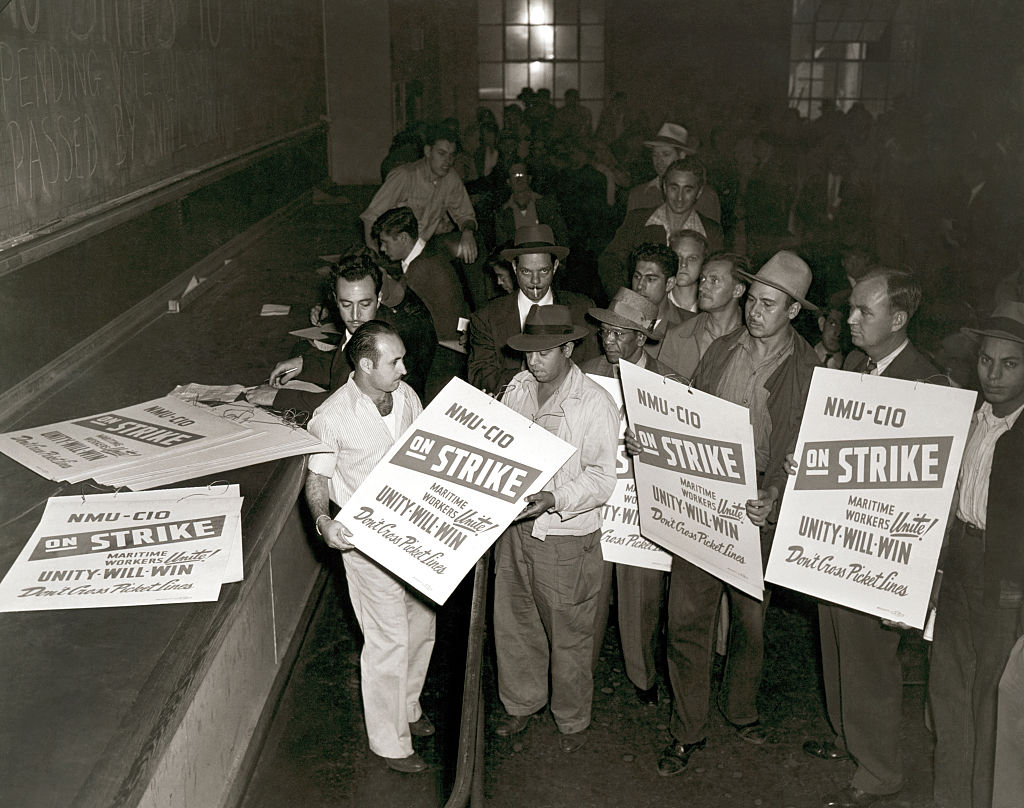
CIO-affiliated National Maritime Union members prepare to go on the picket line during a 1936 waterfront strike in New York. (Underwood Archives / Getty Images)
- Interview by
- Cale Brooks
Unions have more public support than just about anything else in the United States, and yet their membership has cratered. This poses an immense challenge to left-wing politicians who won’t be able to enact lasting change without a robust labor movement beside them.
On this latest episode of the Jacobin Radio podcast Confronting Capitalism, Vivek Chibber addresses the age-old question of whether unions are inherently political, the importance (and limits) of internal democracy within unions, and why socialists have always been at the heart of the labor movement.
Confronting Capitalism with Vivek Chibber is produced by Catalyst: A Journal of Theory and Strategy and published by Jacobin. You can listen to the full episode here.
Cale Brooks
Because this episode is coming out close to Labor Day, I was hoping we could talk about the relationship between socialist politics and unions, and why unions are unique organizations.
Vivek Chibber
I think it’s an absolutely central question, because, as we’ve said so many times on the show, unions are the lifeblood of the socialist movement, and organizing labor is the one essential precondition for a revitalized Left. So going into that in more depth is definitely called for.
Cale Brooks
Let’s start broadly: In terms of density, power, and industrial distribution, what’s the state of American unions in 2026?
Vivek Chibber
Really awful. The term “union density” is a technical term that refers to the proportion of the labor force that is actually dues-paying members of unions. So when we talk about union density, what we’re asking is how much of the working class is actually organized. And that number is at a historic low right now.
Overall union density is just below 11 percent. But that masks the fact that, in the parts of the economy where labor’s power really matters — which is in the private sector, where profits and value are created — it’s at a historic low. Private sector union density is around 6 percent, which, just to be clear, is lower than it was when unions were illegal in the United States.
Why is overall union density higher? It’s because public sector unions have managed not only to survive but actually to grow somewhat since the 1980s. Public sector union density — that is membership in unions for people who work in state, federal, or local governments — is around 33 percent. That’s what’s keeping the overall union density in the double digits. Otherwise, it would be even worse than it is now.
So in terms of just raw coverage of the union movement, it is terrible. Naturally, that also means that the vast majority of the labor force is entirely at the mercy of their employers. They have no way of bargaining effectively for themselves around wages, work conditions, health and safety issues, and pensions.
They are left to the tender mercies of their employers, whose main interest, of course, is not in the workers’ welfare but in profits, which typically come at the expense of those workers. So right now in the United States, the union movement is basically flat on its back. Despite calls and efforts for years on the part of the Left and many union leaders to revitalize it, the trend continues to be downward.
What Do Unions Do?
Cale Brooks
If workers on their own are at the employer’s mercy, as a result of the class structure of capitalism, what is it about unions that allow them to fight back?
Vivek Chibber
What unions do is change the conditions on which employees bargain with their employers around the conditions of work. By that, I mean the wages that they get, the hours that they work, and the pace and intensity of their labor. It’s the union that allows them to bargain better.
The question is: Why? Here, the classical economists from Adam Smith to David Ricardo and down to Karl Marx were pretty clear. The reason is that in that bargain, there is a basic inequality of power. And that inequality of power comes from the fact that one party is already in possession of money and wealth and all kinds of resources. That’s the employer. And the other party is desperate because it lacks all of those things.
As we’ve said many times on the show, what makes somebody a worker is not that they choose to work, but they have to work. Why do they have to work? Well, it’s because they don’t have those things that could enable them to get economic independence. They don’t have land of their own. They don’t own their own means of production. They don’t have their own factories or their own restaurants or own hotels. All they have is their capacity to work.
So workers have to go out and use that capacity to work in order to get the money that they need to survive. Now, without the job, without having some kind of employment, most workers can’t last even a couple of weeks, much less a month. So when they’re out looking for a job, they come to the employer, the employer offers them some kind of condition, some kind of wage, some kinds of terms for employment. They’re not in a position to say no.
Employers, on the other hand, are in a position to say no to the employee. Why? Because there are a lot of people looking for work, way more people looking for work than there are jobs. So if one employee doesn’t take the conditions that the employer is offering them, they can just close the door and wait for the next person to come who’ll be as or even more desperate.
This makes it look like the basic problem is one of numbers, that is, that there are not very many employers and there are a lot of employees. And there are now sections of neoclassical economics that have started to realize that there’s a bargaining asymmetry, but they focus on the numbers. What they say is that, because there are few employers, they have what’s called “monopsony power.” And that monopsony power means that they’re the only buyers of a good. It’s the opposite of a monopoly, right? Monopoly is when there’s only one seller of a good. Monopsony is when there’s only one buyer of a good.
So the idea is, because there are not that many employers and there are lots of employees, employees end up having to form a queue outside the employer’s door, and employers are in a position to pick and choose as they want. The implication is that if you had way more employers, it would wipe out that bargaining inequality between the worker and the employer.
There’s an element of that that’s definitely true. When there are lots of jobs going around, when there are lots of firms hiring, it is true that workers can get better terms for themselves. But it masks an underlying reality, which is that the inequality in bargaining isn’t really driven by the difference in numbers. It’s driven by the difference in wealth.
One way to get your mind around that is imagine that there’s only one employer and one employee on earth. Now each one needs the other. Each one has the ability to say no. And you could think that each one is kind of a monopsonist, each one needs the other.
But Adam Smith acknowledged and recognized this: even if there was only one worker and one capitalist, there would still be an inequality. And the reason is the following. As Smith said, if they come to a standoff and they can’t come to an agreement, and neither one is able to utilize the other’s services, the worker will always give in first. And the simple reason is that if the capitalist doesn’t have the labor that he needs, he still has his assets and his wealth to fall back on, which he can use to buy his food, to pay for his rent, to buy whatever necessities he needs. Push comes to shove, he can liquidate his assets and get the money for it.
Cale Brooks
And he has more time on his side.
Vivek Chibber
Because of the things I said, he has more time on his side. That’s the point. He has more time on his side because if he cannot find workers, he can still survive, as Adam Smith said, for months, maybe even a year.
A worker, on the other hand, can’t survive more than a week or two, a month at the most. That means it’s not a numbers game. It is what Marx recognized. It is an inequality that stems from the property relations, from the fact that one group of people owns assets and the key means of production and the other one does not.
So this means the inequality in bargaining cannot be changed as long as you’re in capitalism. As long as there’s one group of people who has way more wealth and assets than the group of people who are coming to bargain with them, the inequality in assets will show up as an inequality in bargaining power. And that has all the consequences we know about.
In fact, if you could summarize the evils of capitalism in one sentence, this is it. Most everything else we know about capitalism flows from this. The inequality in assets generates the inequality in power, which then generates inequality in income and all the other consequences of power imbalances that we see in society today.
So then, what does the union do specifically?
What the union does is it makes it easier for the workers to hold out when they’re bargaining with the employer. Remember, what makes the worker vulnerable to his employer is that A) he’s easily replaced, and B) he doesn’t have the means to survive a long standoff, like when there’s a strike or when he’s unemployed. So if he refuses to take a job, it means he’s going to be out on the street desperate. What unions do is they change this situation a bit.
First of all, unions make it more costly and harder for the employers to fire employees and to replace them. It’s easy to fire one person and to replace them with somebody standing outside the door. But if you fire a hundred people, now you have to find a hundred replacements. If you fire a thousand people, you have to find a thousand replacements, and so on. So because unions enable workers to bargain with their employers collectively, not as individuals, they force the employer to make concessions that they wouldn’t otherwise make, because unions make it costly for the employers to be jerks, essentially.
The second thing that they do is that they enable workers to survive when there’s a standoff. Unions have what are called strike funds. They sometimes provide insurance to workers. They have health benefits, things like that. So when a worker is without a job, being a member of the union means the union resources can tide them over in between jobs and when they’re unemployed. That reduces the fear of unemployment, which in turn reduces the fear of standing up to the boss.
Notice there are two things that make workers weak. One is that they’re desperate for jobs. And even when there’s just one worker versus one employer, they can’t last without that job.
Unions change both of these equations. They don’t neutralize the imbalance. What they do is they reduce it. And that makes a big difference in workers’ lives. So the function of a union for workers is that they reduce their weakness vis-à-vis their employer. They don’t get rid of it. They don’t erase it, but they do reduce it.
Are Unions Political?
Cale Brooks
In other words, what the union is doing is helping workers get a better price for their labor services. Does that mean that unions are inherently political institutions?
Vivek Chibber
Well, let’s define political. What we mean by political is that they don’t just haggle over the terms of a trade, but they’re trying to change the power balance between the people who are engaged in the trade. So once you’re trying to change power and power balances, we call that politics, right?
So are unions inherently political? Well, I think there is an intrinsically political component to what unions are doing. Because when unions bargain for a better wage, better work conditions, better pace and duration of work, or for things like pensions and benefits, they are not just changing the price for which they’re working, they’re also changing the power balance between themselves and the employer.
When unions make it a rule that you can’t just fire workers at will, or that you have to give them higher wages and pensions and things like that, when you have to negotiate with them over the pace of work, you are taking some of the unilateral power that employers have away from them. You can say that is a political act.
That said, you can do all of these things without really touching the deep sources of power that employers have. Because what unions do is they don’t question the wage bargain itself. They don’t question the fact that one person iss strong, the other weak. One person has all the power, the other doesn’t. They don’t question the fact that this is built into the system. They take the system for granted. They take the actual social relations for granted, and they’re just saying, “Let’s make it so that we are not as weak and as miserable as we would otherwise be without the union.”
In the lexicon of left politics, Vladimir Lenin coined a term called “economism.” And what he said was that there are two kinds of struggles that the social democratic left and the socialist left needs to take up. One is a struggle around the everyday conditions of work that the working class faces. The other is a struggle over the very fact that one group of people has to work for another group of people.
And that cannot be changed without deep structural changes within capitalism, without taking away some of the underlying unilateral power that employers have over work and over wages. At some point, you actually have to start addressing the fact that employers should not have this kind of power at all. That he called a political struggle.
Now, there is a very strong logic for unions to focus on just the economic facts, what’s called economism. And that generates a kind of conservatism. And the conservatism is that you just narrowly focus all your attention on these very day-to-day material concerns that workers have. And it’s possible to just engage in that, focus on that, and be pretty good at it without ever questioning the fact of capitalism itself. Not the degree of power that employers have, but the very fact that employers have such a power and nobody should have that kind of power.
The essence of the socialist movement has always been to say, “It’s not that employers treat their employees badly and we want to fix it. It’s that nobody should have the power to treat people badly in this way at all.” Unions do not, of their own logic, question the system. What they question is the terms on which workers are treated in the system. That makes unions essentially economic institutions, and it requires a partnership with more political entities, like political parties, to bring their focus away from the purely economic and to join in what’s called the political struggle.
Cale Brooks
Right. There’s no automatic slippery slope from the economism to the political struggle. That has to be activated.
Vivek Chibber
We’ve got 150 years of experience now to show this. It’s very, very rare when unions on their own come to inherently political demands. They tend to focus on economic demands.
Why Employers Fight Unions
Cale Brooks
It could be argued that this assessment makes unions sound kind of tame. Why should employers oppose them?
Vivek Chibber
Well, because as I said, even though unions don’t question the basic logic of capitalism, what they do is put limits on the unilateral power of employers. And employers hate that for good reason. When they look at their situation, they say, “Look, it’s a cutthroat competitive market out there. And what I need is the maximum flexibility over my labor force, over my venue of employment, over how I pay them, how much I pay them, how I make them work. And a union ties my hands. Not only is it tying my hands, it raises my costs. When I’m forced to pay higher wages, when I’m forced to pay into a pension fund, my costs go up. And if I want to recoup those costs and make the rate of return that’s worth my while, I’m going to have to do something: either raise my prices, which makes me uncompetitive or eat the losses that come from the higher costs, which may not make me uncompetitive, but it does make me go out of business sooner or later.”
So they see the union as doing two things: raising their costs and reducing their flexibility moving forward.
That’s unlike any other kind of organization. Employers don’t care if workers form a social club — if they’re in a rotary club, even if they have something like tenants’ associations and that kind of thing — they don’t care. What they care about is one specific organization, which is that organization that gets in the way of their profit maximization and in the conditions that they think are essential for profit maximization, like their flexibility at work. And that’s unions.
Whenever they see even a whiff of a union coming around, the first thing they do is try to eradicate it, fire the person who’s doing the organizing, figure out ways of making unions harder to organize, try to craft laws that makes it more difficult to organize them and more difficult to sustain once they’re organized. You don’t see this kind of single-minded hatred of any other kind of organization on the part of employers.
And so, even though from the socialist standpoint, unions fall short in some ways — they get you only part of the way, not the whole way where you’d like to be — from the employer standpoint, they tend to be disastrous. And while employers can find ways of living with them, they would always and everywhere prefer a world in which those unions didn’t exist.
Do Union Gains Come Out of Profits?
Cale Brooks
This reminds me of a quote in the second volume of Capital, where Marx says that if it were in the capacity of capitalists to raise their prices and tuck away a greater profit whenever workers pushed for higher wages, then they would never oppose unions and never wait for those wage demands to raise their prices.
Do you think union gains in wages and other working conditions always come at the expense of capitalists’ profits?
Vivek Chibber
In the short run, yes. Because unions raise the price of labor in direct and indirect ways — either directly through wages or indirectly through forcing capitalists to buy better machinery that’s less dangerous, scrap the machinery when it’s starting to break down and create injuries, pay into pensions and into unemployment insurance — all these things raise the cost of business for employers.
Now that’s a short-run thing. Over the middle to long run, employers can adjust. Once they know that there’s no other way around it, and they’re going to have to live with a union, it forces them to become more productive, to buy better machinery, to reduce their unit costs, even though their overall costs have gone up, which comes through raising productivity. So they manage in some ways to figure it out. But this is why they prefer a world in which they didn’t have to.
Sometimes you see progressive economists or social scientists trying to make a case that we can have unions without having them injuring profits. But it’s a fact that the immediate impact of a union is going to be to injure a firm’s profits. And labor militants have to understand that. And indeed, sometimes you want that.
There are lots of employers who are going to tell you that, “Look, even if there’s a 10 percent increase in wages, we’re going to go under.” Well, one of the things that the union movement everywhere always said was that those employers shouldn’t exist. If a venue of employment requires paying people substandard wages, wages below what’s needed for a minimal standard of living, they should not exist.
Obviously that’s easier said than done, because when you say that such a venue shouldn’t exist, what you’re also saying is that people are going to lose their jobs. And a union movement has to be very cognizant of that. So there are a couple of things to keep in mind.
One is that it shows you that a union movement on its own is going to be really hamstrung. Unions are in the business of improving their members’ lives by getting them better conditions of work. That necessarily means raising the costs of business for employers.
That means a successful union movement is actually going to create some degree of job loss in the short run. That doesn’t have to be terminal, precisely because unions force employers to become more efficient, more productive, to recoup those losses. Those gains in efficiency also generate economic growth overall. And that overall economic growth means that there are also jobs expanding. We previously talked about productivity and AI, and I said that new innovations do create job loss. But if you just let it play out a bit, people usually find new employment because new technology also means faster economic growth.
One of the things unions do, interestingly, is because they shut down what’s called the “low road” — that is to say they make it hard for employers to just go on paying really low wages with really bad work conditions, and they put a floor on what employers are paying people — they force employers to become more productive so that they can afford those higher wages, so that they can afford those better work conditions. That is a social good. The society as a whole and the working class as a whole benefits from this.
That higher productivity, the faster pace of growth, also means that people being laid off are going to find new jobs. Economists love to talk about this, but there’s a catch, which is you don’t know how long it’s going to take for the faster growth to come about from productivity increases. There are instances in which a lot of people fall through the cracks even when there’s growth.
On a human side, even if people are going to find new jobs, that can mean weeks, sometimes months of transition from one job to the other, and workers are bearing all the costs of that. Now, this has an interesting effect.
Unions on their own are very, very hesitant to just give a green light to technological change and are hesitant to make demands that they know might result in some layoffs, because they feel a responsibility to their constituency. So on the one hand, it makes unions somewhat conservative. On the other hand, there’s a real positive aspect to it, which is that everybody is benefiting from higher productivity.
What you want is institutions that enable society to benefit from technological change but shield workers who are in those venues who are going to get laid off from those negative effects. This is one of the things that European social democrats worked out. They had labor market policies where unions and governmental institutions would work together to funnel workers into the expanding sectors of the economy, sometimes to retrain them, to give them new skills.
None of that eradicates the costs of technological change, but what it does do is that it enables unions to insist that employers pay decent wages and have decent conditions of work without worrying about the unemployment effects of that quite as much as they would have to if they didn’t have the institutions working with them.
And if you want to see an example of that, this was the tragedy of the American labor movement. American unions, especially the autoworkers, knew that if they made really ambitious wage demands, the result would be job loss for some of their members. And the problem was they didn’t have any assurance or any kind of institutions to try to funnel workers who were being laid off into new employment. And that made them hold back on some of their demands on employers.
If you look at the Scandinavian countries, this is the big difference. They were able to make much more ambitious demands on their employers because they had social institutions that helped funnel workers from the industry shedding labor and venues that couldn’t afford to pay labor the kind of wages they needed, and got them jobs in the expanding sectors and in the firms that were making the higher profits.
The lesson here is precisely because unions do raise the costs for employers, they need to be surrounded by other institutions — labor market institutions and fiscal institutions — that work in a complementary fashion. Because if they don’t, unions themselves will have a lot of pressure to hold back on their demands. And as one of the chief strategists for the United Auto Workers said in the 1970s, if we don’t make the demands for decent wages, we are rewarding employers for being jerks, for essentially taking the low road and benefiting in a way that actually ends up harming the workers much more.
When Socialists Met Unionists
Cale Brooks
Let’s now go back in history. When did socialists and unions first come into contact, and what were these relationships like?
Vivek Chibber
They were present at the birth. Whichever country you look at, you find that socialists were involved in the formation of the trade union movement just about everywhere.
Now it wasn’t always Marxists. In many countries, Marxists actually were in a minority or sometimes even absent from the formation of trade unions. But the Left more broadly was a pillar, not only once the movements got going but in forming the trade unions writ large. And there’s a reason for that, which is that, as I said, forming a trade union is difficult. And it’s difficult because employers hate them. Employers don’t want to have anything to do with them. Most workers therefore tend to be hesitant. And when they do come together, it’s over very mundane, very short-term demands.
In Europe, this was carried out by the more skilled workers who had some kind of intellectual ambitions, who read a lot, who were reading pamphlets, who were around the Left. It took a kind of intellectual orientation and a moral orientation to say, “We know it’s risky, we know it’s going to be hard, but if we’re able and willing to bear the risks and the costs of bringing these people together, there are going to be immediate payoffs. It’s going to be better for all of us.” And so it took a certain kind of horizon, a certain kind of outlook to be willing to do the arduous work of bringing people together into unions.
It was the Left that did that. Now it wasn’t always pointy-headed intellectuals. A lot of these people who were socialists, who started the union movements, were themselves workers, more skilled workers. But there was a very noticeable participation on the part of journalists and intellectuals as well, who essentially committed class suicide and who devoted their lives to forming unions. And they were all on the Left. So the answer to your question is that right at the beginning, the Left was essential to the rise of unions.
Cale Brooks
We often talk about what socialists gain from the institution of unions, but what do unions stand to gain from socialists being a part of their movement?
Vivek Chibber
Historically, what socialists did was point unions away from pure short-term and purely sectional demands into class-wide demands that had deeper and more lasting benefits for the working class.
Because of all the risks involved in forming a union, the inclination of every worker is to opt for fighting on their own, individually, as subtly as they can without getting caught, and to stay away from the more dangerous tactic of lining up with other of their peers to form a union. Because the moment they start doing that, it becomes visible. And the moment it becomes visible, they risk being fired. So that’s the first obstacle. Workers tend to kind of avoid these risky actions and strategies.
But when they do form unions, it is also the case that employers are going to be lined up against them. And the more ambitious their demands, the more employers are going to be resisting. So the first instinct is to make demands that are easier to achieve.
Then there’s a second problem, which is that organizing workers is hard. Organizing workers who are of different ethnicities, different races, who don’t trust each other, don’t have a history together is even harder. Now, because it’s harder, it means it’s even riskier, and it gives employers even more opportunities to undermine the organizing strategies.
When workers are of different ethnicities, employers can play them off against each other. When they don’t have the same language and the same history, it’s harder to build bonds of trust, which means that when there’s a strike or a job action, it’s harder for them to stay together, because they don’t have a camaraderie that comes naturally from being of the same culture and the same ethnicity. All of these things actually make the material costs of union organizing and union struggles higher and therefore harder.
That being the case, under what conditions will people undertake the more arduous, the more risky, the more cost-bearing strategies? Well, it’s when they have a kind of moral commitment to it. They’re not going to ask workers to be altruists, to become saints, to ignore all these risks, to ignore all the costs, but their own moral commitments as organizers will incline them to look for strategies that will work in the face of these costs. If you don’t look hard, you’re not going to find them.
And what we saw historically was that the unions that had a real commitment to interracial organizing, unions that had a real commitment to making militant demands, to take bigger risks, to find solutions for workers so that they were able to envision a kind of union that was over time engaging in more far-reaching and more militant strategies, those were always leftists. Those were always socialists because of their outlook.
It was the socialists who led the movement away from craft unionism to industrial unionism, from ethnically segmented unions to interracial and multicultural unions. It was a socialist who did this because they were the ones who were ideologically committed to figuring out solutions to very costly ventures. Had it not been for the socialists, the union movement would probably have remained much more sectional, short-termist, and ethnically and racially segmented.
So it basically comes down to this. The secret to capitalism is that the structures of the employment relation make it much more appealing to either avoid organizing altogether or do the kind of organizing that’s the least risky and the easiest to achieve. And the least risky and easiest to achieve strategies are always the ones that do the least for workers. It helps them keep their heads above water, but it doesn’t question employer power very much. And it doesn’t give workers the more far-reaching gains that they would like to have.
Because of that, it takes an ideological and moral commitment to find ways around all of those costs, all of those risks. And that moral commitment has historically come from people with outlook and the orientation of the socialist left.
The Height of Union Power
Cale Brooks
So we’ve talked in a previous episode about how the American labor movement reached the apex of its power shortly after World War II, when approximately one in three workers was part of a union. We just talked about the role of socialists in union organizing. What other social ingredients made that moment possible?
Vivek Chibber
It’s really hard to say. When we look back, we can see that there were some aspects of the workplace and the wider environment that made organizing easier than it is today.
One obvious one was that workplaces were large.
So imagine two scenarios, one in which you have five workplaces in a city that employ just about everyone. They’re quite large. That means that if you are a group of people who want to organize unions, you have five places to go to.
Now imagine a situation in which there are five hundredvenues in which people work in a city. Now you have to have an army of people going into each of those five hundred venues to try to organize them. Each one is going to have different groups of people, sometimes with different ethnicities, sometimes with different conditions of work.
So when you have fewer work venues bringing lots of people together, there are ways in which organizers can enjoy economies of scale. You’re at one place and you can, with the same strategy, bring in lots and lots of people.
The second thing is that you also had a very close connection between workplaces and communities.
Workers lived in slums and ghettos that were very close to the place where they worked, which means that the people you’re working with are also the people you see when you go home and you go out to a bar or you’re having your social engagements, marriage circles, things like that. So social ties and class ties overlap tremendously. That’s very different from the world today, when a lot of workers live in suburbs and drive to work. And when they go back home, they don’t see anybody who they’re working with.
A third factor that was really important when the union movement got going was that much of the working class didn’t have political rights at all, which means that they didn’t have the right to vote. And lacking the right to vote also meant that you were treated like second-class citizens in a variety of ways. And that created a kind of social identity.
It’s not just that I’m an employee who’s being treated badly by my boss. I also am disenfranchised because of my boss. The boss is the one who gets to vote. I don’t. My boss lives outside the ghetto in a decent neighborhood, whereas I live in a place where I don’t have a sewage system. I don’t have basic garbage collection. I’m treated really badly, not just in the workplace but also outside the workplace.
All of these things made a class identity much easier to achieve, because your class oppression overlapped with all kinds of social oppressions.
Now, by the 1940s and ’50s, what do we see? Workers have democratic rights. You’re starting to see the rise of suburbs. There’s a separation of work from home — much, much bigger than there used to be. There’s the invention of mass media, which means that capitalists and workers share in the same culture way more than they used to in the 1910s and ’20s.
All of which is then accentuated by the fact that the workplace becomes a lot more fragmented. Smaller workplaces, inside the workplace, there are all kinds of strategies involved that separate workers and atomize them. In the service sector, you’re working in cubicles where you don’t talk to the next person. Even in factories today, rules are that you are not allowed to talk to the person next to you because cameras catch you doing it. Which means even though I’m standing right next to you, I don’t even know your name.
When I was in Delhi last year, teaching at a school that we hold for workers and for union organizers, one of the most shocking stories we heard from somebody who works in an auto factory was that the pace of work is so intense, and the rules around talking to your coworker are so egregious, that there was a worker who fainted in the production line and the people standing next to him did not know for an hour or two that the person had fainted because they couldn’t avert their eyes from the production line where they were working. This stuff didn’t exist in the 1920s.
And so it means that not just the workplace is different. It’s not just that the rhythm and the internal regime of work is different. Everything about it is different.
That doesn’t mean that we’re in an unresolvable situation. You know, if you looked in the 1920s and ’30s, a lot of unionists were saying, “We can’t win this because the modern factory was so different from the small shops of the 1880s and 1890s where the union movement was born.” And the new environment of the ’30s was one in which a lot of unionists said, “This is going to be hard to navigate.” It’s only after they solve the problems that we were able to come in as intellectuals, as academics, and theorize it and say, “Ah, that’s why it worked.”
So it looks simple in the aftermath. My guess is that because this is capitalism, because profit-making still relies on workers, on workers showing up, and because there are still all kinds of vulnerabilities in the capillaries of the system, we just need to find the new ones. We just need to figure out how this particular instance of capitalism is vulnerable in its own way, know how to work those vulnerabilities.
And thirty years from now, when people look back, they’ll say, “Oh, well that was pretty easy to do,” because once you’ve done it, of course it looks easy to do. It’s just that right now, as the saying goes, it’s darkest before the dawn. We’re in that moment where we just haven’t figured it out. Once we do, it’ll seem a lot simpler than it does right now. And underneath all this was a further enabling condition.
A fourth factor was the rapid economic growth.
The period from the late 1920s right after the Great Depression into the 1960s was the most rapid economic growth the world has ever seen. That rapid economic growth was really a kind of a hidden sauce to the growth of the union movement. Because as long as profits were high, the economy was expanding.
It was easier to take risks because you could find another job. But the second thing is because profits were going up, employers could afford to give workers all those great things that the unions were demanding.
What starts from the 1980s is you still have growth, but it’s much lower. You have expansion, but it’s less rapid. And that means then that employers are going to fight a lot harder against a union than they would have in the 1930s and ’40s.
What you have in your lifetime and mine is a capitalism in which the kind of conditions of work and home have changed enormously. And the Left hasn’t figured out how to get beyond them, how to find the weaknesses. And it’s a much more slow-growing capitalism, which means employer resistance is so much greater.
There’s other stuff I haven’t mentioned, like outsourcing and globalization and all that. And that all figures into it as well. I just was trying to be illustrative of the ways in which capitalism then and now is different. And the way it’s connected to social and political institutions is different.
There are all kinds of ways in which this difference has made it a lot more difficult to organize now. But we shouldn’t lose sight of the fact that profitability is really the deep underlying constraint to all this. And again, that doesn’t mean that it’s going to be impossible, but it does mean that the strategy for A) organizing workers and B) maintaining those unions is going to have to be different.
Any union movement that comes up now is going to have to figure out a way of getting growth going again. And in my opinion, they can’t rely on private capital to do it. There’s going to be a very important role for the state in getting growth going again as a precondition for maintaining the union movement itself.
Reforming the Unions
Cale Brooks
You’ve been talking about the kinds of forces that push unions toward conservatism. But what are the forces within a union that make it effective at fighting for its members?
Vivek Chibber
There are a couple of things that are really important. When a union is functioning right, it’s not just a representative organization but a fighting organization. That means that whatever is going on inside the union has to better enable it, not just to represent the workers and articulate their interests but to fight for them effectively.
There are a few things that feed into this, which are really important. And again, it was the Left that recognized this. And this is why it’s not just the unions have been important for the socialist project, but socialists have been the lifeblood of the union movement.
One key thing is unions ask their members to undertake risks. They make demands that employers don’t want to agree to, which means that there’s always a danger that the employer is going to dig in his heels and there’s going to have to be a strike or some kind of job action.
No worker wants to see that. And depending on the demand you’re making, the battle against the employer will be more or less arduous. And as I said, the more ambitious demands are the ones that will be harder to effectuate, right? That’ll be harder to achieve.
So how do you get people to buy into that? Well, if you’d simply order them, like in an army — “do this or else” — it’s not going to work. And the reason it’s not going to work is that in an army, if somebody doesn’t follow your orders, you can court-martial them. Maybe you can execute them. There are all kinds of bad consequences. Unions can’t do that to their members. They can only achieve some kind of success on the strenght of the voluntary sacrifices that union members are willing to make.
Now, in order for me, as a union member, to undertake any kind of action that involves some degree of risk, if somebody just orders me from on high to do it, I’m not going to do it. I’ll be like, “Man, I wasn’t part of this. I didn’t say I want to do this. So you’re just telling me to do it.”
How do you get around that? Well, if everybody’s part of the decision-making process, and we all collectively come up with the idea that we’re going to take job action x or job action y, then I feel that, “Yeah, it’s risky, but I agree to it.” And because I agree to it, I have something of an obligation not to renege. I still might renege, but at least now I feel like I have an obligation to do it. So one way to bring that about is to have a healthy internal culture of debate and discussion, what we call democracy.
A second thing is that you need to have some kind of internal identity and culture of the union, so that you, as another member of the union, are not just somebody I know from a kind of formal affiliation, but someone I really know. We hang out together. We go to the bars together. We see movies. Our kids go to summer camp or something like that. That means that unions are more effective when they have a kind of internal social life and democratic, interpersonal culture that people have toward each other.
A third thing is that people who are organizing unions have to understand that while you can reasonably ask people to undertake some risks, you cannot ask them to be saints and altruists. You can’t ask them to commit suicide. You can’t ask them to take up demands that are looking great on paper as super radical, super militant, but they’re going to fail. Because once the union members paint you as someone who can’t be trusted, then they’ll never follow you again, which means that there has to be a realism about what you can and cannot do.
Once you make demands that are achievable, people see that they have real power. Then in the next round, you might be able to make more ambitious demands. When you win those, more ambitious demands again. And each cycle deepens the feeling of solidarity, of commitment, of trust, of mutuality, and a confidence in yourselves. So there are these three things that are very important.
Internal democracy, a healthy culture of people identifying with each other and being committed to each other, and thirdly, realism on the part of the leadership. That sense of realism will be much more robust if there’s democracy, because people aren’t fools. If you’re asking them to do things that are crazy, they will tell you, and they will vote it down. These three things are important.
Do the Leaders Sell Out?
Cale Brooks
That sounds like a recipe for success, but there’s a critique on the radical left that says that the main threat to that kind of democratic, solidaristic culture within the union comes from the leaders of the union themselves in a kind of power grab, looking out for their own interests against the members. Do you think that there is a conflict of interest between the leadership and the members?
Vivek Chibber
I think that there is a real danger for a divergence of interests between union leaders and their members. And that divergence of interest comes from the fact that being a union leader can be an awfully cushy job. There are lots of unions in which the union leaders make way more money than the union members, in which the terms are very long, in which they are sitting on top of huge pools of money over which they have discretionary authority.
And once you have that kind of power . . . I mean, if you’re a worker who gets elected off the shop floor, off the everyday conditions of work into a very cushy position, there’s a tendency to not to want to give it up. And since you don’t want to give it up, you’re not going to be wild about elections. You’re not going to be wild about opening up decisions to debate and discussion. And so you’re going to subtly, in all sorts of ways, start shutting down normal avenues of deliberation, debate, and interaction within the union. We’ve seen that in country after country after country. There’s no doubt about that.
That said, there is a tendency on the Left to underestimate the difficulty of creating a culture of democracy and debate inside the union, such that whenever they see that it isn’t where they’d like it to be, the automatic assumption is that the leaders are shutting it down. But even well-intentioned leaders face a problem in any union, which is that coming to meetings, being in debates and discussions, following events, having an opinion on what to do takes time and takes effort.
And there is a tendency on the part of union members to say to leaders, “Hey, look, we elected you to do this work. You do the research. You figure out what’s right. You figure out which strategy works. And when you need a vote, we’ll come in and vote. And we’ll give you the benefit of the doubt and the authority to do what you want to do.”
There is sometimes a tendency on the Left to think that ordinary workers are dying to be in meetings, to have long debates, to be on top of everything. But the fact is most people work eight- or ten-hour days, and they want to go home and then do all sorts of other things — socialize, be with their family, be with their friends. And if you are around unions, even very left-wing unions, one of the things that union leaders, the militants will tell you is it’s really hard getting people to come out, to pay attention, and to get them to come to meetings.
So there are two images of union leadership on the Left, both of which are correct. One is an image in which union leadersusurp authority and shut down debate, discussion, etc., because they fear losing power. That’s true. It happens. The other one, though, is also true, which is that union leaders work their butts off to try to get the union members to come in and to participate. And it’s just really hard to do. In this case, what’s happening is they’re not usurping authority. The authority is being ceded to them.
Both of them are true. And I don’t know if there is a solution to the problem of ceding authority. I don’t know what it is other than exhortation and voluntarism and getting people to come in.
There are solutions to oligarchy and bureaucratization.If it were true that ordinary workers are bubbling over with enthusiasm, but these dastardly leaders outmaneuver them and usurp power, you can devise solutions to that. You can put roadblocks in the way of people taking power for themselves. But I think it’s actually a lot harder when people cede authority to leaders, and in so doing open the door to further kind of malfeasance on the part of the leaders to then take advantage of what they’ve been given. Both things are true.
And I think that a union movement that’s effective needs to be cognizant that bureaucrats do sometimes become oligarchs, but a lot of the bureaucracy inside a union comes from the fact that you can’t rely on voluntarism. You have to create offices. You have to create new tasks. People have to be paid to do it because otherwise they won’t do it. And that’s a real dilemma inside the union movement.
If you don’t understand this, you run into the problem that every time there is a rank-and-file movement, a desire to democratize the union, and they win, you have this bizarre pattern that after winning, they continue with the bureaucracy or they have power that you didn’t think they ought to have. And it’s a mystery to you as to why it’s happening.
Cale Brooks
“They sold out.”
Vivek Chibber
Right, and so one of the things that left-wing unions find themselves doing is every time a left-wing rank-and-file caucus wins, you find that they “sell out.” Well, if people are selling out over and over and over again, it means that it probably isn’t an instance of selling out but actually structural pressures. And so we have to figure out what those pressures are. In my opinion, one such pressure is free-riding. People just would rather have the officers do all the work than do it themselves. And the officers have no choice but to create new offices. And that makes the bureaucracy proliferate.
Rebuilding the Labor Movement
Cale Brooks
Without naming names, it seems like many of the unions that are guilty of what you’re talking about are some of these giant legacy organizations that have been around for nearly a century or more. Is the solution actually to scrap them and start new unions?
Vivek Chibber
I don’t think so.
First of all, the legwork it takes to start a new union is so enormous. In the United States these days, it’s almost impossible to start a new union. Labor law is written in such a way that employers have so many advantages to block unionization efforts that if your strategy is to just do an end run around the existing ones and create new ones from scratch, you’re setting yourself up for failure.
As it happens, when you only have 6 percent union density, you basically have to start new ones anyway. But it is a fact that these existing unions do still cover a lot of workers, and they’re sitting on huge pools of money that can be used to extend organizing drives and to actually get into parts of the economy that pure voluntarism won’t allow you to do.
But a second problem is this: if there are deep structural forces that push unions toward conservatism and bureaucracy, unless you analyze why it happens, what those forces are, and figure out ways of actually undermining them and neutralizing them, creating new unions won’t solve anything. In a few years, they’re going to become bureaucratic, conservative, plotting unions, just like these ones are.
So for both of these reasons, I think you have to start where the unions are. You have to try to reform them, democratize them, make them fighting organizations again, utilize their resources to start new organizing drives, figure out what kinds of organizing drives work, and then just throw money at them. Make it inefficient if it has to be. Have the failures. But right now, unless existing unions really pour money and resources into new organizing, I don’t see how we’re going to get more unions.
Secondly, of course, if you don’t have an analysis of what’s behind the conservatism of the unions, you’re just condemning yourself to repeating those same things over and over.
So my view is that wherever there are any institutions of the working class, even if they’re morbid, even if they’re corrupt, you go in there and you fix them. And then when there’s no other choice, you try to create new ones. But why would you willingly give up on existing resources when you could better utilize them?
Cale Brooks
One might think that this would actually be a fairly popular idea, because when you look at opinion polling, unions have the highest approval rating since the 1950s. Well into the majority of Americans support unions. Does that support actually matter?
Vivek Chibber
It matters a lot, because one of the things that weakened union organizing efforts in the last thirty to forty years was this feeling that the general public wouldn’t support them; that they were isolated and therefore were a sectional interest. And now we understand that most of the American population sees unions as a good thing. And what that means, then, is that we have to focus on the one factor that accounts for the absence of unions, which is employer hostility and the unrelenting class war that they’ve been waging on working people.
Once people who are working for living understand that they have the community support, the population support, the broad cultural support, it helps them overcome the feeling of dejection and the feeling of hopelessness that a lot of union members have felt after the onset of the neoliberal era.
Cale Brooks
Given that we’re in a situation where unions are flat on their back, as you said, do we think unions are still going to play a key role in the future for either rebuilding social democracy or something more ambitious?
Vivek Chibber
My view is either the union movement is revived or there is no future for the Left. It’s a pretty straightforward view.
The reason for that is you can win elections the way Zohran Mamdani has, and other people have, and you can pass a lot of progressive legislation without the unions. That’s great. But if our analysis of the state is correct, that states basically are beholden to the wealthy, and that states are even more deeply constrained by the investment decisions in capitalism as a system, then it is the case that without a union movement, the legislation you’re going to be able to pass is the legislation that capitalists are okay with.
Social democracy has many components to it that will come up against employer resistance. When you do come up against employer resistance, the question is: How are you going to overcome it? And as your policies become more ambitious, as they become more pro-worker, that resistance and the animosity on the part of the wealthy and employers is going to only increase. So how are you going to get around it without some kind of power of your own?
Now, I might be wrong. We’ll find out, because the near-term future is a future without labor. We know that. Maybe we’ll find that a Bernie Sanders or a Mamdani type of politician can pass all kinds of great legislation without any real support from an organized labor movement. I hope that’s true. I would love to be wrong, because what I’m asking for is something very hard, which is rebuilding a labor movement in an era where we haven’t figured out how to do it.
But in my view, if social democracy gets off the ground, it will have to take up policies that employers oppose. And I don’t know any way around it. We’ve never seen any way around it anywhere, in any capitalist country, without an organized labor movement.
So my view is that it’s great to see the culture shifting. It’s great to see people winning elections on a democratic socialist ticket. But all of this right now is hanging in midair because none of it is with the assistance of a labor movement.
And it’s no surprise that we’re ten years into the Sanders era, and we really have not seen the needle move on policies at all. We’ve seen the needle move in electoral outcomes, but people should be aware that nothing has been achieved yet. There’s no lasting achievement yet of the Sanders era, nothing on class issues. And I think that is utterly predictable based on the state of labor.
So I think people inside the Left and Democratic Socialists of America have to understand that we should use the elections to the best of our ability. But once we have office, unless we do everything we can to build a labor movement, I don’t think we’re going to get beyond certain social measures and certain very useful, but nevertheless tepid economic measures.